



The aim of this tool is to assist during the whole process of fuzzing a network protocol, allowing to define the communications, helping to identify the "suspects" of crashing a service, and much more
Last Changes
[16/12/2019]
- Data Generation modules fully recoded (Primitives, Blocks, Requests)
- Improved Strings fuzzing libraries, allowing also for custom lists, files and callback commands
- Variable data type, which takes a variable set by the session, the user or a Response
- Session fully recoded. Now it is based on TestCases, which contains all the information needed to perform the request, check the response, store data such as errors received, etc.
- Responses added. Now you can define responses with s_response(), This allows to check the response from the server, set variables and even perform additional tests on the response to check if something is wrong
- Monitors now automatically mark TestCases as suspect if they fail
- Added the IPP (Internet Printing Protocol) Fuzzer that we used to find several vulnerabilities in different printer brands during our printers research project (https://www.youtube.com/watch?v=3X-ZnlyGuWc&t=7s)
Features
- Based on Sulley Fuzzer for data generation [https://github.com/OpenRCE/sulley]
- Actually, forked BooFuzz (which is a fork of Sulley) [https://github.com/jtpereyda/boofuzz ]
- Python3
- Not random (finite number of possibilities)
- Requires to “create the packets” with types (spike fuzzer style)
- Also allows to create ""Raw"" packets from parameters, with injection points (quite useful for fuzzing simple protocols)
- Has a nice console to pause, review and retest any suspect (prompt_toolkit ftw)
- Allows to skip parameters that cause errors, automatically or with the console
- Nice print formats for suspect packets (to know exactly what was fuzzed)
- It saves PoCs as python scripts for you when you mark a test case as a crash
- Monitor modules to gather information of the target, detecting odd behaviours and marking suspects
- Restarter modules that will restart the target if the connection is lost (e.g. powering off and on an smart plug)
Protocols implemented
- LPD (Line Printing Daemon): Fully implemented
- IPP (Internet Printing Protocol): Partially implemented
- BACnet (Building Automation and Control networks Protocol): Partially implemented
- Modbus (ICS communication protocol): Partially implemented
Installation
virtualenv venv -p python3
source venv/bin/activate
pip install -r requirements.txt
Help
usage: python -m fuzzowski [-h] [-p {tcp,udp,ssl}] [-b BIND] [-st SEND_TIMEOUT]
[-rt RECV_TIMEOUT] [--sleep-time SLEEP_TIME] [-nc] [-tn]
[-nr] [-nrf] [-cr]
[--threshold-request CRASH_THRESHOLD_REQUEST]
[--threshold-element CRASH_THRESHOLD_ELEMENT]
[--ignore-aborted] [--ignore-reset] [--error-fuzz-issues]
[-c CALLBACK | --file FILENAME] -f
{cops,dhcp,ipp,lpd,netconf,telnet_cli,tftp,raw}
[-r FUZZ_REQUESTS [FUZZ_REQUESTS ...]]
[--restart module_name [args ...]]
[--restart-sleep RESTART_SLEEP_TIME]
[--monitors {IPPMon} [{IPPMon} ...]] [--path PATH]
[--document_url DOCUMENT_URL]
host port
â–ˆ â–ˆ
â ;–ˆâ–ˆâ–ˆâ–ˆâ–ˆâ–ˆâ–ˆâ–ˆ
██████████
██ ████ ██
██ ████ ██
████ ████
█ █████ ███████ █
█ ██████████ █ Fuzzowski Network Fuzzer
█ █ █ █ 🄯 Fuzzers, inc.
██ ██
positional arguments:
host Destination Host
port Destination Port
optional arguments:
-h, --help show this help message and exit
Connection Options:
-p {tcp,udp,ssl}, --protocol {tcp,udp,ssl}
Protocol ( Default tcp)
-b BIND, --bind BIND Bind to port
-st SEND_TIMEOUT, --send_timeout SEND_TIMEOUT
Set send() timeout (Default 5s)
-rt RECV_TIMEOUT, --recv_timeout RECV_TIMEOUT
Set recv() timeout (Default 5s)
--sleep-time SLEEP_TIME
Sleep time between each test (Default 0)
-nc, --new-conns Open a new connection after each packet of the same test
-tn, --transmit-next-node
Transmit the next node in the graph of the fuzzed node
RECV() Options:
-nr, --no-recv Do not recv() in the socket after each send
-nrf, --no-recv-fuzz Do not recv() in the socket after sending a fuzzed request
-cr, --check-recv Check that data has been received in recv()
Crashes Options:
--threshold-request CRASH_THRESHOLD_REQUEST
Set the number of allowed crashes in a Request before skippi ng it (Default 9999)
--threshold-element CRASH_THRESHOLD_ELEMENT
Set the number of allowed crashes in a Primitive before skipping it (Default 3)
--ignore-aborted Ignore ECONNABORTED errors
--ignore-reset Ignore ECONNRESET errors
--error-fuzz-issues Log as error when there is any connection issue in the fuzzed node
Fuzz Options:
-c CALLBACK, --callback CALLBACK
Set a callback address to fuzz with callback generator instead of normal mutations
--file FILENAME Use contents of a file for fuzz mutations
Fuzzers:
-f {cops,dhcp,ipp,lpd,netconf,telnet_cli,tftp,raw}, --fuzz {cops,dhcp,ipp,lpd,netconf,telnet_cli,tftp,raw}
Available Protocols
-r FUZZ_REQUESTS [FUZZ_REQUESTS ...], --requests FUZZ_REQUESTS [FUZZ_REQUESTS ...]
Requests of the protocol to fuzz, default All
dhcp: [opt82]
ipp: [http_headers, get_printer_attribs, print_uri_message, send_uri, get_jobs, get_job_attribs]
lpd: [long_queue, short_queue, ctrl_file, data_file, remove_job]
telnet_cli: [commands]
tftp: [read]
raw: ['\x01string\n' '\x02request2\x00' ...]
Restart options:
--restart module_name [args ...]
Restarter Modules:
run: '<executable> [<argument> ...]' (Pass command and arguments within quotes, as only one argument)
smartplug: It will turn off and on the Smart Plug
teckin: <PLUG_IP>
--restart-sleep RESTART_SLEEP_TIME
Set sleep seconds after a crash bef ore continue (Default 5)
Monitor options:
--monitors {IPPMon} [{IPPMon} ...], -m {IPPMon} [{IPPMon} ...]
Monitor Modules:
IPPMon: Sends a get-attributes IPP message to the target
Other Options:
--path PATH Set path when fuzzing HTTP based protocols (Default /)
--document_url DOCUMENT_URL
Set Document URL for print_uri
Examples
Fuzz the get_printer_attribs IPP operation with default options:
python -m fuzzowski printer1 631 -f ipp -r get_printer_attribs --restart smartplug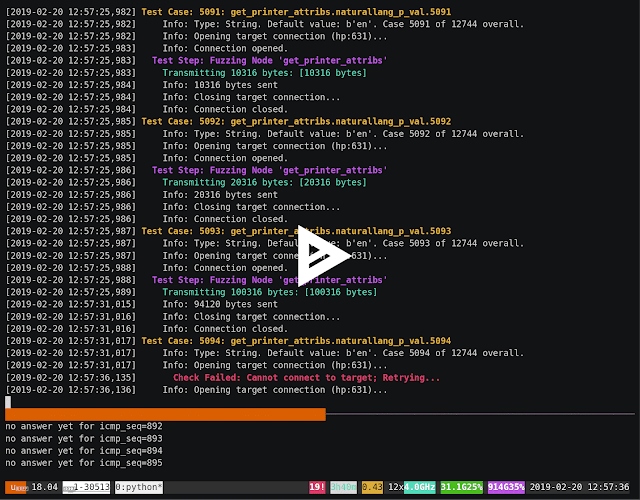
Use the raw feature of IPP to fuzz the finger protocol:
python -m fuzzowski printer 79 -f raw -r '{{root}}\n'
Use the raw feature of IPP to fuzz the finger protocol, but instead of using the predefined mutations, use a file:
python -m fuzzowski printer 79 -f raw -r '{{root}}\n' --file 'path/to/my/fuzzlist'
SOCIAL SHARE CARD GENERATOR