is a useful technique for smartphones to learn a shared prediction model while keeping all the training data on device, thus enabling user privacy. We apply this technique to learn models that estimate air quality from photos taken by a user’s smartphone. In Delhi (India), air quality routinely degrades and a severe Air Quality Index (AQI) rating is no longer shocking news to most residents. Government established AQI monitoring stations provide coverage over less than 5% of the geographical area, which is not sufficient for the public to get an accurate real-time estimate of the air they are breathing.
Toward the goal of building an inexpensive and on-device AQI estimation app, we built . VisionAir is a privacy preserving Android application that allows a user to estimate the AQI of a region using an image that the user takes. We specifically estimate the where we leverage Federated Learning to build a shared model, and share a new open-source dataset.
To build the model, we curated and open-sourced a large dataset of photos collected from the smartphone of the sky horizon in Delhi. Prior work on estimating air quality (PM2.5) using image analysis does not always take privacy of user data (such as images and geo-tag locations) into account. By contrast, VisionAir deploys the model on-device for inference and training. VisionAir achieves on-device training of the deep learning model by using the , VisionAir consistently improves the model performance by taking crowdsourced inputs into consideration in training the model without compromising the privacy of any user.
Deep Learning Model
VisionAir uses a neural network that takes image features, meteorological data, and past AQI data as input to estimate the PM 2.5 of an image. The model is optimized for on-device training by feeding only the most relevant features into a shallow net with only 2 hidden layers. The relevant set of features from the image taken by the user include haze degree, contrast, and entropy computed from the image. For details, you can see our previous and Non-HDR image every 5 minutes (see documentation has been open sourced to enable further research in this field. It consists of approximately 4000 Non-HDR and 1200 HDR images annotated with corresponding image features, weather, and temporal data. It also adds additional meteorological parameters such as wind speed, wind direction, temperature, humidity, precipitation, time of the day.Assigning labels to images in training data
Depending upon where the image was taken, labels were assigned to the images as follows. If there was a which gave us the PM 2.5 AQI reading corresponding to that particular image. We had calibrated the AirVeda Sensor and validated that CPCB sensor readings and maintains two instances of the model: a global model which is updated on the server and a client model updated by using on-device training.Global Model
We developed the ML model to estimate AQI using image features and other meteorological parameters in Python using TensorFlow. The model was trained on 4000 images from VisionAir dataset. We exported the trained model (the metagraph and the checkpoint file) and used that in Java API in our Android application. The metagraph file contains the model architecture while the checkpoint file contains the assigned weights. Using these files, helper functions in the Tensorflow API for Java allow us to restore the model’s graph on the client device. For the detailed analysis of the code used to develop this entire On-Device and Federated architecture for VisionAir, you may find , the typical range of AQI in Jun-Aug is moderate (101–200) suggesting the trained model’s predicted value may deviate from the actual ground truth value by around 9.05 ppm which is acceptable. We would need additional data collection over other months to capture the data distribution of the entire year.Client Model
Global Model is pushed onto all the client devices. We use Tensorflow’s API for Java to train the model on a client device. We run a few epochs on the client device to train the model and then store these weights in a usable form. After every 24 hours, the extracted weights on the client device are sent to our Federated Averaging server. The application currently has approximately 100 users. In every iteration of federated averaging the weights of 5 client devices are uploaded on the intermediate federated averaging server.Federated Learning in VisionAir
In Federated Learning, the improvements in the client model weights are used to update the global model, thereby improving the overall estimation accuracy.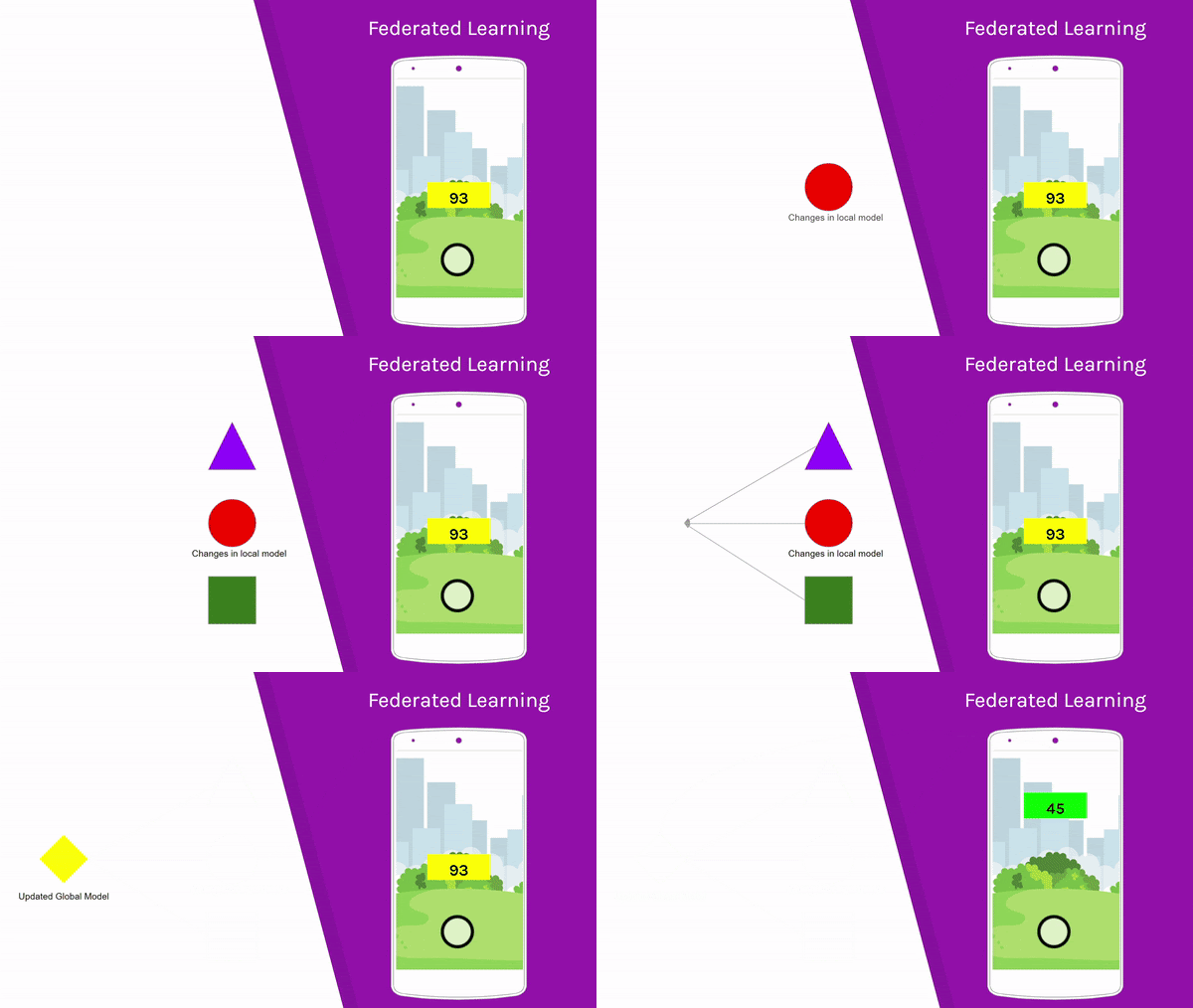 |
| VisionAir implementing Federated Learning |
VisionAir is available on the Google Play Store or medium publication to stay updated about our ongoing work and results.
Vollständiger Original-Bericht
Ausführliche Details, Code-Beispiele & Hersteller-Stellungnahme auf blog.tensorflow.org.

SOCIAL SHARE CARD GENERATOR