TensorFlow Lattice also provides piecewise linear functions (with Keras layer) with similar output bounding to feed into a lattice. Combining the calibrators and the lattice above, we can get a calibrated lattice model.
There are several forms of constraints you can impose on TensorFlow Lattice layers to inject your knowledge of the problem domain into the training process:
- Monotonicity: You can specify that the output should only increase/decrease with respect to an input. In our example, you may want to specify that increased distance to a coffee shop should only decrease the predicted user preference.
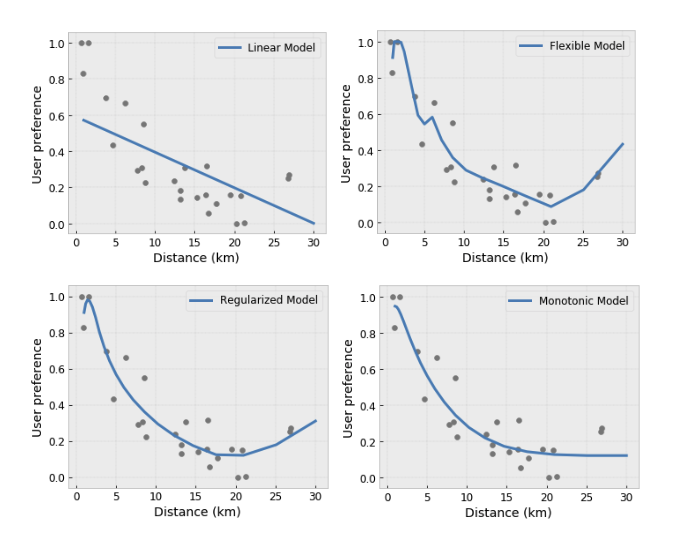
- Convexity/Concavity: You can specify that the function shape can be convex or concave. Mixed with monotonicity, this can force the function to represent diminishing returns with respect to a given feature.
- Unimodality: You can specify that the function should have a unique peak or unique valley. This lets you represent functions that are expected to have a sweet spot with respect to a feature.
- Pairwise trust: This constraint suggests that one input feature semantically reflects trust in another feature. For example, a higher number of reviews makes you more confident in the average star rating of a restaurant. The model will be more sensitive with respect to the star rating (i.e. will have a larger slope with respect to the rating) when the number of reviews is higher.
- Pairwise dominance: This constraint suggests that the model should treat one feature as more important than another feature. This is done by making sure the slope of the function is larger with respect to the dominant feature.
Example: Ranking Restaurants
This example is from our end-to-end for more details in an end-to-end colab describing the effect of each of the described constraints. TF Lattice Keras layers can also be used in combination with other Keras layers to construct partially constrained or regularized models. For example, lattice or PWL calibration layers can be used at the last layer of deeper networks that include embeddings or other Keras layers. For further information check out the , , and .Acknowledgements
This release was made possible with contributions from Oleksandr Mangylov, Mahdi Milani Fard, Taman Narayan, Yichen Zhou, Nobu Morioka, William Bakst, Harikrishna Narasimhan, Andrew Cotter and Maya Gupta.Publications
For further details on the models and algorithms used within the library, check out our publications on lattice models:- , Andrew Cotter, Maya Gupta, H. Jiang, Erez Louidor, Jim Muller, Taman Narayan, Serena Wang, Tao Zhu. International Conference on Machine Learning (ICML), 2019
- , Seungil You, Kevin Canini, David Ding, Jan Pfeifer, Maya R. Gupta, Advances in Neural Information Processing Systems (NeurIPS), 2017
- , Maya Gupta, Andrew Cotter, Jan Pfeifer, Konstantin Voevodski, Kevin Canini, Alexander Mangylov, Wojciech Moczydlowski, Alexander van Esbroeck, Journal of Machine Learning Research (JMLR), 2016
- , Eric Garcia, Maya Gupta, Advances in Neural Information Processing Systems (NeurIPS), 2009
Vollständiger Original-Bericht
Ausführliche Details, Code-Beispiele & Hersteller-Stellungnahme auf blog.tensorflow.org.

SOCIAL SHARE CARD GENERATOR