from the MLPerf Training v0.7 round. We’re happy to share that Google’s submissions demonstrate leading top-line performance (fastest time to reach target quality), with the ability to scale up to 4,000+ accelerators and the flexibility of the TensorFlow 2 developer experience on Google Cloud. highlights our record-setting large-scale training results.
TensorFlow 2: designed for performance and usability
At the TensorFlow Developer Summit earlier this year, we highlighted that TensorFlow 2 would emphasize usability and real-world performance. When competing to win benchmarks, engineers have often relied on low-level API calls and hardware-specific code that may not be practical in everyday enterprise settings. With TensorFlow 2, we aim to provide high performance out of the box with more straightforward code, avoiding the significant issues that low-level optimizations can cause with respect to code reusability, code health, and engineering productivity.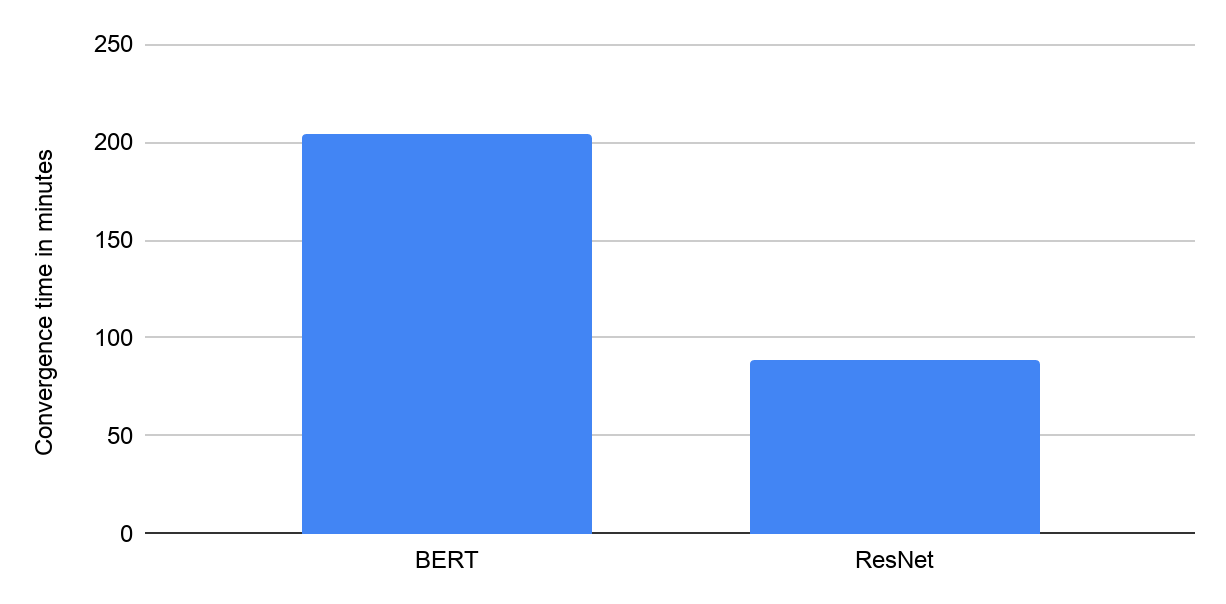 |
| Time to converge (in minutes) using Google Cloud VMs with 8 NVIDIA V100 GPUs from Google’s MLPerf Training v0.7 Closed submission in the “Available” category. |
Looking under the hood: performance enhancements with XLA
Google’s submissions on GPUs and on Cloud TPU Pods leverage the selectively, providing fine-grained control over exactly which functions will be compiled.The performance improvements delivered by XLA are impressive: on a Google Cloud VM with 8 Volta V100 GPUs attached (each with 16 GB of GPU memory), XLA boosts
State-of-the-art accelerators on Google Cloud
Google Cloud is the only public-cloud platform that provides access to both state-of-the-art , which allows AI researchers and data scientists the freedom to choose the right hardware for every task.Cutting-edge models such as , with Google Cloud Deep Learning VMs.
Acknowledgements
The MLPerf submission on GPUs is the result of a close collaboration with NVIDIA. We’d like to thank all engineers at NVIDIA who helped us with this submission. Vollständiger Original-Bericht
Ausführliche Details, Code-Beispiele & Hersteller-Stellungnahme auf blog.tensorflow.org.

SOCIAL SHARE CARD GENERATOR