Posted by Liu Huiyun, a senior algorithm engineer at NetEase, a large eCommerce platform in China, produces and accumulates large volumes of information, such as product attributes, activity operations, aftersales policies. In the meantime, the corresponding business logic is complicated. Intelligent customer service is an intelligent dialog system that leverages this information to automatically answer user questions or help human customer service representatives do so.
However, the e-commerce field involves many detailed and complicated business aspects, and users may ask their questions in many different ways and in a colloquial manner. These features require Intelligent customer service systems to possess strong semantic understanding. To this end, we have combined general customer scenarios with Yanxuan's businesses and designed a deep learning based system. Check Yanxuan Intelligent customer service Framework full picture
in
- As a user inputs a question, the input text and its contextual information are first sent to the intent recognition (IR) module.
- The intent recognition module analyzes the user's multi-layered intents and then distributes them to different sub-modules.
- The sub-modules are responsible for more targeted business Q&A, and different sub-modules apply different technical solutions.
As you can see, deep learning algorithms are applied to different modules in the framework. Because of the advanced NLP algorithms, we can extract more general and multi-granular semantic information from the user's utterance.
Figure 3 shows the Xiaoxuan bot answering questions in a real dialog scenario. Next, I will introduce the different sub-modules that apply deep learning technology.
 |
| Figure 3. Online Conversation Example |
Intent Recognition Module — Multilayer Classification Model
As the user inputs text, we use a multilayer classification intent recognition model built with TensorFlow to analyze the input text, its context, and the historical behavior of the user. We divide first-level intents into four main categories: pre-sales product questions, aftersales questions, casual chatting, and the rest. When users ask common policy-related a ftersales questions, the input is summarized into more detailed sub-level intents. Click to connect to the MLP layer.
Tests showed that these optimizations improved these models. For example, the encoders of the Transformer model showed better accuracy in tasks (1) and (3), increasing performance by nearly 5 percentage points.
In addition, we found that, without any additional feature construction or techniques, BERT could provide stable and outstanding matching performance. This is because, in the pretraining stage, BERT aims to predict whether a contextual relationship exists between two sentences, so it can learn the relationships between sentences. In addition, the self-attention mechanism is adept at capturing deep semantics and can obtain fine-grained matching results for a word in sentence A and any word in sentence B. This is crucial for text matching tasks.
KBQA Module — NER Module
In the product knowledge-base Q&A (KBQA) and shopping guide modules, we built a named-entity recognition (NER) model for the e-commerce field based on TensorFlow. The model can recognize product names, product attribute names, product attribute values, and other key product information in the questions asked by users, as shown in Figure 5. Then, entity names are sent to downstream modules, where Q&A knowledge graph techniques are used to generate a final answer.
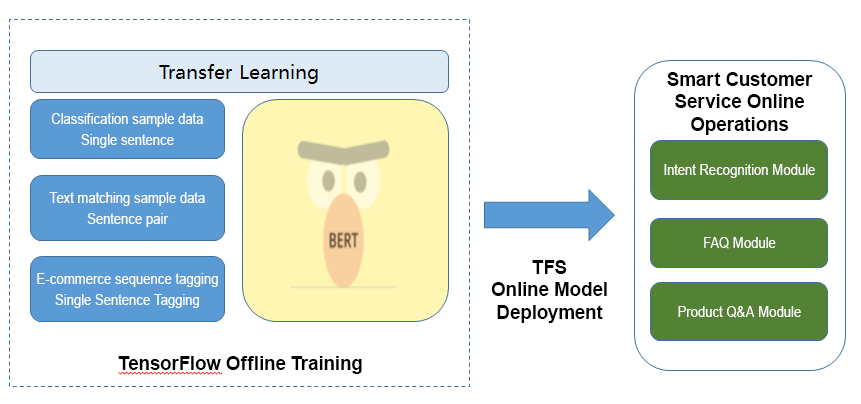
to generate responses in an end-to-end (E2E) manner. However, a purely E2E approach to response generation is difficult to control. Therefore, we decided to fuse the two models in our online system to ensure more reliable responses. Model DeploymentFigure 6 shows an online service flow based on the BERT model. Thanks to the open-source TensorFlow versions of language models such as BERT, only a small number of labeled samples need to be used to build various text models that feature high accuracy. Then, we can use GPUs to accelerate computation in order to meet the QPS requirements of online services. Finally, we can quickly deploy and launch the model based on TensorFlow Serving (TFS). Therefore, it is the support provided by TensorFlow that allows us to deploy and iterate online services in a stable and efficient manner.
ConclusionAs deep learning technology continues to develop, new models will make new breakthroughs in the NLP field. By continuing to apply academic advances in the industry, we can achieve outstanding business results. However, this would not be possible without the work of TensorFlow. In Yanxuan's business scenarios, TensorFlow provides flexible and refined APIs that enables engineers to deal with agile development and test new models, greatly facilitating algorithm model iteration. Vollständiger Original-Bericht Ausführliche Details, Code-Beispiele & Hersteller-Stellungnahme auf blog.tensorflow.org. Wie bewertest du diesen Beitrag? 1 Klick Feedback Teilen mit Netzwerk & Team: Hat Ihnen dieser Tipp / Anleitung geholfen? Community-Analysen & Experten-Meinungen 0Verfasse deine eigene Analyse, teile Workarounds oder diskutiere diesen Vorfall im Blog. Noch keine Community-Analyse verfasst. Markiere einen Textabschnitt oder klicke oben auf „ Eigene Analyse verfassen“! Community Pulse: Relevanz-Einschätzung 1 Klick Experten-Votum 🔴 Akute Relevanz 0% 🟡 In Evaluierung 0% 🟢 Keine Auswirkung 0% Spannende Innovation 0% Verwandte Story-Cluster & Quellen (Vektor-KI) Tipp: Mit Pfeiltasten [ ← ] und [ → ] blättern  Ähnliche Beiträge
🔍 Verwandte News
Auch interessante Nachrichten How NetEase Yanxuan uses TensorFlow for customer service chat botsThematisch verwandte Begriffe: NetEase, Yanxuan, uses, TensorFlow · 6 Treffer 🔧 AI Nachrichten MacDailyNews Apple accuses OpenAI of destroying evidence as trade-secrets fight intensifies 🔧 AI Nachrichten The Mac Observer GPT-6 Astra Release Today? OpenAI’s Next Major AI Model Is Almost Here
Laden...
Videos werden geladen ...
Laden...
Beiträge werden geladen ...
Laden...
Videos werden geladen ...
Laden...
Beiträge werden geladen ...
Laden...
Videos werden geladen ...
Laden...
Beiträge werden geladen ...
Laden...
Videos werden geladen ...
Laden...
Beiträge werden geladen ...
Laden...
Videos werden geladen ...
🔖 Gespeicherte Artikel
📂
Keine gespeicherten Artikel vorhanden.
📂 News
⏱️ 3 Min
vor 10 Min
Artikeldaten werden geladen...
tsecurity.de AppOffline-Lesen, Eilmeldungen & 0ms Ladezeit
Installiere tsecurity.de direkt auf deinen Home-Bildschirm für das ultimative Vollbild-Magazinerlebnis ohne Browser-Leisten.
Nächster Beitrag
🤖
Community Radar & Live Chat
Sentinel Bot online • Live-Stream
Dein Cluster:
Security Explorer
👥 Match:
lädt…
📡 Aktivitäten deiner Analystenlädt…
💡 Neues Thema oder Eilmeldung einreichenReiche interessante Links, Zero-Days oder Debatten ein. Die Community entscheidet per Upvote über die Veröffentlichung. 🔥 Heiß diskutierte Einreichungen |
SOCIAL SHARE CARD GENERATOR