Posted by Hsin-Yuan Huang, Google/Caltech, Michael Broughton, Google, Jarrod R. McClean, Google, Masoud Mohseni, Google.
Data drives machine learning. Large scale research and production ML both depend on high volume and high quality sources of data where it is often the case that for, . Without data, these machine learning algorithms would not be any more useful than traditional algorithms.
While existing machine learning models run on classical computers, quantum computers provide the potential to design (the advantage of using quantum computers instead of classical computers) extends to machine learning problems in the classical domain, like computer vision or natural language processing.
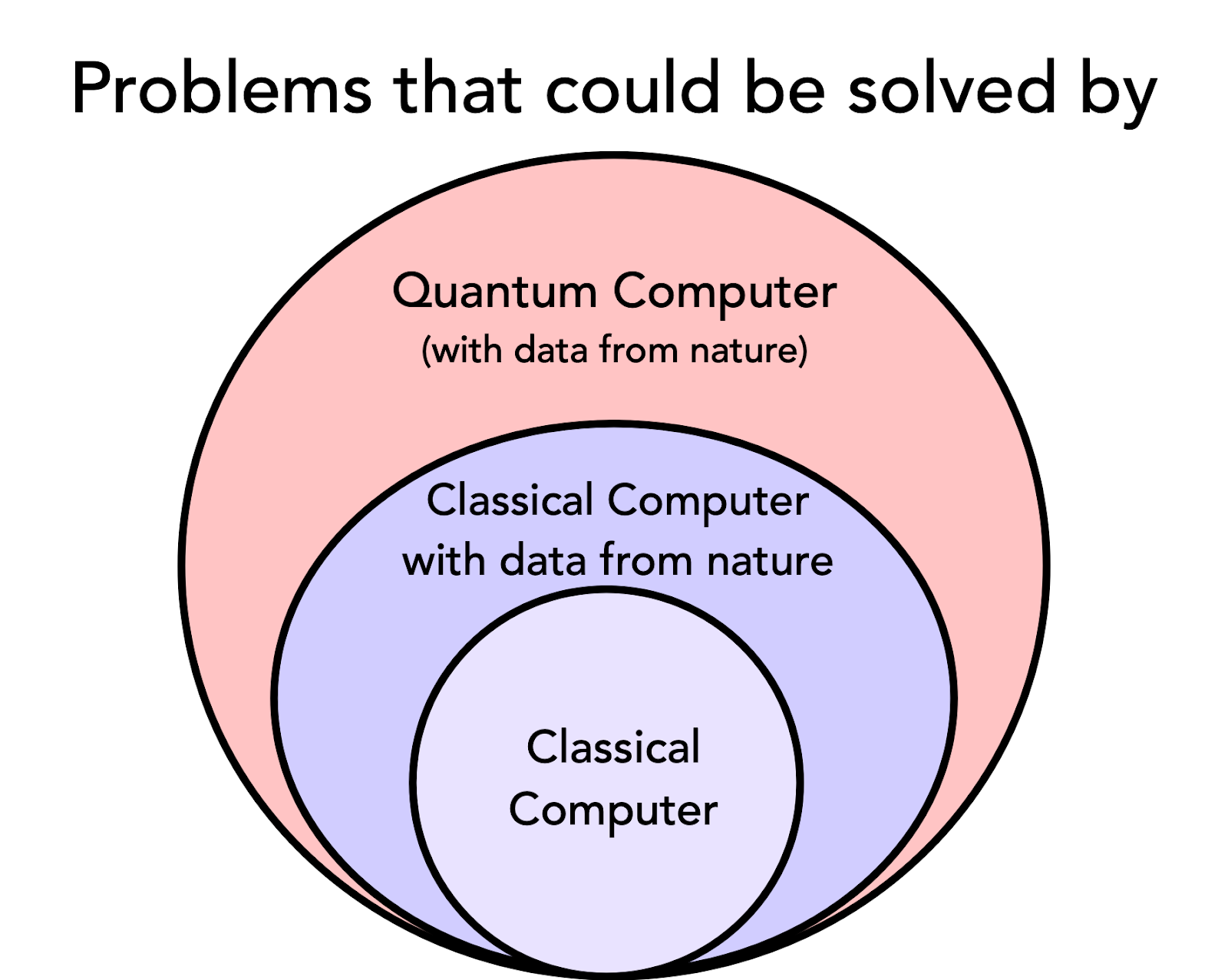
Conventional wisdom might suggest that the use of data coming from quantum experiments that are hard to reproduce classically would imply the potential for a quantum advantage. However, we show that this is not always the case. It is perhaps no surprise to machine learning experts that with enough data, an arbitrary function can be learned. It turns out that this extends to learning functions that have a quantum origin, too. By taking data from physical experiments obtained in nature, such as experiments for exploring new catalysts, superconductors, or pharmaceuticals, classical ML models can achieve some degree of generalization beyond the training data. This allows classical algorithms with data to solve problems that would be hard to solve using classical algorithms without access to the data (rigorous justification of this claim is given in our paper).
We provide a method to quantitatively determine the amount of samples required to make accurate predictions in datasets coming from a quantum origin. Perhaps surprisingly, sometimes there is no great difference between the number of samples needed by classical and quantum models. This method also provides a constructive approach to generate datasets that are hard to learn with some classical models.
- Develop a functioning single-node prototype using TensorFlow and TensorFlow Quantum.
- Incorporate minimal code changes to use .
- Using the .
TensorFlow Quantum has a tutorial showcasing a variation of . If you are a quantum machine learning researcher, you can read our paper addressing the power of data in quantum machine learning for more detailed information. We are excited to see what other kinds of large scale QML experiments can be carried out by the community using TensorFlow Quantum. Only through expanding the community of researchers will machine learning with quantum computers reach its full potential.
Community-Analysen & Experten-Meinungen 0
Verwandte Story-Cluster & Quellen (Vektor-KI)
 Ähnliche Beiträge
Auch interessante Nachrichten Characterizing quantum advantage in machine learning by understanding the power of data
Thematisch verwandte Begriffe: Characterizing, quantum, advantage, machine · 6 Treffer
Apple accuses OpenAI of destroying evidence as trade-secrets fight intensifies
GPT-6 Astra Release Today? OpenAI’s Next Major AI Model Is Almost Here
Videos werden geladen ...
Beiträge werden geladen ...
Videos werden geladen ...
Beiträge werden geladen ...
Videos werden geladen ...
Beiträge werden geladen ...
Videos werden geladen ...
Beiträge werden geladen ...
Videos werden geladen ...
SOCIAL SHARE CARD GENERATOR