Posted by Summer Misherghi and Thomas Greenspan, Software Engineers, Google Research
Last December, we open-sourced .
Today, we’re announcing .
MinDiff Walkthrough
You can follow along and run the code yourself in this . Since this text classifier could be used to automatically moderate forums on the internet (for example, to flag potentially toxic comments), we want to ensure that it works well for everyone. You can read more about how fairness problems can arise in automated content moderation in
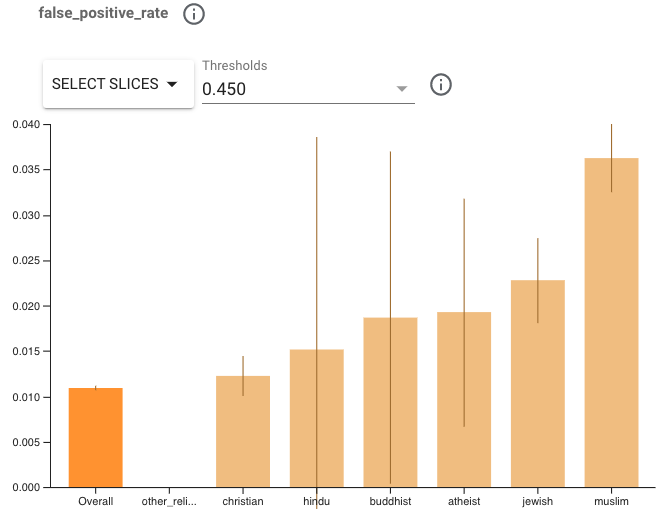
Let’s look at the evaluation results. Try selecting the metric false positive rate (FPR) with threshold 0.450. We can see that the model does not perform as well for some religious groups as for others, displaying a much higher FPR. Note the wide confidence intervals on some groups because they have too few examples. This makes it difficult to say with certainty that there is a significant difference in performance for these slices. We may want to collect more examples to address this issue. We can, however, attempt to apply MinDiff for the two groups that we are confident are underperforming.
We’ve chosen to focus on FPR, because a higher FPR means that comments referencing these identity groups are more likely to be incorrectly flagged as toxic. This could lead to inequitable outcomes for users engaging in dialogue about religion, but note that disparities in other metrics can lead to other types of harm.
Now, we’ll try to improve the FPR for religious groups for which our model underperforms. We’ll attempt to do so using .
To train with MinDiff, simply take the original model and wrap it in a MinDiffModel with a corresponding `loss` and `loss_weight`. We are using 1.5 as the default `loss_weight`, but this is a parameter that needs to be tuned for your use case, since it depends on your model and product requirements. You should experiment with changing the value to see how it impacts the model, noting that increasing it pushes the performance of the minority and majority groups closer together but may come with more pronounced tradeoffs.
As specified above, we create the original model, and wrap it in a MinDiffModel. We pass in one of the MinDiff losses and use a moderately high weight of 1.5.
PYTHON
original_model = ... # Same structure as used for baseline model.
After wrapping the original model, we compile the model as usual. This means using the same loss as for the baseline model:
PYTHON
optimizer = tf.keras.optimizers.Adam(learning_rate=0.001)
loss = tf.keras.losses.BinaryCrossentropy()
min_diff_model.compile(
  optimizer=optimizer, loss=loss, metrics=['accuracy'])
We fit the model to train on the MinDiff dataset, and save the original model to evaluate (see
Note: The scale of the y-axis has changed from .04 in the graph for the baseline model to .02 for our MinDiff model
Reviewing these results, you may notice that the FPRs for our target groups have improved. The gap between our lowest performing group and the majority group has improved from .024 to .006. Given the improvements we’ve observed and the continued strong performance for the majority group, we’ve satisfied both of our goals. Depending on the product, further improvements may be necessary, but this approach has gotten our model one step closer to performing equitably for all users.
on . You can also learn more about evaluating for fairness in this guide.
Acknowledgements
The MinDiff framework was developed in collaboration with Thomas Greenspan, Summer Misherghi, Sean O'Keefe, Christina Greer, Catherina Xu, Manasi Joshi, Dan Nanas, Nick Blumm, Jilin Chen, Zhe Zhao, James Chen, Maciej Kula, Lichan Hong, Mahesh Sathiamoorthy. This research effort on ML Fairness in classification was jointly led by (in alphabetical order) Alex Beutel, Ed H. Chi, Flavien Prost, Hai Qian, Jilin Chen, Shuo Chen, and Tulsee Doshi. Further, this work was pursued in collaboration with Christine Luu, Jonathan Bischof, Pierre Kreitmann, and Qiuwen Chen.
Vollständiger Original-Bericht
Ausführliche Details, Code-Beispiele & Hersteller-Stellungnahme auf blog.tensorflow.org.

SOCIAL SHARE CARD GENERATOR