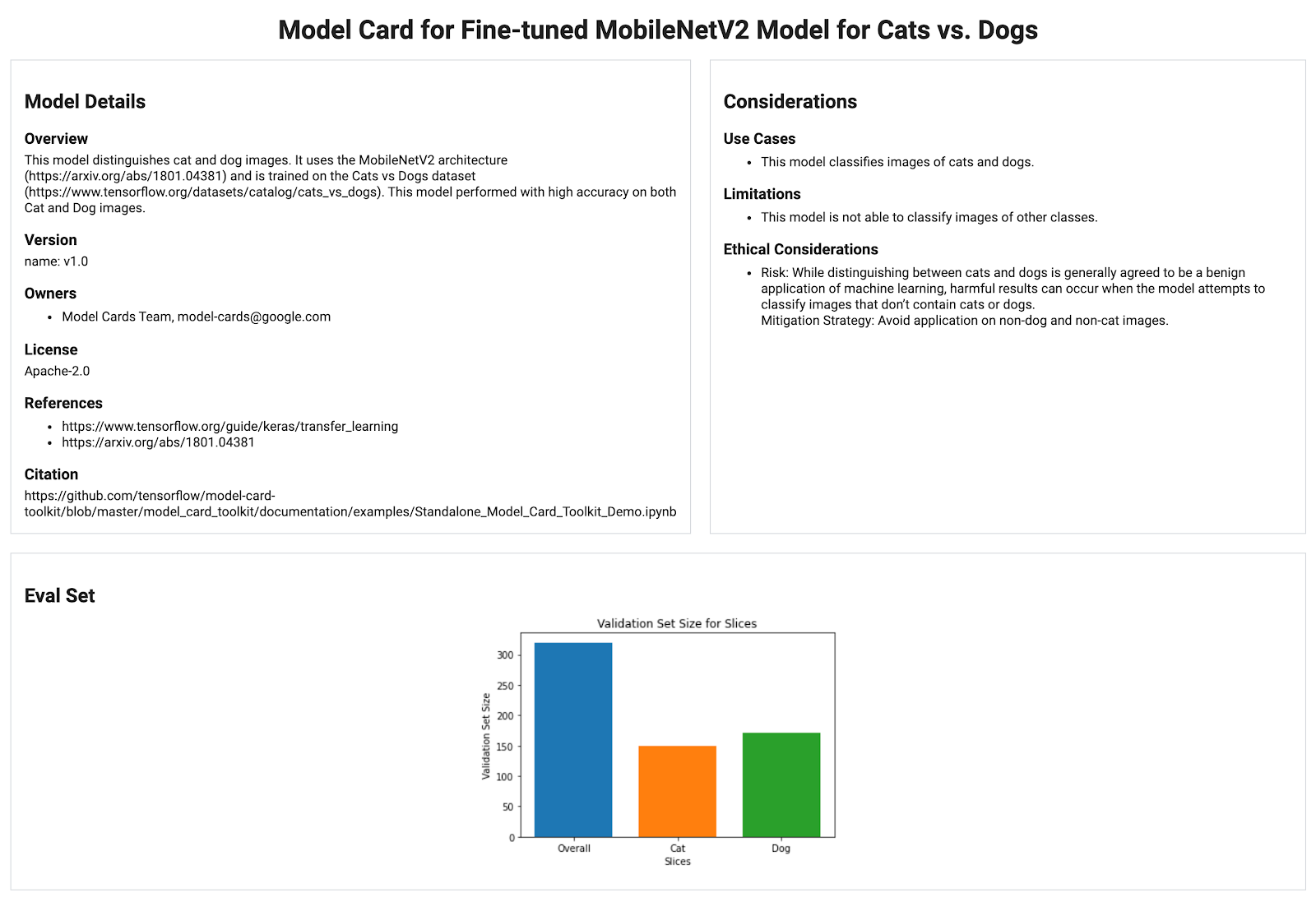
 Posted by Karan Shukla, Software Engineer, Google Research, a framework for transparent reporting on ML model performance, provenance, ethical considerations and more. It can be time consuming, however, to compile the information necessary to create a useful Model Card. To address this, we recently announced the open-source launch of , which specifies the fields to include in the Model Card
 | for a larger version. |
Model Card Toolkit Walkthrough
You can follow along and run the code yourself in model and the weights generated by fine-tuning the model on the cats_vs_dogs dataset. For more information on how we fine-tuned our model, you can see the and if you’d like to see the Matplotlib code. If you are using ). You can also use other visualization libraries, like Seaborn.
We add our graphs to our Model Card.
model_card.model_parameters.data.eval.graphics.collection = [
 {'name': 'Validation Set Size', 'image': validation_set_size_barchart},
]
model_card.quantitative_analysis.graphics.collection = [
 {'name': 'Accuracy', 'image': accuracy_barchart},
]
We’re finally ready to generate our Model Card! Let’s do that now. First we need to update the ModelCardToolkit object with the latest ModelCard.
mct.update_model_card_json(model_card)Lastly, we generate the Model Card document in the chosen output format.
# Generate a model card document in HTML (default)
html_doc = mct.export_format()

# Display the model card document in HTML
display.display(display.HTML(html_doc))


# Generate a model card document in Markdown
md_path = os.path.join(model_card_dir, 'template/md/default_template.md.jinja')
md_doc = mct.export_format(md_path, 'model_card.md')

# Display the model card document in Markdown
display.display(display.Markdown(md_doc))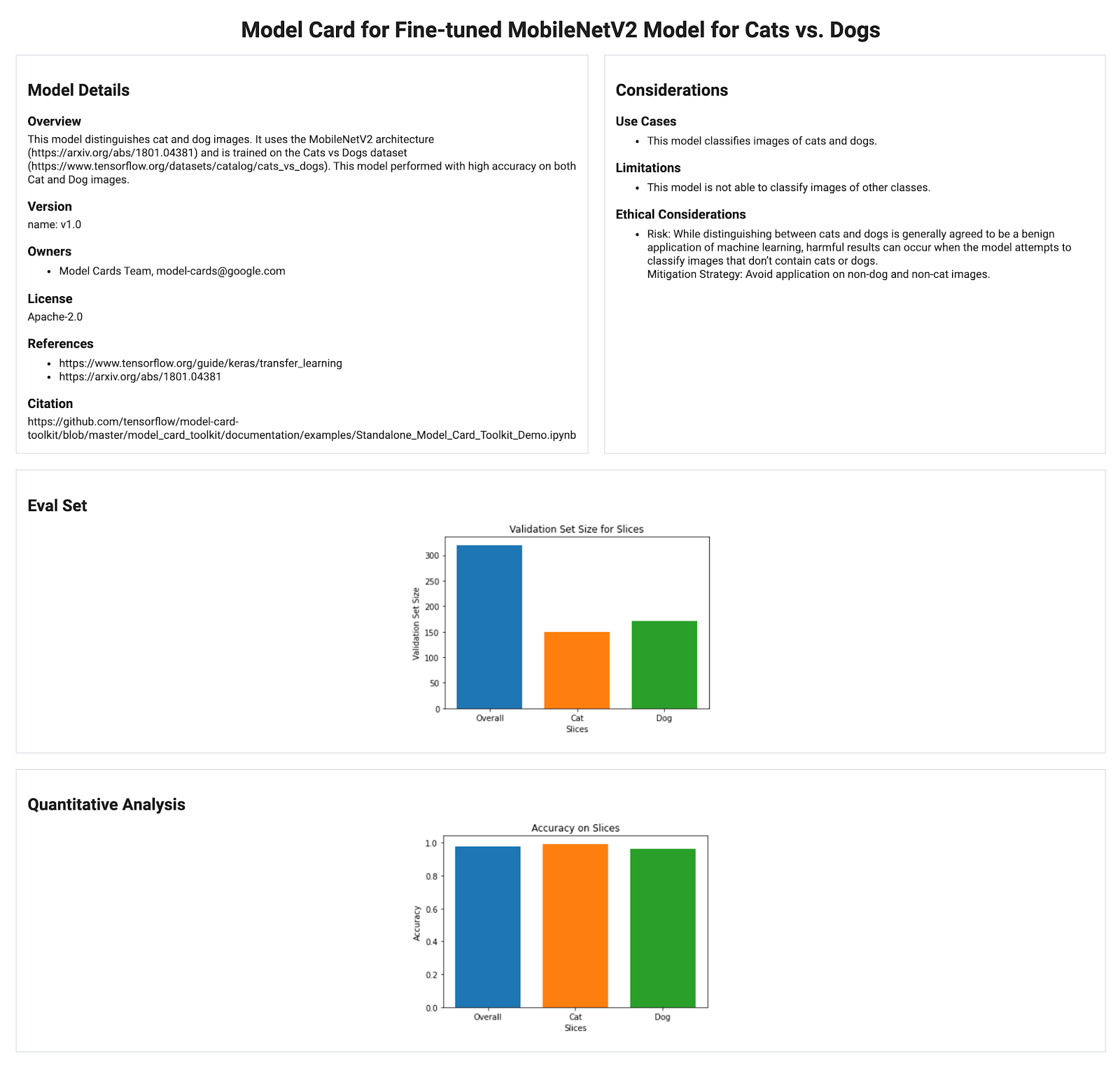
And we’ve generated our Model Card! It’s a good idea to review the end product with your direct team, as well as members who are further away from the project. In particular, we recommend reviewing the qualitative fields such as “ethical considerations” to ensure you’ve adequately captured all potential use cases and their potential consequences. Does your Model Card answer the questions that people from different backgrounds might have? Is the language accessible to a developer? What about a policy maker, or a downstream user who might interact with the model? In the future, we hope to offer Model Card creators more guidance that they can use to help answer these questions and provide more thorough instructions on how to fill out the considerations fields.
Have questions? Have Model Cards to share? Let us know at [email protected]!
Acknowledgements
Huanming Fang, Hui Miao, Karan Shukla, Dan Nanas, Catherina Xu, Christina Greer, Neoklis Polyzotis, Tulsee Doshi, Tiffany Deng, Margaret Mitchell, Timnit Gebru, Andrew Zaldivar, Mahima Pushkarna, Meena Natarajan, Roy Kim, Parker Barnes, Tom Murray, Susanna Ricco, Lucy Vasserman, and Simone Wu

SOCIAL SHARE CARD GENERATOR