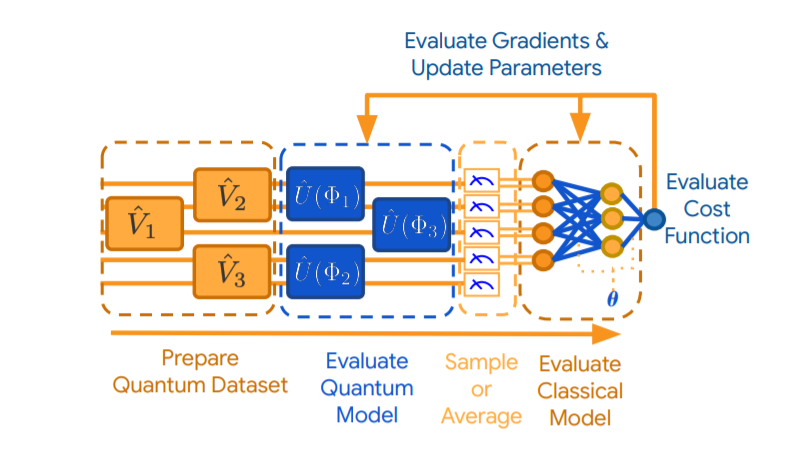
A guest post by (TFQ) and on quantum reinforcement learning in the 16th ). The diagram is read from left to right, with the qubits being represented by the horizontal lines. In a QVC there are three important and distinct parts: the encoder circuit, the variational circuit and the measurement operators. The encoder circuit either takes naturally quantum data (i.e. a nonparametrized quantum circuit) or converts classical data into quantum data. This circuit is connected to the variational circuit which is defined by its learnable parameters. The parametrized part of the circuit is the part that is updated during the learning process. The last part of the QVC is the measurement operators. In order to extract information from the QVC some sort of quantum measurement (such as a Pauli X, Y, or Z basis measurements) must be applied. With the information extracted from these measurements a loss function (and gradients) can be calculated on a classical computer and the parameters can be updated. These gradients can be optimized with the same optimizers as traditional neural networks such as . QVC’s can also be combined with traditional neural networks (as is shown in the diagram) as the quantum circuit is differentiable and thus gradients can be backpropagated through.
Currently, access to real quantum hardware is limited and as such, many quantum computing researchers conduct work on simulations of quantum computers. Near term and current quantum devices have 10s-100s of quantum bits (qubits) like the (NISQ) technology. TFQ and Cirq are built for these near term NISQ devices. These devices are far smaller than what some of the most famous quantum algorithms require to achieve quantum speedups given current error correction techniques; e.g. (QAOA) could require at least ).
My Work With TFQ
TFQ was announced in mid March this year (2020) and I began to use it shortly after. Around that time I had begun research into QML, specifically QML for , we expanded upon applying QML to RL tasks.
In our work we demonstrate the potential to use QVCs in place of neural networks in contemporary RL algorithms (specifically ). We also show the potential to use multiple types of QVC models, using QVCs with either a dense layer or
The representational power of QVCs is also put on display; using a QVC with ~50 parameters we were able to achieve comparable performance to neural networks with orders of magnitude more parameters. See the graphs for a comparison of the reward achieved on the canonical CartPole environment (balancing a pole on a cart), the left graph includes all neural networks and the right shows only the largest neural network. The number in front of the NN represents the size of the parameter space.
We are continuing to work with QML applications to RL and have more manuscripts in submission. Continuation of this work has been accepted into the 2020 NeurIPS workshop: “The pre-registration experiment: an alternative publication model for machine learning research”.
Suggested use of TFQ
TFQ can be an incredible tool for anyone interested in QML research no matter your background. All too common in scientific communities is a ‘publish or perish’ mentality which can . The API of TFQ and the modules it provides (i.e. Keras-esque layers and differentiators) share design principles with TF and their similarities make for an easier programming transition. For researchers already in the QML field, TFQ can certainly help.
In order to get started with TFQ it is important to become familiar with the basics of quantum computing, with either the references mentioned above or with any of the many other great resources out there. Another important step that often gets overlooked, is reading the TFQ white paper. The white paper is accessible to QML beginners and is an invaluable introduction to QML and the basic as well as advanced usage of TFQ. Just as important is to play around with TFQ. Try different things out, experiment; it is a great way to expand not only understanding of the software but of the theory and mathematics as well. Reading other contemporary papers and the papers that cite TFQ is a great way to become immersed with the current research going on in the field.

SOCIAL SHARE CARD GENERATOR