Posted by Ruoxi Wang, Phil Sun, Rakesh Shivanna and Maciej Kula (Google) , a library that makes building state-of-the-art recommender system models easy. Today, we’re excited to announce a new release of TensorFlow Recommenders (TFRS), , TFRS now makes it possible to build deep learning recommender models that can retrieve the best candidates out of millions in milliseconds - all while retaining the simplicity of deploying a single “query features in, recommendations out” SavedModel object.
The second is support for better techniques for modelling feature interactions. The new release of TFRS includes an implementation of and , TensorFlow Recommenders makes it easy to build , all help with reducing this cost.
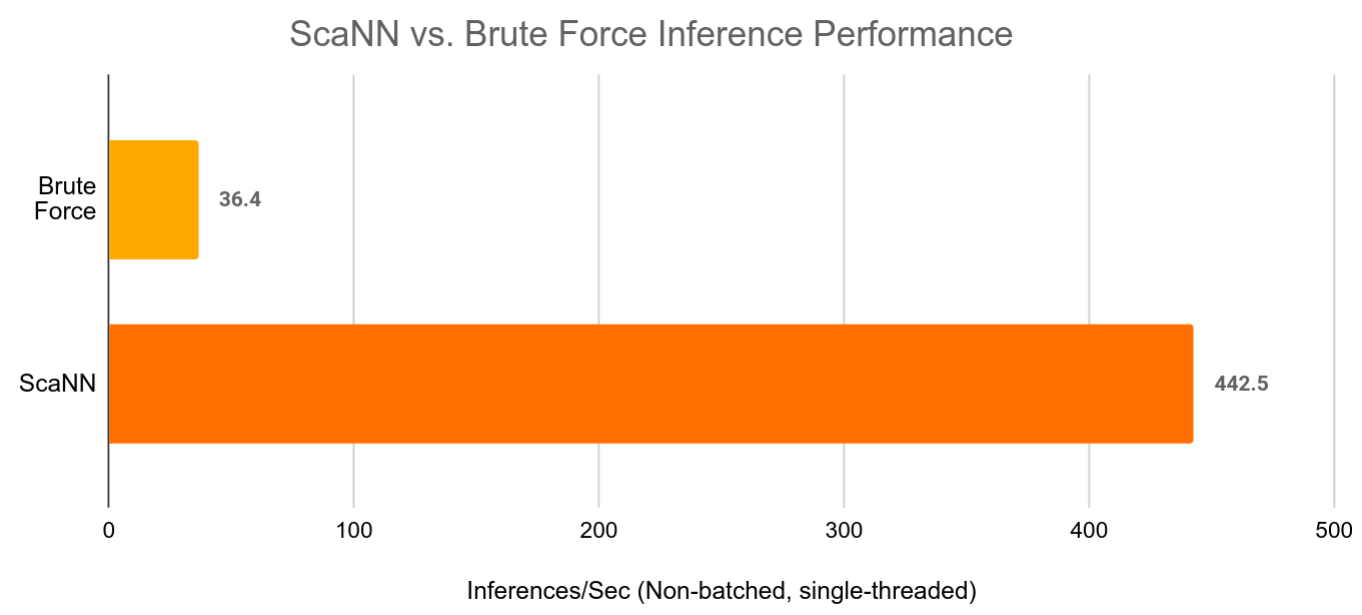
However, for large databases with millions of candidates, the second step is generally even more important for fast inference. Our two-tower model uses the dot product of the user input and candidate embedding to compute candidate relevancy, and although computing dot products is relatively cheap, computing one for every embedding in a database, which scales linearly with database size, quickly becomes computationally infeasible. A fast . Furthermore, it integrates seamlessly with TensorFlow Recommenders. As seen below, the
ScaNN can speed up large retrieval models by over 10x while still providing almost the same retrieval accuracy as brute force vector retrieval.
We believe that ScaNN’s features will lead to a transformational leap in the ease of deploying state-of-the-art deep retrieval models. If you’re interested in the details of how to build and serve ScaNN based models, have a look at our
In web-scale applications, data are mostly categorical, leading to large and sparse feature space. Identifying effective feature crosses in this setting often requires manual feature engineering or exhaustive search. Traditional feed-forward multilayer perceptron (MLP) models are universal function approximators; however, they cannot efficiently approximate even 2nd or 3rd-order feature crosses as pointed out in the papers.
What is a Deep & Cross Network (DCN)?
DCN was designed to learn explicit and bounded-degree cross features more effectively. They start with an input layer (typically an embedding layer), followed by a cross network which models explicit feature interactions, and finally a deep network that models implicit feature interactions.
Cross Network
This is the core of a DCN. It explicitly applies feature crossing at each layer, and the highest polynomial degree (feature cross order) increases with layer depth. The following figure shows the (?+1)-th cross layer.
. Commonly, we could stack a deep network on top of the cross network (stacked structure); we could also place them in parallel (parallel structure).
Learned weight matrix in the cross layer.
Cross layers are now for example usage and practical lessons. If you are interested in more detail, have a look at our research papers .
Acknowledgements
We would like to give a special thanks to Derek Zhiyuan Cheng, Sagar Jain, Shirley Zhe Chen, Dong Lin, Lichan Hong, Ed H. Chi, Bin Fu, Gang (Thomas) Fu and Mingliang Wang for their critical contributions to Deep & Cross Network (DCN). We also would like to thank everyone who has helped with and supported the DCN effort from research idea to productionization: Shawn Andrews, Sugato Basu, Jakob Bauer, Nick Bridle, Gianni Campion, Jilin Chen, Ting Chen, James Chen, Tianshuo Deng, Evan Ettinger, Eu-Jin Goh, Vidur Goyal, Julian Grady, Gary Holt, Samuel Ieong, Asif Islam, Tom Jablin, Jarrod Kahn, Duo Li, Yang Li, Albert Liang, Wenjing Ma, Aniruddh Nath, Todd Phillips, Ardian Poernomo, Kevin Regan, Olcay Sertel, Anusha Sriraman, Myles Sussman, Zhenyu Tan, Jiaxi Tang, Yayang Tian, Jason Trader, Tatiana Veremeenko, Jingjing Wang, Li Wei, Cliff Young, Shuying Zhang, Jie (Jerry) Zhang, Jinyin Zhang, Zhe Zhao and many more (in alphabetical order). We’d also like to thank David Simcha, Erik Lindgren, Felix Chern, Nathan Cordeiro, Ruiqi Guo, Sanjiv Kumar, Sebastian Claici, and Zonglin Li for their contributions to ScaNN.
Vollständiger Original-Bericht
Ausführliche Details, Code-Beispiele & Hersteller-Stellungnahme auf blog.tensorflow.org.
 Posted by Ruoxi Wang, Phil Sun, Rakesh Shivanna and Maciej Kula (Google)
SOCIAL SHARE CARD GENERATOR