A guest post by (Large Hadron Collider) high energetic particle beams collide and thereby create massive and possibly yet unknown particles from the collision energy following the well known equation E=mc2. Most of these newly created particles are not stable and decay to more stable particles almost immediately. Detecting these decay products and measuring their properties precisely is the key to understanding what happened during the high energy collision, and will possibly shed light on big questions such as the origin of dark matter.
Detecting and measuring particles
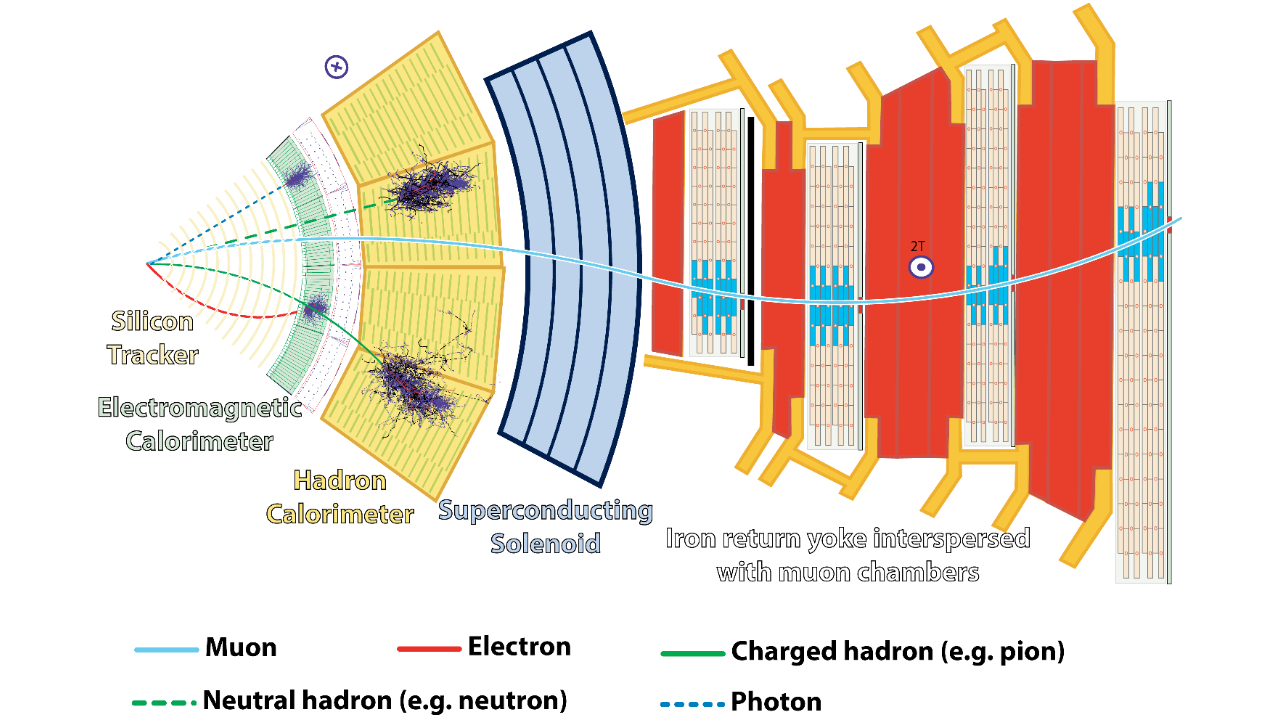
For this purpose, the collision interaction points are surrounded by large detectors covering as much as possible in all possible directions and energies of the decay products. These detectors are further split into sub-detectors, each collecting complementary information. The innermost detector, closest to the interaction point, is the tracker consisting of multiple layers. Similar to a camera, each layer can detect the spatial position at which a charged particle passed through it, providing access to its trajectory. Combined with a strong magnetic field, this trajectory gives access to the particle charge and the particle momentum.
While the tracker is aimed at measuring the trajectories, only, while minimising any further interaction with and scattering of the particles, the next sub-detector layer is aimed at stopping them entirely. By stopping the particles completely, these calorimeters can extract the initial particle energy, and can also detect neutral particles. The only particles that pass through these calorimeters are muons, which are identified by additional muon chambers that constitute the outermost detector shell and use the same detection principles as the tracker.
| that - by construction - reduces the resource requirements significantly while maintaining |
| GravNet layer architecture (from left to right): point features are projected into a feature space FLR, and a low dimensional coordinate space S; k nearest neighbours are determined in S; mean and maximum of distance weighted neighbour features are accumulated; accumulated features are combined with original features. |
Since many of the reconstruction tasks, even the refinement of already reconstructed particles, rely on an unknown number of inputs, the recent addition and support of , where object properties are condensed in at least one representative condensation point per object that can be chosen freely by the network through a high confidence score.
But coming back to particle reconstruction, as shown on github, using DeepJetCore as an interface to data formats commonly used in high-energy physics. Right now, there is a particular focus on implementing fast k-nearest-neighbour algorithms, a crucial building block for GravNet, that can handle the large input dimensionality, but also ragged implementations of other operations as well as implementations of the Object Condensation loss can be found there.
Conclusion
To conclude, the application of deep neural networks to reconstruction tasks is exhibiting a shift from refining classically reconstructed particles to reconstructing the particles and their properties directly, in an optimizable and highly parallelizable way to meet the person-power and computing challenges in the future. This development will give rise to more custom implementations, and will be using more of the bleeding edge features in TensorFlow and tf.keras such as ragged data structures, so that a closer contact between high-energy physics reconstruction developers and TensorFlow developers is foreseeable.
Acknowledgements
I would like to acknowledge the support of Thiru Palanisamy and Josh Gordon at Google for their help with the blog post collaboration and with providing active feedback.
Community-Analysen & Experten-Meinungen 0
Verwandte Story-Cluster & Quellen (Vektor-KI)
 Ähnliche Beiträge
Auch interessante Nachrichten Reconstructing thousands of particles in one go at the CERN LHC with TensorFlow
Thematisch verwandte Begriffe: Reconstructing, thousands, particles, CERN · 6 Treffer
Apple accuses OpenAI of destroying evidence as trade-secrets fight intensifies
GPT-6 Astra Release Today? OpenAI’s Next Major AI Model Is Almost Here
Videos werden geladen ...
Beiträge werden geladen ...
Videos werden geladen ...
Beiträge werden geladen ...
Videos werden geladen ...
Beiträge werden geladen ...
Videos werden geladen ...
Beiträge werden geladen ...
Videos werden geladen ...
SOCIAL SHARE CARD GENERATOR