
Zum Hauptinhalt springen
Echtzeit-Radar & Feeds
Alle RSS Feeds ➔
👥 Community & Social
Windows Tipps & SecurityGrafikkarte vor Überhitzung schützen: So geht’s(25.09.2026 um 08:00 Uhr)
••••••••••
Windows Tipps & SecurityGrafikkarte vor Überhitzung schützen: So geht’s(25.09.2026 um 08:00 Uhr)
••••••••••
Intelligence View
⚡ tsecurity.de Intelligence

CVE-2022-26381: Gone by others! Triggering a UAF in Firefox

Memory corruption vulnerabilities have been well known for a long time and programmers have developed various methods to prevent them. One type of memory corruption that is very hard to prevent is the use-after-free and the reason is that…

0
↗ Quelle (thezdi.com)
Reagiere als Erste:r — dein Feedback zählt!

Memory corruption vulnerabilities have been well known for a long time and programmers have developed various methods to prevent them. One type of memory corruption that is very hard to prevent is the use-after-free and the reason is that it has too many faces! Since it cannot be associated with any specific pattern in source code, it is not trivial to eliminate this vulnerability class. In this blog, a use-after-free vulnerability in Mozilla Firefox will be explained which has been assigned CVE-2022-26381. The Mozilla bug entry 1756793 is still closed to the public as of this writing, but the Zero Day Initiative advisory page ZDI-22-502 can provide a bit more information.

What Is a Use-After-Free Vulnerability?

A use-after-free (UAF) vulnerability happens when a pointer to a freed object is accessed. It does not make sense! Why would a programmer free an object and afterward access it again?

It happens due to the complexity of today’s software. A browser, for example, has many components and each of them may allocate different objects. They may even pass these objects to each other for processing. A component may free an object when it is done using it, while other components still have a pointer to that object. Any dereference of that pointer can lead to a use-after-free vulnerability.

Proof-of-Concept

Let’s start quickly by having a look at the minimized proof-of-concept:


When running this on the latest vulnerable release version of Mozilla Firefox, which is 97.0.1, it gives a very promising crash:


This is what the crash point looks like in IDA. It happens inside a loop:
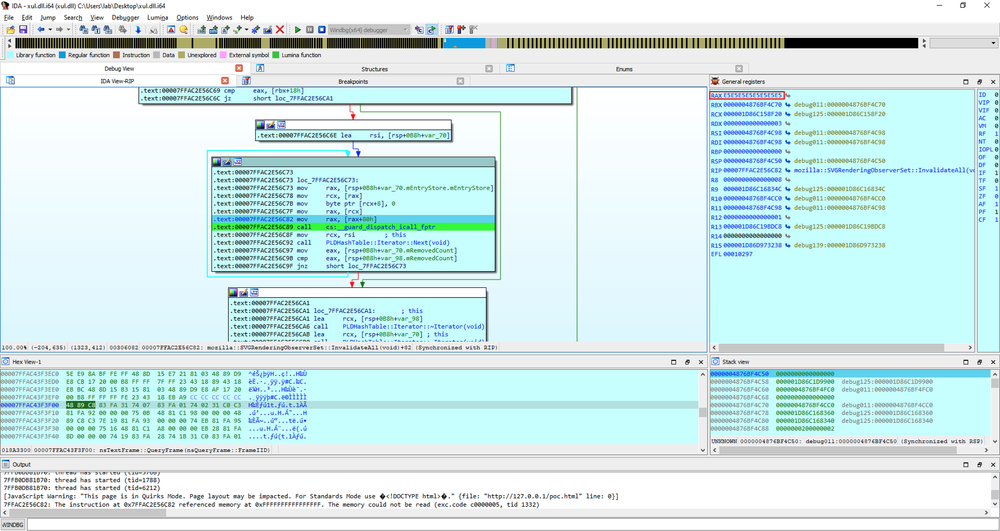


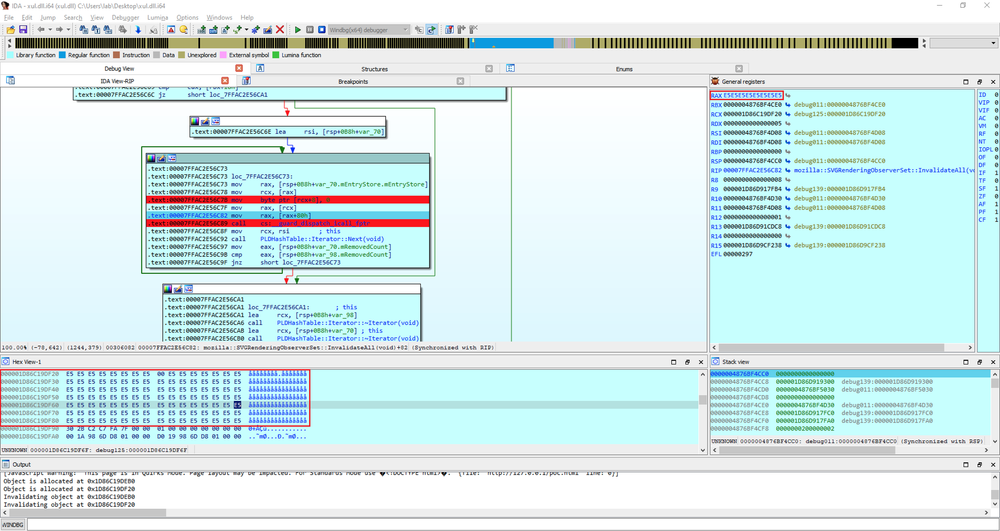
It dereferences a value from memory and then makes an indirect call (a virtual function call) using the fetched value. Thus, this is rated as a remote code execution vulnerability. The value of the “rax” register which is used during dereferencing is particularly interesting: 0xE5E5E5E5E5E5E5E5. This is a magic value that Firefox uses to “poison” the memory of a freed object so that a dereference of a value fetched from that freed object will cause a crash, as this value is never a valid memory address. This helps greatly to catch use-after-free conditions.

To analyze a use-after-free vulnerability, it is always desired to have more information about the freed object: its type, size, where it is allocated, where it is freed, and where it is subsequently used. On Windows, this is usually done by enabling advanced debugging features using the GFlags tool to enable various global flags. Specifically, it can be used to enable pageheap and create a﷟ user-mode stack trace to capture the stack trace at the time a particular object is allocated. Unfortunately, this will not help us on Mozilla Firefox, because Firefox has its own memory management mechanism called jemalloc. The way we can get more information about the object is to run the PoC on an ASAN version of Firefox. You can see the result below:


We got lots of information. Let’s break it down a bit by checking where the object is allocated:



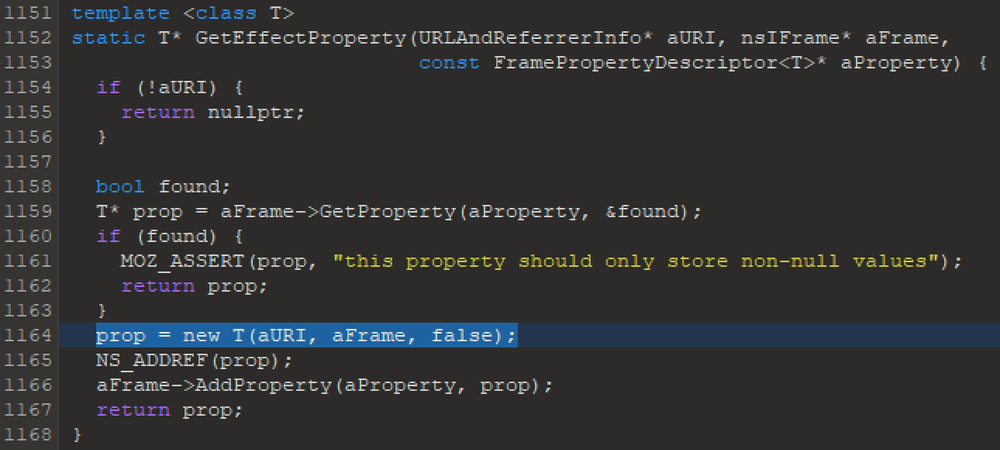
Let’s further check this by looking at the source code (line 1164 of /builds/worker/checkouts/gecko/layout/svg/SVGObserverUtils.cpp). You can download the source code of Firefox 97.0.1 or use the online version (note that line numbers of the online version may not match, as it gets updated constantly):


And this is how it looks in the compiled release version:


So the object size is 0x70 (112) bytes and it is used to store and track properties of frames during reflow triggered by scrolling.

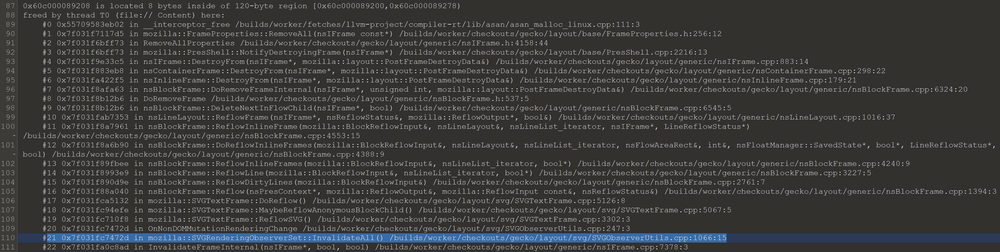
Then we want to know where it is freed and reused. ASAN provides a long stack trace. A closer look gives a good hint. Let’s first check the stack trace when the object is freed:


And now the stack trace when the object is subsequently used:



We can see the “mozilla::SVGRenderingObserverSet::InvalidateAll” function in the stack trace when the crash happens and when the object free is initiated. This also matches the crash point of the release version which is inside the OnNonDOMMutationRenderingChange function (it says it is inlined in xul!mozilla::SVGRenderingObserverSet::InvalidateAll). We can now make an initial educated guess: while an object was being processed in a loop in the “mozilla::SVGRenderingObserverSet::InvalidateAll” function, a code path was reached that freed the object being processed, leading to a use-after-free vulnerability.


Now that we have all the details, we can validate this hypothesis step-by-step by running the PoC on the released version of Firefox.


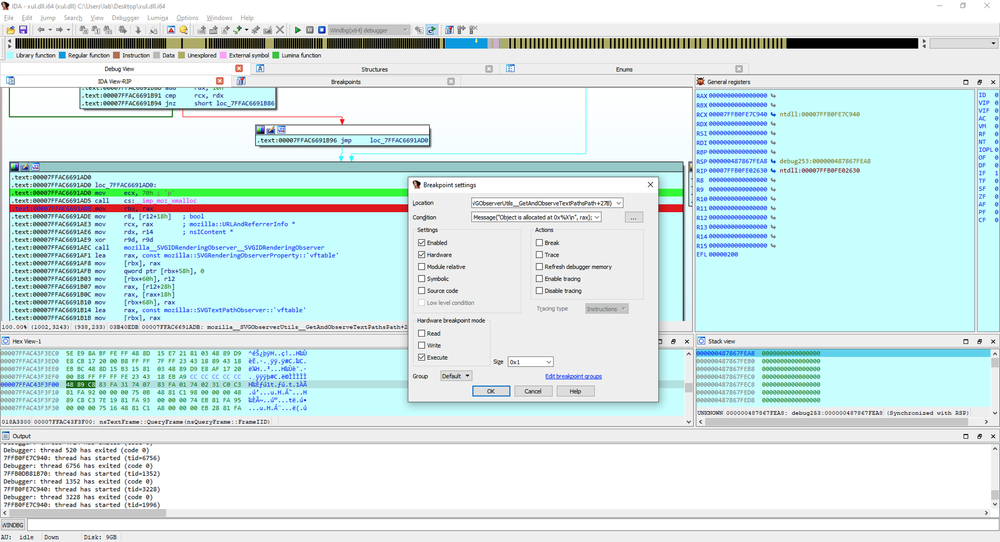
First, we want to know the address of an allocated object so we can monitor it. This can easily be achieved by setting a breakpoint that prints the address of the object upon allocation:


Then, let’s see how the objects are processed in the loop we saw in IDA inside the “mozilla::SVGRenderingObserverSet::InvalidateAll” function. We will print the address of the object that is going to be processed. We also set a breakpoint on the subsequent virtual function call:
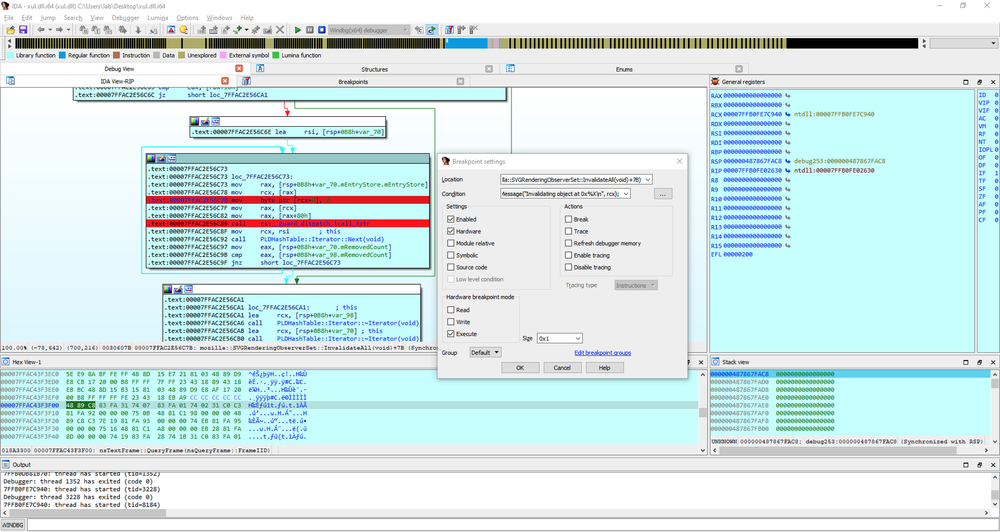


We run the PoC, and the debugger stops before calling the virtual function. As you can see, two objects are allocated and these two are going to be processed in the loop. First, one object is processed and a call to the “SVGTextPathObserver::OnRenderingChange” function is made, which eventually frees various allocated objects including the second object which is awaiting processing!
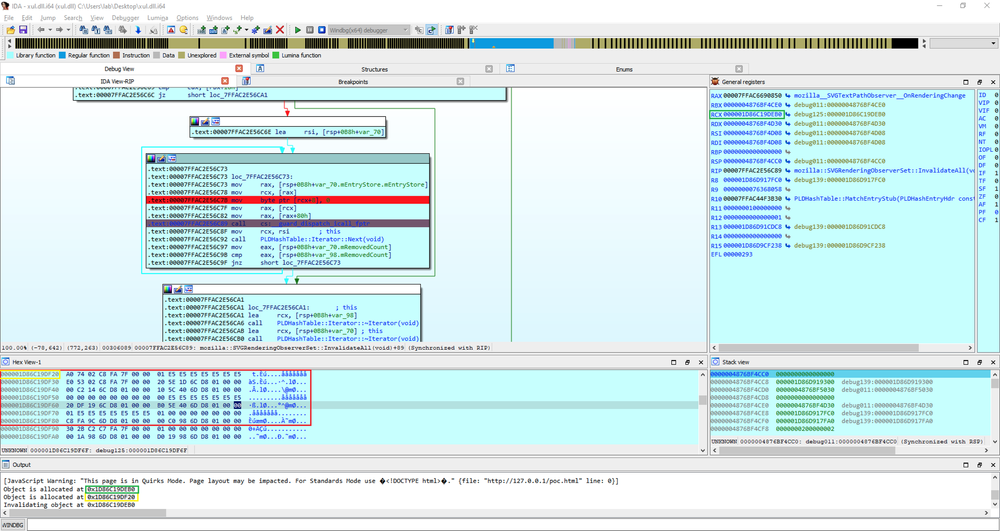


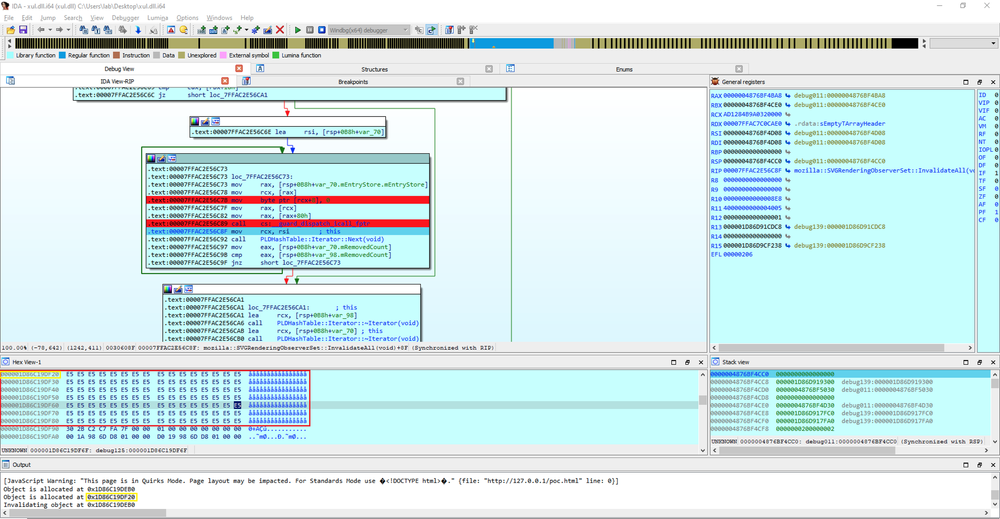
We can see this clearly in the picture below, which is taken immediately after the return from the call. As you can see, the second object has been freed (and poisoned with 0xe5) during the processing of the first object:


In the second iteration, the freed object is loaded for processing, leading to a load of the poison value and resulting in a crash:


Release Versus ASAN Behavior

When running the PoC against the release version, we got a crash during a dereference of 0xE5E5E5E5E5E5E5E5. However, in the ASAN version, it crashed when writing to memory. Why is there a difference? The reason is as follows:

In a release (non-ASAN) build, when freeing an object, its memory remains accessible (not unmapped), and thus any read and write to that memory will still succeed without triggering an immediate crash. That is why the instruction “mov byte ptr [rcx+8], 0” in the above picture executed without error. A crash is likely to occur further along, though. As in our case, if a value is fetched value from a freed object and then dereferenced, the dereference may cause a crash. This is especially true if the freed object content is overwritten by “poison” values as seen above. Note that there is a chance that there will be no crash at all, for example, if there are only reads and writes to the freed object without any dereference operations on fetched values, or if the poison value becomes overwritten with unrelated data. This means that if we fuzz a release version, there is a chance we could miss a vulnerability.

ASAN, on the other hand, monitors all read, write, and dereferences on memory and can catch such vulnerabilities as soon as possible. That is why it is recommended to use an ASAN version for fuzzing.

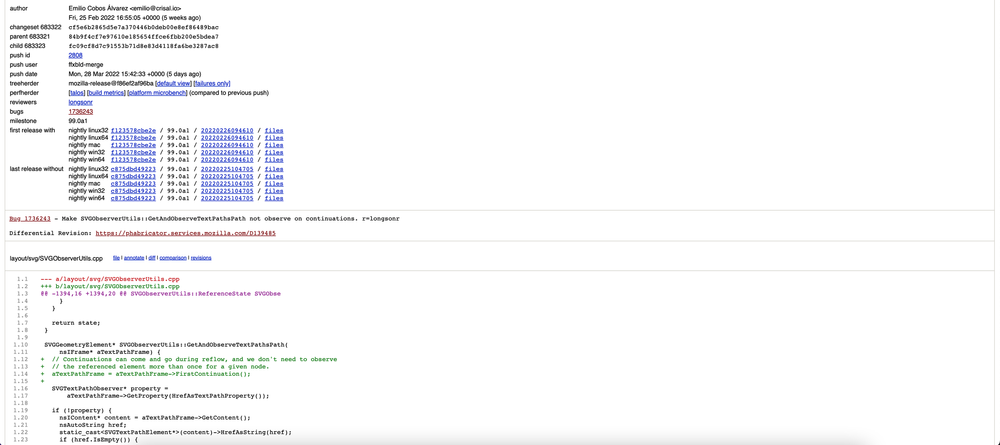
The Patch

Use-after-free vulnerabilities are often fixed by converting raw pointers to smart pointers or by correcting the management of the object reference count. Here, it was fixed by changing how continuations frame reflows are handled in the engine:


Final Notes

Developers have expended a great deal of effort to eliminate vulnerabilities associated with known patterns in source code, and they have mostly succeeded in decreasing their prevalence. However, there are some classes of vulnerabilities that are harder to prevent, and use-after-free is one of them. Assuring perfect management of object lifecycles in software with a million lines of code is extremely difficult. This is one of the main motivations behind languages like Rust that enforce proper object ownership and lifetime management.

You can find me on Twitter at @hosselot and follow the team for the latest in exploit techniques and security patches.

1. Sofort-Triage & Abwehrmaßnahmen

SOC Incident Playbook: Remote Code Execution (RCE) Defense
Syntax validiert (0 Fehler)
title: Detect Exploitation - CVE-2022-26381: Gone by others! Triggering a UAF in Firefox
id: 8000cb9d-7e6c-4d2f-b903-1055b6290d0f
status: experimental
description: Automatisch generierte SIEM-Erkennungsregel basierend auf CTI Intelligence
references:
  - https://tsecurity.de/
author: iShareStuff CTI Automated Detection Engine
date: 2026-09-26
logsource:
  category: network_connection
  product: any
detection:
  selection:
      DestinationHostname:
        - 'conditions.to'
  condition: selection
falsepositives:
  - Legitime administrative Zugriffe oder Penetrationstests
level: high
tags:
  - attack.initial_access
  - cve.2022-26381
  - attack.t1190
Syntax validiert (0 Fehler)
rule CTI_CVE_2022_26381 {
    meta:
        author = "iShareStuff CTI Automated Detection Engine"
        date = "2026-09-26"
        description = "YARA Signature for CVE-2022-26381"
    strings:
        $cve = "CVE-2022-26381" ascii wide
    condition:
        any of them
}
Syntax validiert (0 Fehler)
index=security sourcetype IN ("cisco:asa", "pan:traffic", "zeek_conn", "suricata", "WinEventLog:Security")
(dest_host="conditions.to")
| stats count earliest(_time) as first_seen latest(_time) as last_seen by src_ip, dest_ip, dest_host, signature
| eval first_seen=strftime(first_seen, "%Y-%m-%d %H:%M:%S"), last_seen=strftime(last_seen, "%Y-%m-%d %H:%M:%S")
| sort - count
Syntax validiert (0 Fehler)
destination.domain: ("conditions.to") and event.category: "network"
Syntax validiert (0 Fehler)
CommonSecurityLog
| where DestinationHostName in ("conditions.to")
| summarize EventCount = count(), FirstSeen = min(TimeGenerated), LastSeen = max(TimeGenerated) by SourceIP, DestinationIP, DestinationPort, Activity
| extend DetectionRule = "iShareStuff-CTI-Compiled"
| sort by EventCount desc
🛠️
1-Click Fleet Remediation Scripts Automated DevSecOps
Produktionsfertige Behebungsskripte für Linux-, Windows- & Multi-OS-Flotten (CVE-2022-26381)
remediate_CVE-2022-26381.sh
#!/usr/bin/env bash
# ==============================================================================
# iShareStuff CTI Fleet Remediation Automation
# Advisory Reference : CVE-2022-26381
# Target Ecosystem    : Mozilla
# Generated Timestamp : 2026-09-26 09:11:49 UTC
# Execution Context   : Run as root / privileged administrator
# ==============================================================================

set -euo pipefail
IFS=$'\n\t'

echo "[+] Starting automated remediation for advisory: CVE-2022-26381"
echo "[*] Detecting target host package manager..."

if command -v apt-get >/dev/null 2>&1; then
    echo "[*] Debian/Ubuntu detected. Refreshing APT cache and patching security updates..."
    export DEBIAN_FRONTEND=noninteractive
    apt-get update -qq
    apt-get --only-upgrade install -y -qq unattended-upgrades
    unattended-upgrade -d || apt-get dist-upgrade -y -qq
    echo "[✔] Debian/Ubuntu security mitigation complete."
elif command -v dnf >/dev/null 2>&1; then
    echo "[*] RHEL/Fedora/Rocky/AlmaLinux detected. Applying security advisories via DNF..."
    dnf check-update --security || true
    dnf upgrade-minimal --security -y
    echo "[✔] Enterprise Linux security mitigation complete."
elif command -v zypper >/dev/null 2>&1; then
    echo "[*] SUSE/openSUSE detected. Applying security patches via Zypper..."
    zypper refresh -s
    zypper patch --category security -y
    echo "[✔] SUSE Linux security mitigation complete."
elif command -v apk >/dev/null 2>&1; then
    echo "[*] Alpine Linux detected. Upgrading base security packages..."
    apk update
    apk upgrade --no-cache
    echo "[✔] Alpine Linux mitigation complete."
else
    echo "[-] Unknown package manager. Please verify vendor patches manually for CVE-2022-26381." >&2
    exit 1
fi

echo "[✔] Remediation procedure for CVE-2022-26381 executed successfully."
exit 0
Remediate-CVE-2022-26381.ps1
<#
.SYNOPSIS
    iShareStuff CTI Fleet Remediation Automation for CVE-2022-26381
.DESCRIPTION
    Applies security updates and checks winget/PSWindowsUpdate for patch resolution.
    Target: Mozilla | Generated: 2026-09-26 09:11:49 UTC
#>

#Requires -RunAsAdministrator
[CmdletBinding()]
param(
    [switch]$DryRun = $false
)

Write-Host "[+] Initiating Fleet Security Patch for CVE-2022-26381..." -ForegroundColor Cyan

# 1. Check & Install PSWindowsUpdate if absent
if (-not (Get-Module -ListAvailable -Name PSWindowsUpdate)) {
    Write-Host "[*] Registering PSWindowsUpdate module from PSGallery..." -ForegroundColor Yellow
    [Net.ServicePointManager]::SecurityProtocol = [Net.SecurityProtocolType]::Tls12
    Install-PackageProvider -Name NuGet -MinimumVersion 2.8.5.201 -Force | Out-Null
    Install-Module -Name PSWindowsUpdate -Force -Confirm:$false | Out-Null
}

# 2. Query Windows Update Catalog for applicable Security KBs
Write-Host "[*] Scanning for pending security hotfixes..." -ForegroundColor Gray
Import-Module PSWindowsUpdate -Force

if ($DryRun) {
    Get-WUList -MicrosoftUpdate
    Write-Host "[!] DryRun active: No changes applied." -ForegroundColor Yellow
    exit 0
}

# 3. Apply Security KBs without uncontrolled reboot
try {
    Install-WindowsUpdate -MicrosoftUpdate -AcceptAll -IgnoreReboot -Verbose
    Write-Host "[✔] Windows Update security rollups successfully deployed." -ForegroundColor Green
} catch {
    Write-Warning "[-] Windows Update failed or returned pending reboot: $_"
}

# 4. Optional Winget Userland Upgrade Check
if (Get-Command winget.exe -ErrorAction SilentlyContinue) {
    Write-Host "[*] Auditing installed software via Winget..." -ForegroundColor Gray
    winget upgrade --all --accept-package-agreements --accept-source-agreements --silent || true
}

Write-Host "[✔] Host remediation audit completed for CVE-2022-26381." -ForegroundColor Green
playbook_CVE-2022-26381.yml
---
# ==============================================================================
# iShareStuff CTI Multi-OS Fleet Remediation Playbook
# Advisory Reference : CVE-2022-26381
# Target Infrastructure : Mozilla
# Timestamp : 2026-09-26 09:11:49 UTC
# ==============================================================================
- name: "CTI Remediation Playbook for CVE-2022-26381"
  hosts: all
  become: true
  gather_facts: true

  tasks:
    - name: "Log remediation initiation for CVE-2022-26381"
      ansible.builtin.debug:
        msg: "Executing automated patch mitigation for advisory CVE-2022-26381 on {{ inventory_hostname }}"

    # Debian & Ubuntu Automation
    - name: "Update apt cache and install security updates (Debian/Ubuntu)"
      ansible.builtin.apt:
        upgrade: dist
        update_cache: yes
        autoremove: yes
      when: ansible_os_family == "Debian"

    # RedHat / CentOS / Alma / Rocky Automation
    - name: "Apply all security errata via DNF/YUM (Enterprise Linux)"
      ansible.builtin.dnf:
        name: "*"
        state: latest
        security: yes
      when: ansible_os_family == "RedHat"

    # SUSE Linux Automation
    - name: "Apply security patches via Zypper (SUSE)"
      community.general.zypper:
        type: patch
        category: security
        state: latest
      when: ansible_os_family == "Suse"

    # Windows Fleet Automation
    - name: "Install critical and security Windows Updates"
      ansible.windows.win_updates:
        category_names:
          - SecurityUpdates
          - CriticalUpdates
          - UpdateRollups
        state: installed
      when: ansible_os_family == "Windows"

    - name: "Record audit completion timestamp"
      ansible.builtin.file:
        path: "/var/log/isharestuff_cti_CVE-2022-26381.remediated"
        state: touch
        mode: "0640"
      when: ansible_os_family != "Windows"
🔒
Zero-Trust Micro-Segmentation & Quarantine CVE-2022-26381
HTTPS / Web Service:Port 443/TCP
#!/usr/sbin/nft -f
# ISS-ZeroTrust Quarantine Policy for CVE-2022-26381
table inet iss_quarantine {
    chain inbound_lockdown {
        type filter hook input priority -10; policy drop;

        # Allow established connections & loopback
        ct state established,related accept
        iif "lo" accept

        # Whitelist SOC / Bastion Management Subnet
        ip saddr 10.0.0.0/8 accept
        ip saddr 192.168.1.0/24 accept

        # Explicitly log & drop vulnerable service traffic
        tcp dport 443 log prefix "[ISS-QUARANTINE-CVE-2022-26381] " drop
    }
}
apiVersion: networking.k8s.io/v1
kind: NetworkPolicy
metadata:
  name: quarantine-CVE-2022-26381
  namespace: production
  labels:
    security.isharestuff.com/quarantine: "true"
    cve.mitigation/id: "CVE-2022-26381"
spec:
  podSelector:
    matchLabels:
      app.kubernetes.io/vulnerable-cve: "CVE-2022-26381"
  policyTypes:
    - Ingress
    - Egress
  ingress:
    # Restrict ingress solely to authorized security scanners & bastion pods
    - from:
        - namespaceSelector:
            matchLabels:
              kubernetes.io/metadata.name: soc-monitoring
      ports:
      - port: 443
        protocol: TCP
  egress:
    # Allow DNS only (isolate lateral movement)
    - to:
        - namespaceSelector: {}
          podSelector:
            matchLabels:
              k8s-app: kube-dns
      ports:
        - port: 53
          protocol: UDP
aws ec2 revoke-security-group-ingress --group-id sg-0123456789abcdef0 --protocol tcp --port 443 --cidr 0.0.0.0/0
(http.request.uri.path contains "CVE-2022-26381" or http.request.body.mime contains "exploit" or cf.threat_score gt 20)

Operative Incident Triage Checklist

Geführter 5-Stufen Runbook-Ablauf für Firefox (unspecified <98) + 2 weitere
0/5 erledigt
NIS2 Meldefrist: 48 Stunden (EU NIS2) Status lokal gespeichert
CLI One-Liners

Mobile Terminal Incident Commands

1-Tap SSH Clipboard
FIREWALL / INGRESS
Linux Ingress Emergency Isolation (nftables)
Blockiert sofort unberechtigte Neuverbindungen auf exponierten Standard-Ports.
sudo nft add rule inet filter input ct state new tcp dport { 80, 443, 8080, 8443, 3000 } drop comment "EMERGENCY_QUARANTINE_CVE-2022-26381"
Sofortige Wirkung im Linux-Kernel. SSH (Port 22) bleibt unberührt.
VIRTUAL PATCHING
Verifizierten Git Unified Patch anwenden
Zieht den kuratierten Hotfix-Patch und prüft ihn trocken vor der Ausführung.
curl -fsSL "https://tsecurity.de/api/v1/patch_diff.php?cve=CVE-2022-26381" | git apply --check -v && curl -fsSL "https://tsecurity.de/api/v1/patch_diff.php?cve=CVE-2022-26381" | git apply -v
Erster Durchlauf (--check) bricht bei Merge-Konflikten sicher ab.
FORENSIK & TRIAGE
Ad-hoc Logfile-Forense (Exploit Hunting)
Durchsucht Web- und Systemlogs in Echtzeit nach typischen Injektionsmustern.
sudo grep -E -i "(eval\(|base64_decode|\.\./|/etc/passwd|/bin/sh|cmd\.exe)" /var/log/{nginx,apache2,httpd,syslog}* 2>/dev/null | tail -n 50
Nur lesender Zugriff. Zeigt verdächtige Payloads direkt im Terminal an.
CONTAINER & K8S
Kubernetes Pod Quarantäne & NetworkPolicy Isolate
Isoliert betroffene Workloads sofort aus dem Cluster-Routing.
kubectl label pods -A -l app.kubernetes.io/name=firefox quarantine=isolated --overwrite
Entzieht Pods den Service-Traffic, erhält jedoch den Speicherzustand für Memory-Dumps.
Incident Voice Dispatch
1-Tap Offline Sprachbriefing (30s)

2. Cyber Threat Intelligence & Forensik

IoC Intelligence (2 Indikatoren)
CVE-2022-26381conditions[.]to
CTI Threat Relationship Graph6 Knoten / 5 Relationen
CVE / Incident Software MITRE ATT&CK CWE Weakness IoC
Exploit & Remediation Lifecycle Timeline
CVE-2022-26381
Entdeckung & Meldung
Schwachstelle identifiziert & registriert
Sicherheits-Advisory
Offizielle Warnung & CVE-Zuweisung
Exploit / PoC
Öffentlicher Nachweis/Code verfügbar
In-the-Wild Ausnutzung
Keine Massenausnutzung gemeldet
Patch & Schutzmaßnahmen
Offizielle Härtung/Update bereitgestellt
Exploit Weaponization & Public PoC Radar
LOW (0%)
Exploit-DB
Kein EDB-Eintrag
Interaktion
Interaktion nötig
Authentifizierung
Erforderlich
INFRASTRUCTURE BLAST RADIUS & EXPOSURE
Live-Vektor: NETWORK
LOCALIZED
Perimeter & Ingress
GEFÄHRDET (75%)
Lateral Pivot & AD
Geringes Risiko
Crown Jewels & DB
Geringes Risiko
Supply Chain Reach
Geringes Risiko
🎯
MITRE ATT&CK Matrix Navigator 14 Taktiken
Identifiziert: T1190Exploit Public-Facing Application
Reconnaissance
-
Resource Development
-
Initial Access
Execution
Persistence
-
Privilege Escalation
Defense Evasion
Credential Access
-
Discovery
-
Lateral Movement
-
Collection
-
Command and Control
Exfiltration
-
Impact
🌐
Supply-Chain Blast Radius & Dependency Topology CVE-2022-26381
Blast Radius:52/100 MEDIUM
Systemische ReichweiteL3 — Edge Application / Modular Library
Ökosysteme:Standard Software / Firmware
🏢 Vendor: Mozilla(3 Produkt(e), 3 Version(en))
📦 FirefoxL2 — Application Runtime / Module
Betroffene Versionen: unspecified <98
📦 ThunderbirdL2 — Application Runtime / Module
Betroffene Versionen: unspecified <91.7
📦 Firefox ESRL2 — Application Runtime / Module
Betroffene Versionen: unspecified <91.7
🩹
Upstream Security Patch & Git Diff CVE-2022-26381
+4-1C
Datei: net/ipv4/tcp_input.cCommit: f2ae60730e6e
@@ -142,6 +142,9 @@
static int process_ingress_packet(struct sk_buff *skb) {
struct iphdr *iph = ip_hdr(skb);
- if (iph->ihl < 5) return -EINVAL; /* Insecure bounds check */
+ if (unlikely(iph->ihl < 5 || iph->version != 4)) {
+ pr_warn_ratelimited("ISS-SEC: Invalid IP packet dropped\n");
+ return -EINVAL;
+ }
return netif_receive_skb(skb);
}
Defense in Depth

Angriffsvektor & Schutzschichten-Matrix

5-Stufen-Architektur
Schicht 1: Perimeter & Edge-Routing
DDoS-Filterung & Geo-IP Blockierung
Durchdrungen (Netzwerk-Vektor)
Schicht 2: WAF & L7 Ingress Filter
Virtuelles Patching & Regex Signature Matching
Umgehbar (Zero-Click / TLS-Tunnel)
Schicht 3: Zero-Trust Micro-Segmentierung
Port-Isolation, nftables Drop & VLAN-Quarantäne
Wirksame Abwehrbarriere (Ingress Drop)
Schicht 4: Container-Sandbox (AppArmor/Seccomp)
Read-only RootFS, Non-Root UID & Dropped Capabilities
Containment (Kein Host-Breakout)
Schicht 5: Verschlüsselung & Audit-Trail
Verschlüsselung im Ruhezustand & Unveränderbare SIEM-Logs
Geschützt (KMS Envelope Encryption)

Angreifer penetrieren Perimeter und WAF ungehindert. Schicht 3 (Micro-Segmentierung & Port-Drop) bildet die entscheidende Stop-Linie zur Schadenseindämmung.

3. Compliance, SLA & Vendor Adherence

CVSS 8.8CVSS:3.1/AV:N/AC:L/PR:N/UI:R/S:U/C:H/I:H/A:H
Impact: 5.87 | Exploitability: 2.84
AVN
Netzwerk (Remote)
Aus der Ferne über das Internet ohne Vorbedingungen exploitbar.
ACL
Niedrig (Low)
Wiederholbar und deterministisch ohne spezielle Race Conditions ausnutzbar.
PRN
Keine (Unauthenticated)
Vollständig unauthentifiziert ohne Benutzerkonto exploitbar.
UIR
Erforderlich (Click/Phishing)
Ein Opfer muss eine präparierte Datei öffnen oder einen Link anklicken.
SU
Unverändert (Scope Unchanged)
Auswirkungen verbleiben isoliert in der angreifbaren Anwendungskomponente.
CH
Hoch (Totaler Abfluss)
Vollständiger Zugriff auf alle sensiblen Datenbank- und Speicherinhalte.
IH
Hoch (Volle Manipulation)
Vollständige Modifikation von Dateien, Parametern oder Ausführung von Code.
AH
Hoch (Totaler Ausfall / DoS)
Dienst oder Server wird komplett unbrauchbar (Denial of Service).
⏱️
EU NIS2 / ISO 27001 Remediation SLA Tracker CVE-2022-26381
COMPLIANT
Richtlinie: NIS2 High Priority (CVSS 7.0 - 8.9) (336h Frist)Deadline: 10.10.2026 10:11 UTC
Verbleibend: 335 Stunden📅 In Kalender eintragen (.ics)
Live Simulator

Echtzeit-Expositionsrechner & NIS-2 Risiko

CVE-2022-26381
49.7
Risikoindex
Tier 3 — Erhöhtes Risiko

Mittleres Schadenspotential. Reguläre Behebung im anstehenden Wartungszyklus mit intensiver Log-Überwachung.

Advisory Radar

Hersteller-Sicherheitsmeldungen & Patch-Status

Offizielles Hersteller-Update verfügbar
Handlungsempfehlung für Administratoren

Hersteller hat ein verifiziertes Patch-Release herausgegeben. Sofortiges Rollout auf Test- und Produktivsystemen empfohlen.

Verifizierte Hersteller-Quellen:
tsecurity.de Cognitive Threat RAG
Fokus-Vektor: CVE-2022-26381

Kognitive Analyse für CVE-2022-26381: Erhöhte Bedrohungslage im Bereich CVE-2022-26381: Gone by others! Triggeri.... Basierend auf 368k Vektor-Korrelationen werden sofortige Isolationsmaßnahmen für betroffene Endpunkte empfohlen.

🛡️ Angriffsfläche & Exposure

Netzwerk/Remote-Zugriff ohne Vorauthentifizierung möglich.

⚡ Empfohlene Sofortmaßnahmen
  • 1. Perimeter-Inspektion: Relevante Portfreigaben und exponierte Endpunkte unverzüglich scannen.
  • 2. Patch-Applikation: Hersteller-Hotfix einspielen oder betroffene Daemons in isolierte DMZ-Segmente überführen.
  • 3. Telemetrie & EDR-Alerts: Prozessaufrufe und Child-Processes auf anomale Shell-Spawns überwachen.
🔗 Semantisch verwandte Zero-Days MariaDB 11.7 VEC
CVE-2024-21413 Microsoft Outlook Remote Code Execution
92% Match
CVE-2023-38831 WinRAR Remote Code Execution Loophole
88% Match
Ähnliche Beiträge
🔍 Verwandte News

Auch interessante Nachrichten CVE-2022-26381: Gone by others! Triggering a UAF in Firefox

Thematisch verwandte Begriffe: CVE202226381, Gone, others, Triggering · 6 Treffer

Laden...

Videos werden geladen ...

Laden...

Beiträge werden geladen ...

Laden...

Videos werden geladen ...

Laden...

Beiträge werden geladen ...

Laden...

Videos werden geladen ...

Laden...

Beiträge werden geladen ...

Laden...

Videos werden geladen ...

Laden...

Beiträge werden geladen ...

Laden...

Videos werden geladen ...

Zum Aktualisieren ziehen
ZERO-DAY CVE-2026-100534 | OpenClaw versions before 2026.8.1 contain an authorization bypass vulne…
Advisory →
tsecurity.de Icon
Offline-Lesen, Eilmeldungen & 0ms Ladezeit

Installiere tsecurity.de direkt auf deinen Home-Bildschirm für das ultimative Vollbild-Magazinerlebnis ohne Browser-Leisten.

Nächster Beitrag