Posted by , Google
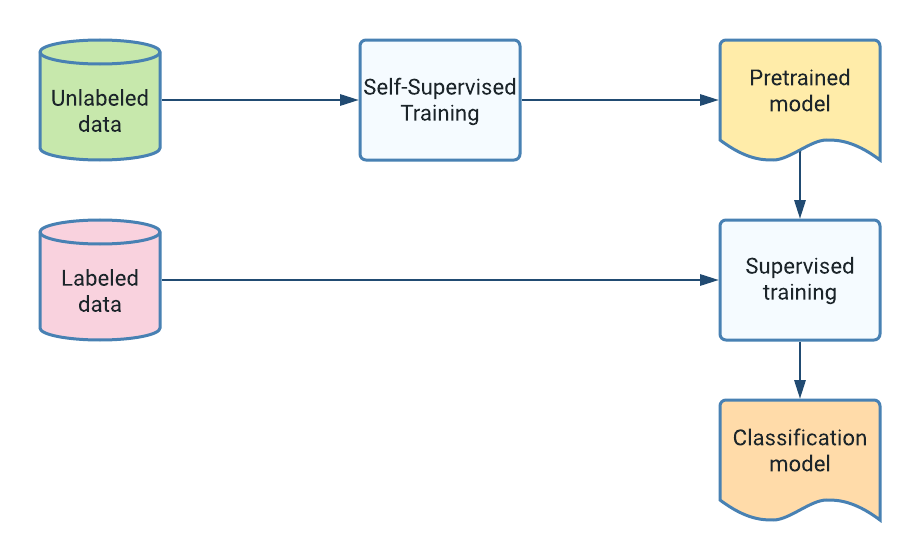
now supports key uses the ImageNet ILSVRC-2012 dataset for training the representations and then evaluates the transfer learning performance on 12 other image datasets such as CIFAR, Oxford-IIIT Pets, Food-101, and others. Self-supervised learning works at larger scales as well, where pre-training on billions of examples improves accuracy as well, including .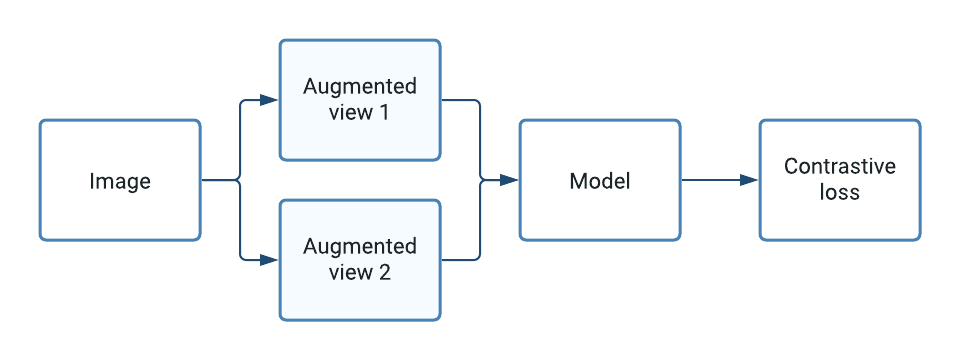 |
| High level overview of how self-supervised learning works for images. |
At its core, self-supervised learning works by contrasting two augmented “views” of the same example. The model objective is to maximize the similarity between these views to learn representations that are useful for down-stream tasks, such as training a supervised classifier. In practice, after pre-training on a large corpus of unlabeled images, training an image classifier is done by adding a single softmax dense layer on top of the frozen pre-trained representation and training as usual using a small number of labeled examples.
 |
| Examples of pairs of augmented views on CIFAR10 from the hello world notebook. |
TensorFlow Similarity currently provides three key approaches for learning self-supervised representations: , notebook that demonstrates how to double the accuracy on CIFAR10.
Vollständiger Original-Bericht
Ausführliche Details, Code-Beispiele & Hersteller-Stellungnahme auf blog.tensorflow.org.

SOCIAL SHARE CARD GENERATOR