🕵️ SicherheitslückenHak5: Hackers Just Poisoned the Rust Supply Chain | Threat Wire(01.09.2026 um 14:00 Uhr)
🕵️ SicherheitslückenHak5: Hackers Found a Way Into Humanoid Robots | Threat Wire(04.09.2026 um 15:04 Uhr)
🔧 AI Nachrichten Bits und so #1021 (Passwort für Laufwerk)(31.08.2026 um 22:15 Uhr)
🔧 AI Nachrichten Bits und so #1022 (Wie Weißbier)(06.09.2026 um 20:39 Uhr)
🍏 iOS / Mac OSHue-App 6.0 ist da: das sind die Neuerungen(07.09.2026 um 17:21 Uhr)
🕵️ SicherheitslückenHak5: Hackers Just Poisoned the Rust Supply Chain | Threat Wire(01.09.2026 um 14:00 Uhr)
🕵️ SicherheitslückenHak5: Hackers Found a Way Into Humanoid Robots | Threat Wire(04.09.2026 um 15:04 Uhr)
🔧 AI Nachrichten Bits und so #1021 (Passwort für Laufwerk)(31.08.2026 um 22:15 Uhr)
🔧 AI Nachrichten Bits und so #1022 (Wie Weißbier)(06.09.2026 um 20:39 Uhr)
🍏 iOS / Mac OSHue-App 6.0 ist da: das sind die Neuerungen(07.09.2026 um 17:21 Uhr)

🎥 Künstliche Intelligenz Videos 🕛 kürzlich 7 Min Lesezeit
0

Building a reinforcement learning agent with JAX, and deploying it on Android with TensorFlow Lite

↗ Quelle (blog.tensorflow.org)
🗣️ Stimme:
📑 Inhaltsübersicht
📺
blog.tensorflow.org

Posted by Wei Wei, Developer Advocate

, we showed you how to use TensorFlow and TensorFlow Agents to train a reinforcement learning (RL) agent to play a simple board game ‘Plane Strike’. We also converted the trained model to TensorFlow Lite and then deployed it into a fully-functional Android app. In this blog, we will demonstrate a new path: train the same RL agent with and deploy it into the same Android app we have built before. The complete code has been open sourced in the .
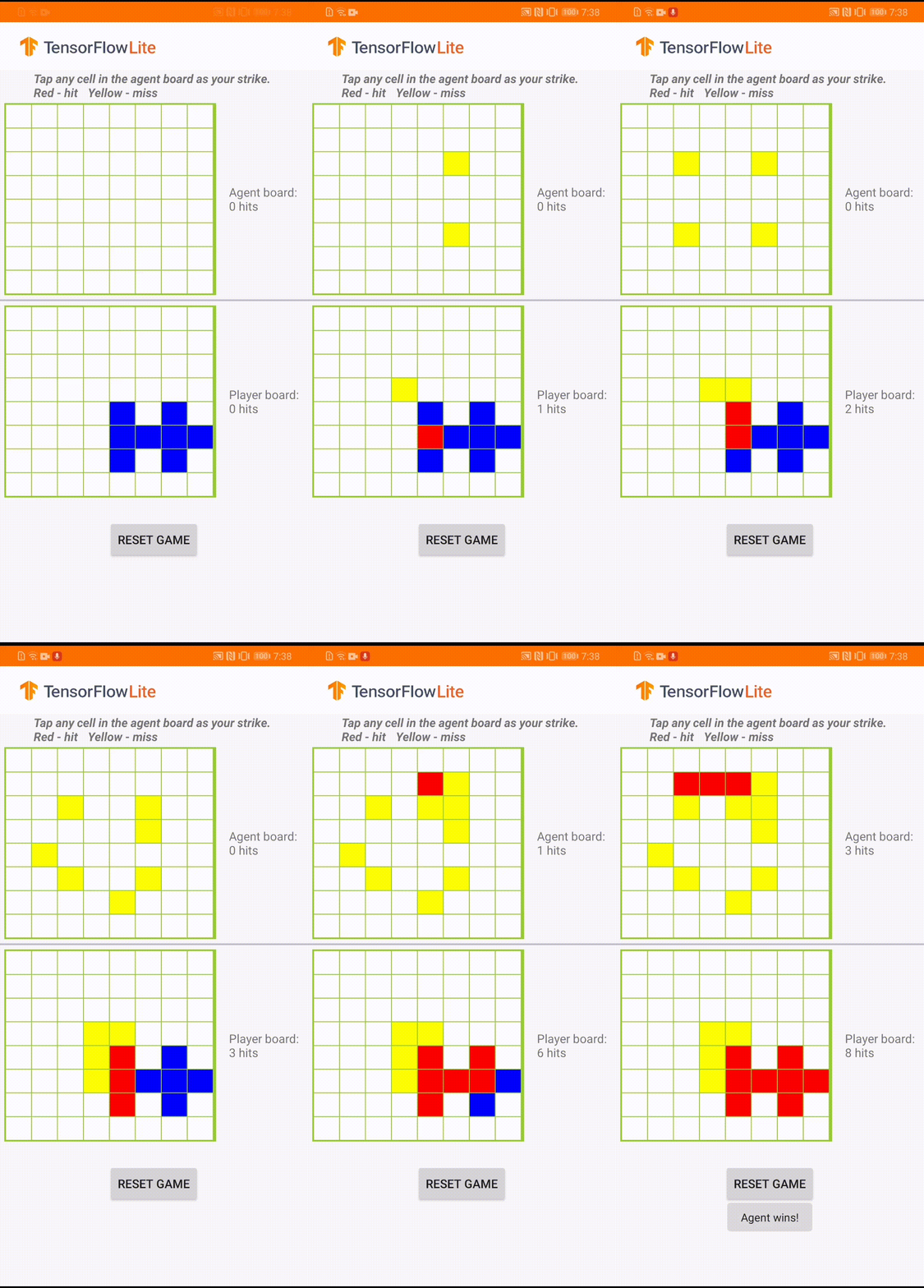
Demo game play in ‘Plane Strike’

Background: JAX and TensorFlow

to compile programs optimized for GPUs and is a popular neural network library built on top of JAX. Researchers have been using JAX/Flax to train very large models with billions of parameters (such as for image generation), making full use of modern hardware. If you're new to JAX and Flax, start with .

TensorFlow started as a library for ML towards the end of 2015 and has since become a rich ecosystem that includes tools for productionizing ML pipelines (), deploying ML models to edge devices (). Models developed in JAX or Flax can tap into this rich ecosystem by first converting such a model to the TensorFlow video shows you how to deploy JAX models with TensorFlow Serving
  • environment as before. We will train the same policy gradient model using Flax/JAX this time. Recall that mathematically the policy gradient is defined as:
 
, a gradient processing and optimization library for JAX, to update the model parameters.

def compute_loss(logits, labels, rewards):

  one_hot_labels = jax.nn.one_hot(labels, num_classes=common.BOARD_SIZE**2)

  loss = -jnp.mean(

      jnp.sum(one_hot_labels * jnp.log(logits), axis=-1) * jnp.asarray(rewards))

  return loss


def train_step(model_optimizer, params, opt_state, game_board_log,

              predicted_action_log, action_result_log):

"""Run one training step."""


  def loss_fn(model_params):

    logits = run_inference(model_params, game_board_log)

    loss = compute_loss(logits, predicted_action_log, action_result_log)

    return loss


  def compute_grads(params):

    return jax.grad(loss_fn)(params)


  grads = compute_grads(params)

  updates, opt_state = model_optimizer.update(grads, opt_state)

  params = optax.apply_updates(params, updates)

  return model_optimizer, params, opt_state


@jax.jit

def run_inference(model_params, board):

  logits = PolicyGradient().apply({'params': model_params}, board)

  return logits


That’s it for the training loop. We can visualize the training progress in TensorBoard as below; here we use the proxy metric ‘game_length’ (the number of steps to finish the game) to track the progress. The intuition is that when the agent becomes smarter, it can finish the game in fewer steps.

, a TensorFlow-JAX interoperation tool, to convert the JAX model into a TensorFlow concrete function. And the final step is to call TensorFlow Lite converter to convert the concrete function into a TFLite model.

# Convert to tflite model

 model = PolicyGradient()

 jax_predict_fn = lambda input: model.apply({'params': params}, input)


 tf_predict = tf.function(

     jax2tf.convert(jax_predict_fn, enable_xla=False),

     input_signature=[

         tf.TensorSpec(

             shape=[1, common.BOARD_SIZE, common.BOARD_SIZE],

             dtype=tf.float32,

             name='input')

     ],

     autograph=False,

 )


 converter = tf.lite.TFLiteConverter.from_concrete_functions(

     [tf_predict.get_concrete_function()], tf_predict)


 tflite_model = converter.convert()


 # Save the model

 with open(os.path.join(modeldir, 'planestrike.tflite'), 'wb') as f:

   f.write(tflite_model)


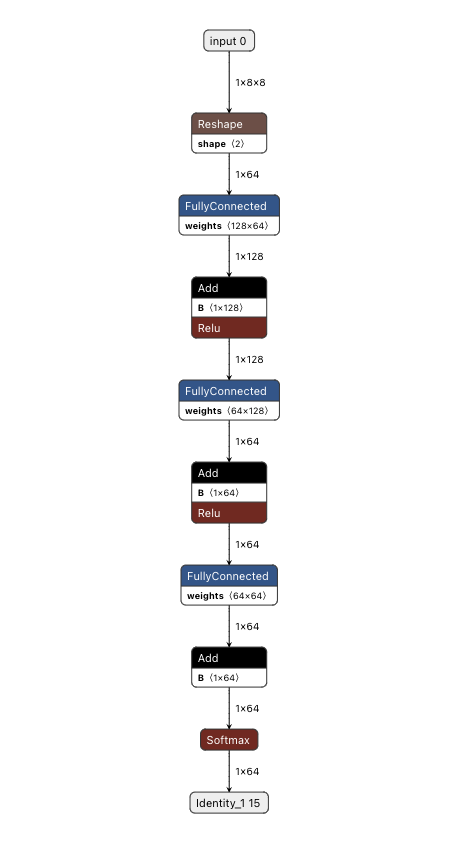
The JAX-converted TFLite model behaves exactly like any TensorFlow-trained TFLite model. You can visualize it with Netron:
Visualizing TFLite model converted from Flax/JAX using Netron
We can use exactly the same Java code as before to invoke the model and get the prediction.

convertBoardStateToByteBuffer(board);
tflite.run(boardData, outputProbArrays);
float[] probArray = outputProbArrays[0];
int agentStrikePosition = -1;
float maxProb = 0;
for (int i = 0; i < probArray.length; i++) {
  int x = i / Constants.BOARD_SIZE;
  int y = i % Constants.BOARD_SIZE;
  if (board[x][y] == BoardCellStatus.UNTRIED && probArray[i] > maxProb) {
    agentStrikePosition = i;
    maxProb = probArray[i];
  }
}

Conclusion

In summary, this article walks you through how to train a simple reinforcement learning model with Flax/JAX, leverage jax2tf to convert it to TensorFlow Lite, and integrate the converted model into an Android app.

Now you have learned how to build neural network models with Flax/JAX, and tap into the powerful TensorFlow ecosystem to deploy your models pretty much anywhere you want. We can’t wait to see the fantastic apps you build with both JAX and TensorFlow!
Vollständiger Original-Bericht
Ausführliche Details, Code-Beispiele & Hersteller-Stellungnahme auf blog.tensorflow.org.
↗ Original-Artikel auf blog.tensorflow.org lesen
Wie bewertest du diesen Beitrag?
1 Klick Feedback
Teilen mit Netzwerk & Team:

Community-Analysen & Experten-Meinungen 0

Verfasse deine eigene Analyse, teile Workarounds oder diskutiere diesen Vorfall im Blog.
Noch keine Community-Analyse verfasst. Markiere einen Textabschnitt oder klicke oben auf Eigene Analyse verfassen“!
Community Pulse: Relevanz-Einschätzung
1 Klick Experten-Votum
🔴 Akute Relevanz 0%
🟡 In Evaluierung 0%
🟢 Keine Auswirkung 0%
Spannende Innovation 0%
Verwandte Story-Cluster & Quellen (Vektor-KI)
Port 8095 Engine
1 Quelle
Hackers Just Poisoned the Rust Supply Chain | Threat Wire
1 Quelle
Hackers Found a Way Into Humanoid Robots | Threat Wire
1 Quelle
Bits und so #1021 (Passwort für Laufwerk)
Ähnliche Beiträge
🔍 Verwandte News

Auch interessante Nachrichten Building a reinforcement learning agent with JAX, and deploying it on Android with TensorFlow Lite

Thematisch verwandte Begriffe: Building, reinforcement, learning, agent · 6 Treffer

Laden...

Videos werden geladen ...

Laden...

Beiträge werden geladen ...

Laden...

Videos werden geladen ...

Laden...

Beiträge werden geladen ...

Laden...

Videos werden geladen ...

Laden...

Beiträge werden geladen ...

Laden...

Videos werden geladen ...

Laden...

Beiträge werden geladen ...

Laden...

Videos werden geladen ...