Posted by Jianhui Li, Zhoulong Jiang, Yiqiang Li from Intel, Penporn Koanantakool from Google
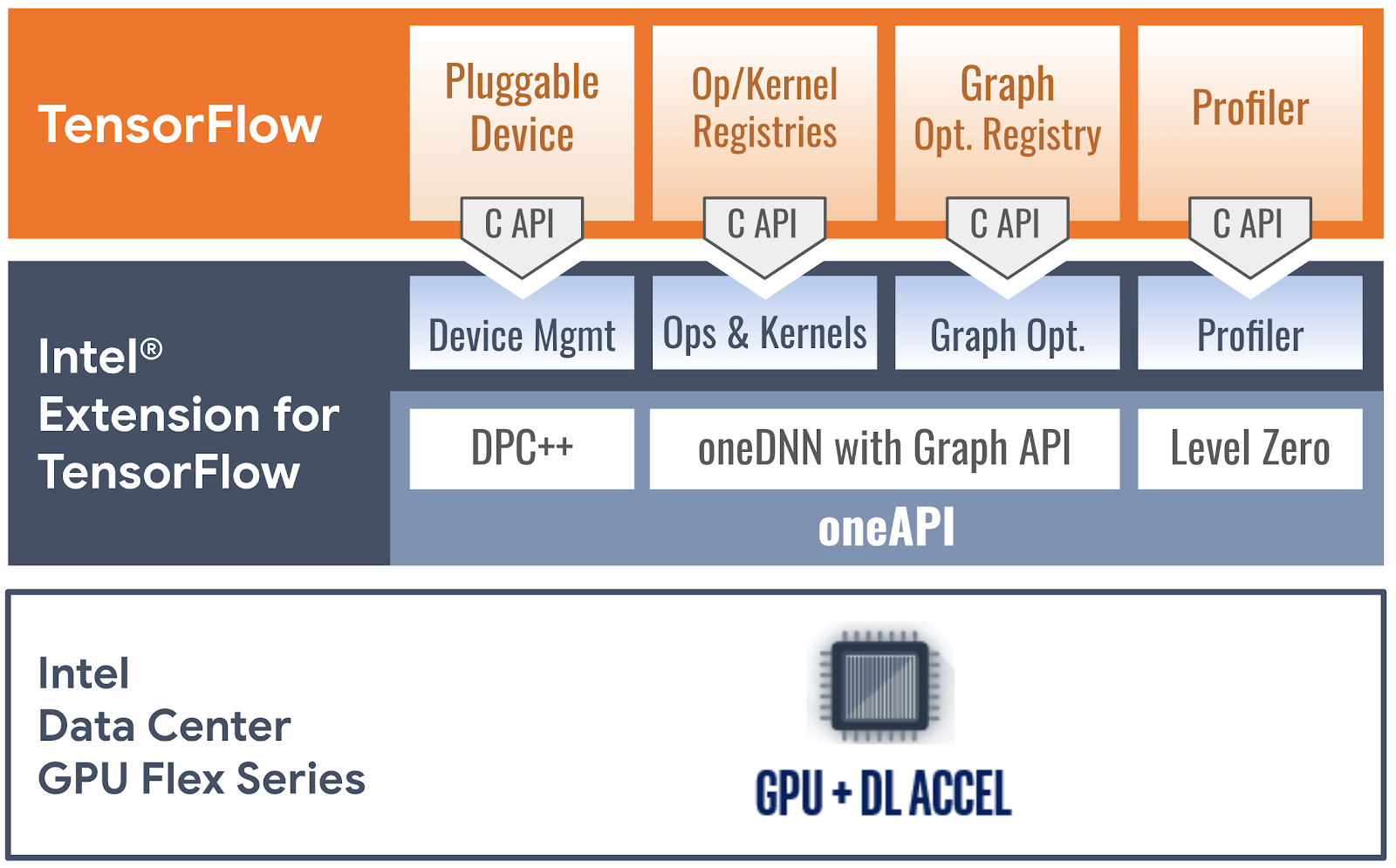
, a mechanism that lets hardware vendors independently release plug-in packages for new device support that can be installed alongside TensorFlow, without modifying the TensorFlow code base. PluggableDevice has been the only way to add a new device to TensorFlow since its release in TensorFlow 2.5. To bring feature-parity with native devices, Intel and Google also added a profiling C interface to TensorFlow 2.7. The TensorFlow community . Today, we are excited to announce the latest PluggableDevice - , an open, standard-based, unified programming model that delivers a common developer experience across accelerator architectures:- Device management: We implemented TensorFlow’s ). StreamExecutor C API defines stream, device, context, memory structure, and related functions, all of which have trivial mappings to corresponding implementations in the allows adding device-specific kernel implementations and custom operations. To ensure sufficient model coverage, we match TensorFlow native GPU device’s op coverage, implementing most performance critical ops by calling highly-optimized deep learning primitives from the oneAPI Deep Neural Network Library ( math library. Our plug-in ports Eigen to C++ with SYCL so that it can generate programs to implement device ops.
- Graph optimization: The Flex Series GPU plug-in optimizes TensorFlow graphs in and offloads performance-critical graph partitions to the oneDNN library through lets PluggableDevices communicate profiling data in TensorFlow’s native profiling format. The Flex Series GPU plug-in takes a serialized XSpace object from TensorFlow, fills the object with runtime data obtained through the oneAPI for more detailed information. For issues and feedback specific to Intel® Extension for TensorFlow, please provide feedback and sample code if you would like to integrate a new device with TensorFlow. We look forward to enabling more AI accelerators in TensorFlow through PluggableDevice.
Contributors: Anna Revinskaya (Google), Yi Situ (Google), Eric Lin (Intel), AG Ramesh (Intel), Sophie Chen (Intel), Yang Sheng (Intel), Teng Lu (Intel), Guizi Li (Intel), River Liu (Intel), Cherry Zhang (Intel), Rasmus Larsen (Google), Eugene Zhulenev (Google), Jose Baiocchi Paredes (Google), Saurabh Saxena (Google), Gunhan Gulsoy (Google), Russell Power (Google)

SOCIAL SHARE CARD GENERATOR