Posted by The Hugging Face Team 🤗
. Although Transformers can be used in many NLP applications, one is particularly alluring: text generation. It caters to the practical goals of automating verbal tasks and to our dreams of future interactions with chatbots.Text generation can significantly impact user experiences. So, optimizing the generation process for throughput and latency is crucial. On that end, for XLA-powered text generation in 🤗 transformers for the TensorFlow models. This post dives deeper into the design choices that had to be made in order to make the text generation models TensorFlow XLA-compatible. Through these changes to incorporate XLA compatibility, we were able to significantly improve the speed of the text generation models ~ 100x faster than before.
A Deeper Dive into Text Generation
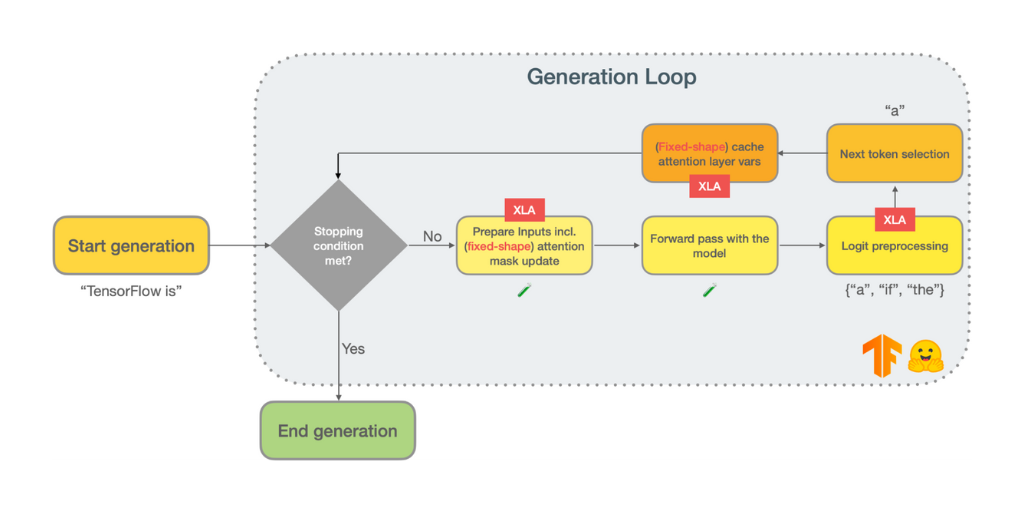
To understand why XLA is non-trivial to implement for text generation, we need to understand text generation in more detail and identify the areas that would benefit the most from XLA.
Popular models based on the Transformer architecture (such as .
Logit preprocessing
Perhaps the least discussed step of text generation is what happens between the model forward pass and the next token selection. When performing a forward pass with a text generation model, you will obtain the unnormalized log probabilities for each token (also known as logits). At this stage, you can freely manipulate the logits to impart the desired behavior to text generation. Here are some examples:
- You can prevent certain tokens from being generated if you set their logits to a very large negative value;
- Token repetition can be reduced if you add a penalty to all tokens that have been previously generated;
- You can nudge sampling towards the most likely tokens if you multiply all logits by a constant smaller than one, also known as . In summary, you can (and should) cache the keys and the values from the masked self-attention layers where the size of the cache equals the number of input tokens obtained in the previous generation iteration.
Here we identified three keys areas that could benefit from XLA:
- Control flow
- Data structures
- Utilities accepting dynamically shaped inputs
Adjusting Text Generation for XLA
As a TensorFlow user, the first thing you must do if you want to compile your function with XLA is to ensure that it can be wrapped with a
. There are many different paths you can follow to get it done for autoregressive text generation – this section will cover the design decisions made at Hugging Face 🤗, and is by no means prescriptive.Switching between eager execution and XLA-enabled graph mode should come with as few surprises as possible. This design decision is paramount to the
transformerslibrary team. Eager execution provides an easy interface to the TensorFlow users for better interaction, greatly improving the user experience. To maintain a similar level of user experience, it is important for us to reduce the friction of XLA conversion.Control flow
As mentioned earlier, text generation is an iterative process. You condition the inputs based on what has been generated, where the first generation is usually “seeded” with a start token. But, this continuity is not infinite – the generation process terminates with a stopping criterion.
For dealing with such a continuous process, we resort to
whilestatements. in the function created bytf.function. Withtf.while_loop, you can specify which variables will be used across iterations and if they are shape-invariant or not (which you can’t do with regular Python while statements, more on this later).# This will have an implicit conversion to a `tf.while_loop` in a `tf.function`
x = tf.constant([10.0, 20.0])
while tf.reduce_sum(x) > 1.0:
x = x / 2
# This will give you no surprises and a finer control over the loop.
x = tf.constant([10.0, 20.0])
x = tf.while_loop(
cond=lambda x: tf.reduce_sum(x) > 1.0,
body=lambda x: [x / 2],
loop_vars=[x]
)[0]An advantage of using
tf.while_loopfor the text generation autoregressive loop is that the stopping conditions become clearly identifiable – they are the termination condition of the loop, corresponding to itscondargument. Here are two examples we resorted totf.while_loopwith explicit conditioning:Sometimes a
forloop repeats the same operation for an array of inputs, such as in the processing of candidates for beam search. is one example of logit processing, benefitting from this type of vectorization.The last type of control flow that must be addressed for text generation is theif/elsebranches. Similarly towhilestatements, if the condition is a tensor.# If statements can look trivial like this one.
x = tf.constant(1.0)
if x > 0.0:
x = x - 1.0
# However, they should be treated with care inside a `tf.function`
x = tf.constant(1.0)
x = tf.cond(
tf.greater(x, 0.0),
lambda: x - 1.0,
lambda: x
)This conversion places some constraints on your design: the branches of yourifstatement must now be converted to function calls, and both branches must return the same number and type of outputs. This change impacts complex logit processors, such as the one that prevents specific tokens from being generated. to use variables with varying shapes across iterations, this process will trigger re-tracing, which should be avoided whenever possible since it’s computationally expensive. You can refer to obtained from the maximum possible generation length. Those structures can be padded and easily ignored thanks to the attention masking mechanisms in the Transformer architecture. Similarly, tracing is also a problem when your function itself has different possible input shapes. For text generation, this problem is handled the same way: you can (and should) pad your input prompt to reduce the possible input lengths.# You have to run each section separately, commenting out the other.
import time
import tensorflow as tf
# Same function being called with different input shapes. Notice how the
# compilation times change -- most of the weight lifting is done on the
# first call.
@tf.function(jit_compile=True)
def reduce_fn_1(vector):
return tf.reduce_sum(vector)
for i in range(10, 13):
start = time.time_ns()
reduce_fn_1(tf.range(i))
end = time.time_ns()
print(f"Execution time -- {(end - start) / 1e6:.1f} ms")
# > Execution time -- 520.4 ms
# > Execution time -- 26.1 ms
# > Execution time -- 25.9 ms
# Now with a padded structure. Despite padding being much larger than the
# actual data, the execution time is much lower because there is no retracing.
@tf.function(jit_compile=True)
def reduce_fn_2(vector):
return tf.reduce_sum(vector)
padded_length = 512
for i in range(10, 13):
start = time.time_ns()
reduce_fn_2(tf.pad(tf.range(i), [[0, padded_length - i]]))
end = time.time_ns()
print(f"Execution time -- {(end - start) / 1e6:.1f} ms")
# > Execution time -- 511.8 ms
# > Execution time -- 0.7 ms
# > Execution time -- 0.4 msPositional embeddingsTransformer-based language models rely on )
- GPT-J ().
To summarize, our journey from a naive TensorFlow text generation implementation to an XLA-powered one consisted of:
- Replacing for/while Python loops conditional on tensors with
tf.while_loopor vectorization; - Replacing if/else operations conditioned on tensors with
tf.cond; - Creating fixed-size tensors for all tensors that had dynamic size;
- Stopping relying on tensor shapes to obtain the positional embedding;
- Documenting proper use of the XLA-enabled text generation.
What’s next?
The journey to XLA-accelerated TensorFlow text generation by Hugging Face 🤗 was full of learning opportunities. But more importantly, the results speak for themselves: with these changes, TensorFlow text generation can execute 100x faster than before! You can try it yourself in .
Bringing XLA into your mission-critical application can greatly impact driving down costs and latency. The key to accessing these benefits lies in understanding how AutoGraph and tracing work to bring the most out of them. Have a look at the resources shared in this blog post and give it a go!
Acknowledgements
Thanks to the TensorFlow team for bringing support for XLA. Thanks to Joao Gante (Hugging Face) for spearheading the development of XLA-enabled text generation models for TensorFlow in 🤗 Transformers.
↗ Original-Artikel auf blog.tensorflow.org lesenVollständiger Original-BerichtAusführliche Details, Code-Beispiele & Hersteller-Stellungnahme auf blog.tensorflow.org.Wie bewertest du diesen Beitrag?1 Klick FeedbackTeilen mit Netzwerk & Team:Hat Ihnen dieser Tipp / Anleitung geholfen?Community-Analysen & Experten-Meinungen 0
Verfasse deine eigene Analyse, teile Workarounds oder diskutiere diesen Vorfall im Blog.Noch keine Community-Analyse verfasst. Markiere einen Textabschnitt oder klicke oben auf „ Eigene Analyse verfassen“!Community Pulse: Relevanz-Einschätzung1 Klick Experten-Votum🔴 Akute Relevanz 0%🟡 In Evaluierung 0%🟢 Keine Auswirkung 0%Spannende Innovation 0%Port 8095 EngineVerwandte Story-Cluster & Quellen (Vektor-KI)
Tipp: Mit Pfeiltasten [ ← ] und [ → ] blättern Ähnliche Beiträge
🔍 Verwandte News
Ähnliche Beiträge
🔍 Verwandte NewsAuch interessante Nachrichten How Hugging Face improved Text Generation performance with XLA
Thematisch verwandte Begriffe: Hugging, Face, improved, Text · 6 Treffer
🔧 AI Nachrichten Elastic Security LabsGetting the Most Out of Transformers in Elastic
🍏 iOS / Mac OS AppleInsider NewsCode in iOS 27 seems to prove iPhone Ultra will use Touch ID
🕵️ Sicherheitslücken InfoSec Write-ups - MediumHow I Turned Self-XSS into Reflected XSS (and Bypassed the WAF)
🔧 AI Nachrichten freeCodeCamp Programming TutHow to Build AI Systems That Know When They Don't Know: A Practical Guide
Laden...Videos werden geladen ...
Laden...Beiträge werden geladen ...
Laden...Videos werden geladen ...
Laden...Beiträge werden geladen ...
Laden...Videos werden geladen ...
Laden...Beiträge werden geladen ...
Laden...Videos werden geladen ...
Laden...Beiträge werden geladen ...
Laden...Videos werden geladen ...
SOCIAL SHARE CARD GENERATOR