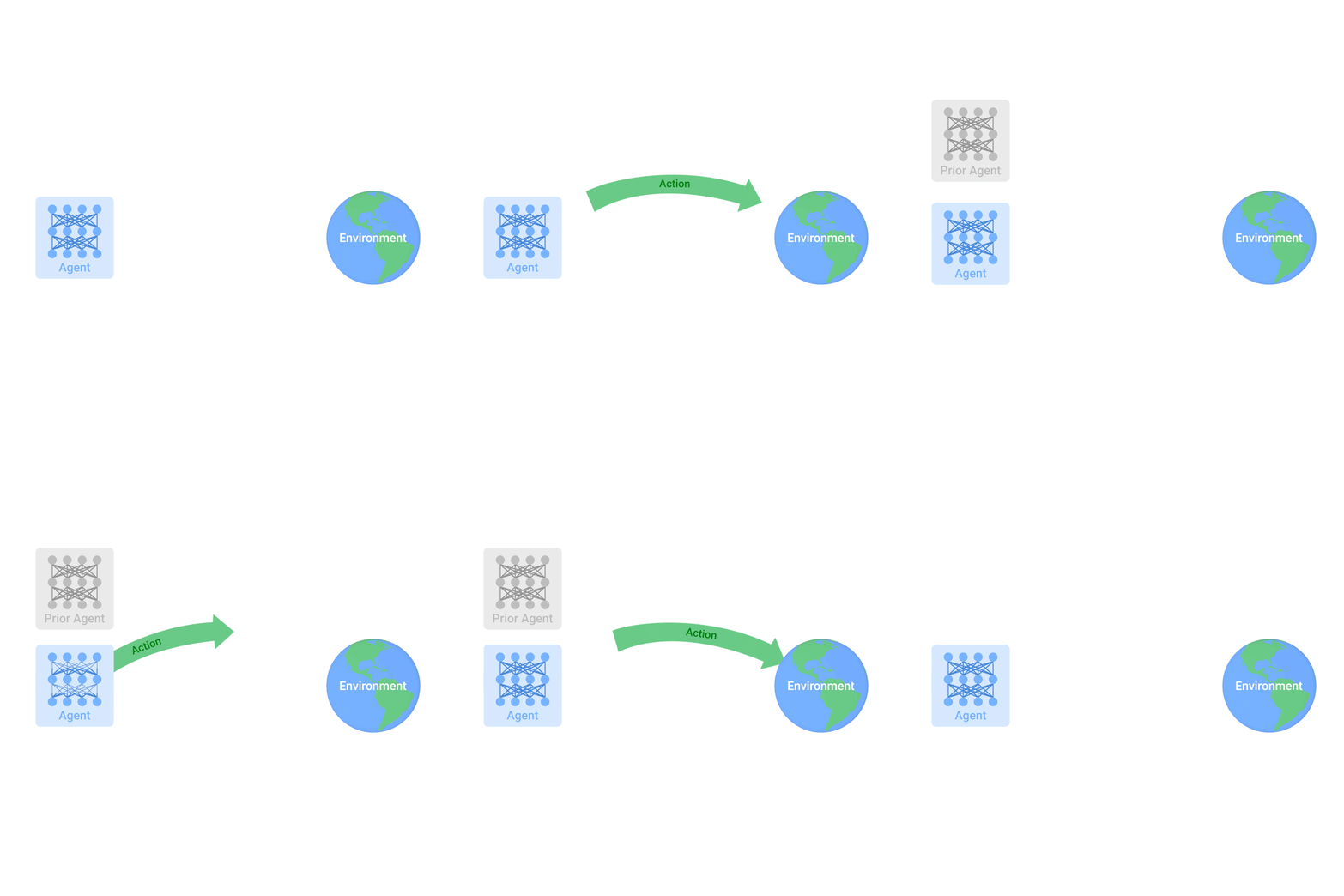
that focuses on training intelligent agents using related experiences so they can learn to solve decision making tasks, such as , and , that is, from scratch without using previously learned knowledge about the problem. However, in practice, tabula rasa RL systems are typically the exception rather than the norm for solving large-scale RL problems. Large-scale RL systems, such as , undergo multiple design changes (e.g., algorithmic or architectural changes) during their developmental cycle. This modification process can last months and necessitates incorporating such changes without re-training from scratch, which would be prohibitively expensive.
for 200M frames (the standard protocol) requires 1,000+ GPU days. As deep RL moves towards more complex and challenging problems, the computational barrier to entry in RL research will likely become even higher.To address the inefficiencies of tabula rasa RL, we present “. Here, we propose an alternative approach to RL research, where prior computational work, such as learned models, policies, logged data, etc., is reused or transferred between design iterations of an RL agent or from one agent to another. While some sub-areas of RL leverage prior computation, most RL agents are still largely trained from scratch. Until now, there has been no broader effort to leverage prior computational work for the training workflow in RL research. We have also released our to enable researchers to build on this work.
| or |
| RRL as an alternative research workflow. Imagine a researcher who has trained an agent A1 for some time, but now wants to experiment with better architectures or algorithms. While the tabula rasa workflow requires retraining another agent from scratch, RRL provides the more viable option of transferring the existing agent A1 to another agent and training this agent further, or simply fine-tuning A1. |
While there have been some ad hoc large-scale reincarnation efforts with limited applicability, e.g., , / .
Given the DQN (Adam) agent as a starting point, fine-tuning is restricted to the 3-layer ) and a better neural network architecture (
Overall, these results indicate that past research could have been accelerated by incorporating a RRL approach to designing agents, instead of re-training agents from scratch. Our , where we demonstrate that RRL allows us to make progress on the problem of navigating stratospheric balloons using only a few hours of TPU-compute by reusing a and for a broader discussion on scientific comparisons, generalizability and reproducibility in RRL. Overall, we hope that this work motivates researchers to release computational work (e.g., model checkpoints) on which others could directly build. In this regard, we have open-sourced with their final replay buffers. We believe that reincarnating RL can substantially accelerate research progress by building on prior computational work, as opposed to always starting from scratch.
Acknowledgements
This work was done in collaboration with Pablo Samuel Castro, Aaron Courville and Marc Bellemare. We’d like to thank Tom Small for the animated figure used in this post. We are also grateful for feedback by the anonymous NeurIPS reviewers and several members of the Google Research team, DeepMind and Mila.
Community-Analysen & Experten-Meinungen 0
Verwandte Story-Cluster & Quellen (Vektor-KI)
 Ähnliche Beiträge
Auch interessante Nachrichten Beyond Tabula Rasa: Reincarnating Reinforcement Learning
Thematisch verwandte Begriffe: Beyond, Tabula, Rasa, Reincarnating · 6 Treffer
How I Turned Self-XSS into Reflected XSS (and Bypassed the WAF)
Reverse Engineering Windows Security Center
Building Agentic RAG, Step by Step: From Static Retrieval to Reasoning Pipelines
Stripping safety guardrails from open-weight AI models is now a turnkey commercial service
Videos werden geladen ...
Beiträge werden geladen ...
Videos werden geladen ...
Beiträge werden geladen ...
Videos werden geladen ...
Beiträge werden geladen ...
Videos werden geladen ...
Beiträge werden geladen ...
Videos werden geladen ...
SOCIAL SHARE CARD GENERATOR