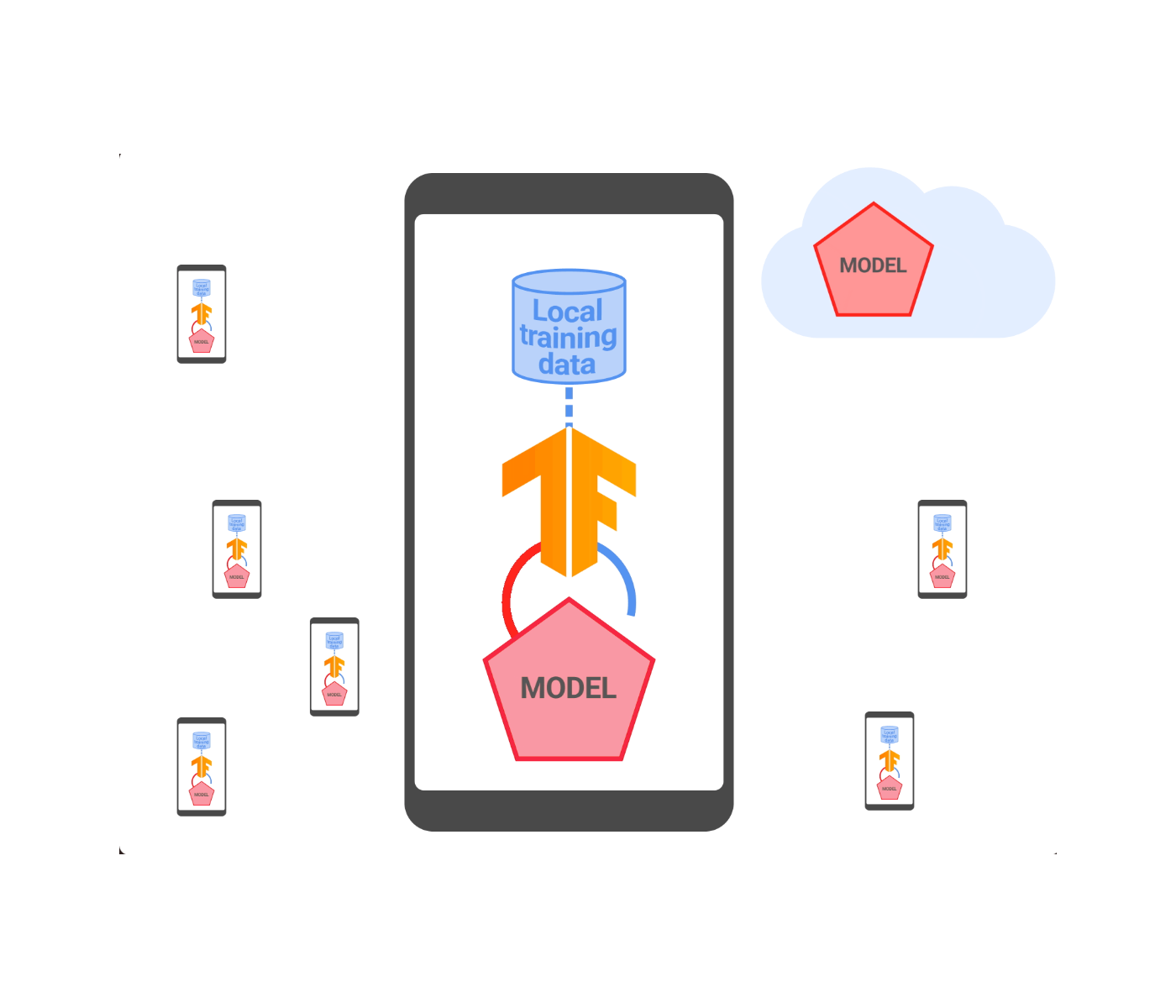
models, an Android feature that helps users select and copy text easily by predicting what text they want to select and then automatically expanding the selection for them.
(SecAgg) and a distributed version of differential privacy. In this post, we describe how we built and deployed the first federated learning system that provides formal privacy guarantees to all user data before it becomes visible to an honest-but-curious server, meaning a server that follows the protocol but could try to gain insights about users from data it receives. The Smart Text Selection models trained with this system have reduced memorization by more than two-fold, as measured by standard empirical testing methods.Scaling secure aggregation
Data minimization is an important privacy , client computation now scales logarithmically in N. This, along with similar gains in server costs, results in a protocol able to handle larger rounds. Having more users participate in each round improves privacy, both empirically and formally.
The above improvements made it easier and faster to train Smart Text Selection with stronger data minimization guarantees.
Aggregating everything via secure aggregation
A typical federated training system not only involves aggregating model updates but also metrics that describe the performance of the local training. These are important for understanding model behavior and debugging potential training issues. In federated training for Smart Text Selection, all model updates and metrics are aggregated via SecAgg. This behavior is , and locally enforced in Android’s (DP) comes in. DP is a mathematical framework that sets a limit on an individual's influence on the outcome of a computation, such as the parameters of a ML model. This is accomplished by bounding the contribution of any individual user and adding noise during the training process to produce a probability distribution over output models. DP comes with a parameter (ε) that quantifies how much the distribution could change when adding or removing the training examples of any individual user (the smaller the better).
Recently, we and
We tested our DDP solution on a variety of benchmark datasets and in production and validated that we can match the accuracy to central DP with a SecAgg finite group of size 12 bits per model parameter. This meant that we were able to achieve added privacy advantages while also reducing memory and communication bandwidth. To demonstrate this, we applied this technology to train and launch Smart Text Selection models. This was done with an appropriate amount of noise chosen to maintain model quality. All Smart Text Selection models trained with federated learning now come with DDP guarantees that apply to both the model updates and metrics seen by the server during training. We have also from the trained model. To get a more concrete understanding of the empirical privacy advantages, we performed thorough analyses by applying the Secret Sharer framework to Smart Text Selection models. Secret Sharer is a model auditing technique that can be used to measure the degree to which models unintentionally memorize their training data.
To perform Secret Sharer analyses for Smart Text Selection, we set up control experiments which collect gradients using SecAgg. The treatment experiments use distributed differential privacy aggregators with different amounts of noise.
We found that even low amounts of noise reduce memorization meaningfully, more than doubling the Secret Sharer rank metric for relevant canaries compared to the baseline. This means that even though the DP ε is large, we empirically verified that these amounts of noise already help reduce memorization for this model. However, to further improve on this and to get stronger formal guarantees, we aim to use even larger noise multipliers in the future.
Next steps
We developed and deployed the first federated learning and distributed differential privacy system that comes with formal DP guarantees with respect to an honest-but-curious server. While offering substantial additional protections, a fully malicious server might still be able to get around the DDP guarantees either by manipulating the public key exchange of SecAgg or by injecting a sufficient number of "fake" malicious clients that don’t add the prescribed noise into the aggregation pool. We are excited to address these challenges by continuing to strengthen the DP guarantee and its scope.
Acknowledgements
The authors would like to thank Adria Gascon for significant impact on the blog post itself, as well as the people who helped develop these ideas and bring them to practice: Ken Liu, Jakub Konečný, Brendan McMahan, Naman Agarwal, Thomas Steinke, Christopher Choquette, Adria Gascon, James Bell, Zheng Xu, Asela Gunawardana, Kallista Bonawitz, Mariana Raykova, Stanislav Chiknavaryan, Tancrède Lepoint, Shanshan Wu, Yu Xiao, Zachary Charles, Chunxiang Zheng, Daniel Ramage, Galen Andrew, Hugo Song, Chang Li, Sofia Neata, Ananda Theertha Suresh, Timon Van Overveldt, Zachary Garrett, Wennan Zhu, and Lukas Zilka. We’d also like to thank Tom Small for creating the animated figure.

SOCIAL SHARE CARD GENERATOR