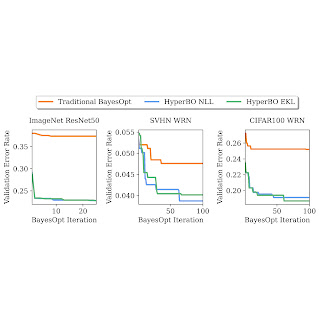
tasks, such as , , and even that are expensive to evaluate. A black-box function’s underlying mapping from inputs (configurations of the thing we want to optimize) to outputs (a measure of performance) is unknown. However, we can attempt to understand its internal workings by evaluating the function for different combinations of inputs. Because each evaluation can be computationally expensive, we need to find the best inputs in as few evaluations as possible. BayesOpt works by repeatedly constructing a surrogate model of the black-box function and strategically evaluating the function at the most promising or informative input location, given the information observed so far.
are popular surrogate models for BayesOpt because they are easy to use, can be updated with new data, and provide a confidence level about each of their predictions. The Gaussian process model constructs a ”, we consider the challenge of hyperparameter optimization for deep neural networks using BayesOpt. We propose Hyper BayesOpt (HyperBO), a highly customizable interface with an algorithm that removes the need for quantifying model parameters for Gaussian processes in BayesOpt. For new optimization problems, experts can simply select previous tasks that are relevant to the current task they are trying to solve. HyperBO pre-trains a Gaussian process model on data from those selected tasks, and automatically defines the model parameters before running BayesOpt. HyperBO enjoys theoretical guarantees on the alignment between the pre-trained model and the ground truth, as well as the quality of its solutions for black-box optimization. We share strong results of HyperBO both on ). We also demonstrate that HyperBO is robust to the selection of relevant tasks and has low requirements on the amount of data and tasks for pre-training.
(a commonly used divergence) between the ground truth model and the pre-trained model. Since the ground truth model is unknown, we cannot directly compute this loss function. To solve for this, we introduce two data-driven approximations: (1) Empirical –based methods like , described by the mean (m) and variance (s). Hence the loss function only has those two parameters, m and s, and we can visualize EKL and NLL as follows:
|

SOCIAL SHARE CARD GENERATOR