 Posted by Thad Starner (Professor, Georgia Tech and Staff Research Scientist, Google), Sam Sepah (ML Research Program Manager), Manfred Georg (Software Engineer, Google), Mark Sherwood (Senior Product Manager, Google), Glenn Cameron (Product Marketing Manager, Google)
around the world use sign language to communicate. Collectively, they use more than 300 different sign languages worldwide. And over 1.5 billion people are affected by hearing loss globally. Most Deaf and Hard of Hearing people cannot use their voice to initiate a search or perform actions due to speech limitations. Additionally, the interfaces used by smart home devices and mobile platforms to respond to speech are generally audio based.
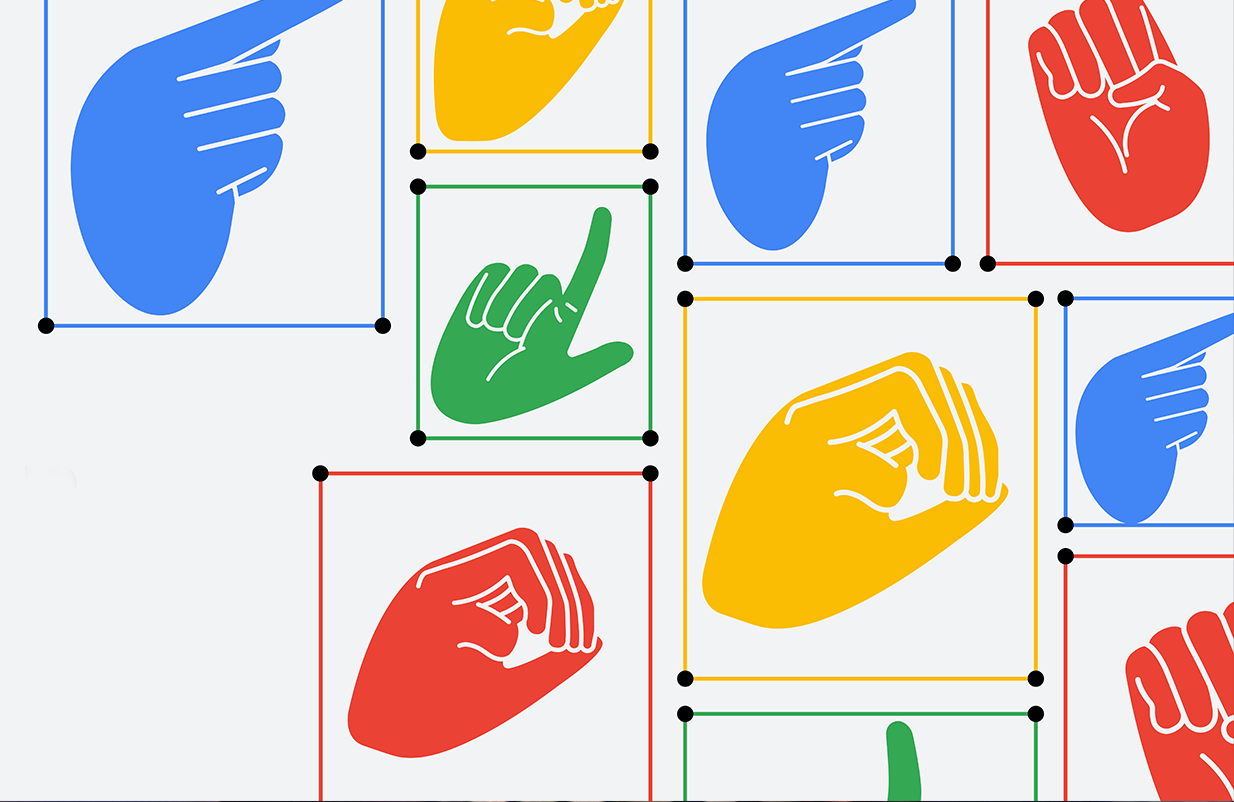
Signed languages are sophisticated systems of communication, each with a complete set of language features. On a surface level, handshapes along with four other "parameters" form the basis of signed communication. An open hand or a closed hand while making the same motion can completely change the meaning of a sign. Likewise, palm orientation, motion/contact, location, and non-manual markers (typically mouth movements and facial expressions) define individual signs. A number of grammatical constructs, some of which have no analog in spoken languages, allow a signer to produce complex phrases.
As we develop translation systems for American Sign Language (ASL) and other sign languages, it is natural to break apart various aspects of the language and attempt to perform tasks using those parts.
To that end, we’re excited to announce the release of one of the largest datasets of ASL fingerspelling and a to help us make AI more accessible for the Deaf and hard of hearing community.

SOCIAL SHARE CARD GENERATOR