Figure 1: stepwise behavior in self-supervised learning. When training common SSL algorithms, we find that the loss descends in a stepwise fashion (top left) and the learned embeddings iteratively increase in dimensionality (bottom left). Direct visualization of embeddings (right; top three PCA directions shown) confirms that embeddings are initially collapsed to a point, which then expands to a 1D manifold, a 2D manifold, and beyond concurrently with steps in the loss.
It is widely believed that deep learning’s stunning success is due in part to its ability to discover and extract useful representations of complex data. Self-supervised learning (SSL) has emerged as a leading framework for learning these representations for images directly from unlabeled data, similar to how LLMs learn representations for language directly from web-scraped text. Yet despite SSL’s key role in state-of-the-art models such as , fundamental questions like “what are self-supervised image systems really learning?” and “how does that learning actually occur?” lack basic answers.
Our loss function under gradient flow for the special case of a linear model \(\mathbf{f}(\mathbf{x}) = \mathbf{W} \mathbf{x}\). To sketch our findings here, we find that, when initialization is small, the model learns representations composed precisely of the top-\(d\) eigendirections of the featurewise cross-correlation matrix \(\boldsymbol{\Gamma} \equiv \mathbb{E}_{\mathbf{x},\mathbf{x}’} [ \mathbf{x} \mathbf{x}’^T ]\). What’s more, we find that these eigendirections are learned one at a time in a sequence of discrete learning steps at times determined by their corresponding eigenvalues. Figure 2 illustrates this learning process, showing both the growth of a new direction in the represented function and the resulting drop in the loss at each learning step. As an extra bonus, we find a closed-form equation for the final embeddings learned by the model at convergence.
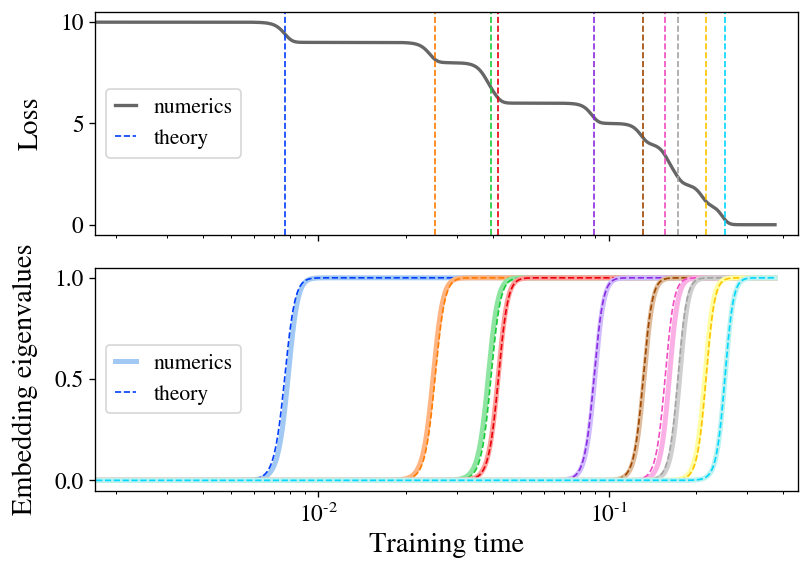
Figure 2: stepwise learning appears in a linear model of SSL. We train a linear model with the Barlow Twins loss on a small sample of CIFAR-10. The loss (top) descends in a staircase fashion, with step times well-predicted by our theory (dashed lines). The embedding eigenvalues (bottom) spring up one at a time, closely matching theory (dashed curves).
Our finding of stepwise learning is a manifestation of the broader concept of spectral bias, which is the observation that many learning systems with approximately linear dynamics preferentially learn eigendirections with higher eigenvalue. This has recently been well-studied in the case of standard supervised learning, where it’s been found that higher-eigenvalue eigenmodes are learned faster during training. Our work finds the analogous results for SSL.
The reason a linear model merits careful study is that, as shown via the “neural tangent kernel” (, which is joint work with Maksis Knutins, Liu Ziyin, Daniel Geisz, and Joshua Albrecht. This work was conducted with . We’d be delighted to field your questions or comments.

SOCIAL SHARE CARD GENERATOR