🕵️ SicherheitslückenHak5: Hackers Just Poisoned the Rust Supply Chain | Threat Wire(01.09.2026 um 14:00 Uhr)
🕵️ SicherheitslückenHak5: Hackers Found a Way Into Humanoid Robots | Threat Wire(04.09.2026 um 15:04 Uhr)
🔧 AI Nachrichten Bits und so #1021 (Passwort für Laufwerk)(31.08.2026 um 22:15 Uhr)
🔧 AI Nachrichten Bits und so #1022 (Wie Weißbier)(06.09.2026 um 20:39 Uhr)
🍏 iOS / Mac OSHue-App 6.0 ist da: das sind die Neuerungen(07.09.2026 um 17:21 Uhr)
🕵️ SicherheitslückenHak5: Hackers Just Poisoned the Rust Supply Chain | Threat Wire(01.09.2026 um 14:00 Uhr)
🕵️ SicherheitslückenHak5: Hackers Found a Way Into Humanoid Robots | Threat Wire(04.09.2026 um 15:04 Uhr)
🔧 AI Nachrichten Bits und so #1021 (Passwort für Laufwerk)(31.08.2026 um 22:15 Uhr)
🔧 AI Nachrichten Bits und so #1022 (Wie Weißbier)(06.09.2026 um 20:39 Uhr)
🍏 iOS / Mac OSHue-App 6.0 ist da: das sind die Neuerungen(07.09.2026 um 17:21 Uhr)

🎥 Künstliche Intelligenz Videos 🕛 kürzlich 9 Min Lesezeit
0

Pre-processing temporal data made easier with TensorFlow Decision Forests and Temporian

↗ Quelle (blog.tensorflow.org)
🗣️ Stimme:
📑 Inhaltsübersicht


Posted by Google: Mathieu Guillame-Bert, Richard Stotz, Robert Crowe, Luiz GUStavo Martins (Gus), Ashley Oldacre, Kris Tonthat, Glenn Cameron, and Tryolabs: Ian Spektor, Braulio Rios, Guillermo Etchebarne, Diego Marvid, Lucas Micol, Gonzalo Marín, Alan Descoins, Agustina Pizarro, Lucía Aguilar, Martin Alcala Rubi

is a new open-source Python library for preprocessing and feature engineering temporal data for machine learning applications. It is developed in collaboration between Google and for more details.


This blog post demonstrates how to train a forecasting model on transactional data. Specifically, we will show how to forecast the total weekly sales from individual sales records. For the modeling part, we will use , a newly released library designed for ingesting and aggregating transactional data from multiple non-synchronized sources.

ALT TEXT


Time series are the most commonly used representation for temporal data. They consist of uniformly sampled values, which can be useful for representing aggregate signals. However, time series are sometimes not sufficient to represent the richness of available data. Instead, multivariate time series can represent multiple signals together, while time sequences or event sets can represent non-uniformly sampled measurements. Multi-index time sequences can be used to represent relations between different time sequences. In this blog post, we will use the multivariate multi-index time sequence, also known as event sets. Don’t worry, they’re not as complex as they sound.


Examples of temporal data include:

  • Weather and other environmental data for weather forecasting, soil profile forecasting and crop yield optimization, temperature tracking, and climate change characterization.

  • Sensory data for quality monitoring, and predictive maintenance.

  • Health data for early treatment, personalized medicine, and epidemic detection.

  • Retail customer data for sales forecasting, sales optimization, and targeted advertising.

  • Banking customer data for fraud detection and loan risk analysis.

  • Economic and financial data for risk analysis, budgetary analysis, stock market analysis, and yield projections.


A simple example


Let's start with a simple example. We have collected sales records from a fictitious online shop. Each time a client makes a purchase, we record the following information: time of the purchase, client id, product purchased, and price of the product.


The dataset is stored in a single CSV file, with one transaction per line:


$ head -n 5 sales.csv
timestamp,client,product,price
2010-10-05 11:09:56,c64,p35,405.35
2010-09-27 15:00:49,c87,p29,605.35
2010-09-09 12:58:33,c97,p10,108.99
2010-09-06 12:43:45,c60,p85,443.35

Looking at data is crucial to understand the data and spot potential issues. Our first task is to load the sales data into an is a general-purpose container for temporal data. It can represent multivariate time series, time sequences, and indexed data.


# Import Temporian
import temporian as tp

# Load the csv dataset
sales = tp.from_csv("/tmp/sales.csv")

# Print details about the EventSet
sales

This code snippet load and print the data:


operator.


weekly_sales = sales["price"].moving_sum(tp.duration.days(7))

weekly_sales.plot()

ALT TEXT

BONUS: To make the plots interactive, you can add the interactive=True argument to the plot function. 


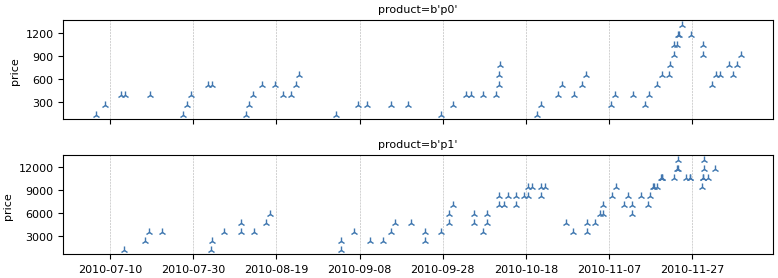
Sales per products


In the previous step, we computed the overall moving sum of sales for the entire shop. However, what if we wanted to calculate the rolling sum of sales for each product or client separately?


For this task, we can use an index.

# Index the data by "product"
sales_per_product = sales.add_index("product")

# Compute the moving sum for each product
weekly_sales_per_product = sales_per_product["price"].moving_sum(
        tp.duration.days(7)
)

# Plot the results
weekly_sales_per_product.plot()


ALT TEXT


NOTE: Many operators such as

Train a forecasting model with TensorFlow model


A key application of Temporian is to clean data and perform feature engineering for machine learning models. It is well suited for forecasting, anomaly detection, fraud detection, and other tasks where data comes continuously.


In this example, we show how to train a TensorFlow model to predict the next day's sales using past sales for each product individually. We will feed the model various levels of aggregations of sales as well as calendar information.


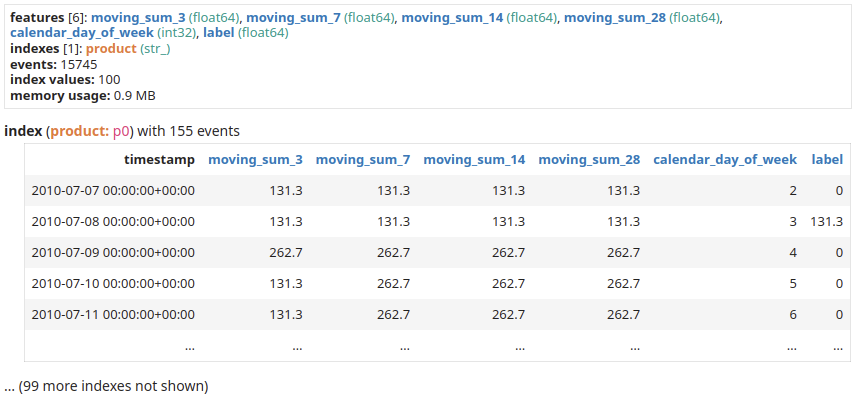
Let's first augment our dataset and convert it to a dataset compatible with a tabular ML model.

sales_per_product = sales.add_index("product")

# Create one example per day
daily_sampling = sales_per_product.tick(tp.duration.days(1))

# Compute moving sums with various window length.
# Machine learning models are able to select the ones that matter.

features = []
for w in [3, 7, 14, 28]:
features.append(sales_per_product["price"]
.moving_sum(
tp.duration.days(w),
sampling=daily_sampling)
.rename(f"moving_sum_{w}"))

# Calendar information such as the day of the week are
# very informative of human activities.
features.append(daily_sampling.calendar_day_of_week())

# The label is the daly sales shifted / leaked one days in the future.
label = (sales_per_product["price"]
.leak(tp.duration.days(1))
.moving_sum(
tp.duration.days(1),
sampling=daily_sampling,
)
.rename("label"))

# Collect the features and labels together.
dataset = tp.glue(*features, label)

dataset


ALT TEXT


We can then convert the dataset from EventSet to TensorFlow Dataset format, and train a Random Forest.

import tensorflow_decision_forests as tfdf

def extract_label(example):
example.pop("timestamp") # Don't use use the timestamps as feature
label = example.pop("label")
return example, label

tf_dataset = tp.to_tensorflow_dataset(dataset).map(extract_label).batch(100)

model = tfdf.keras.RandomForestModel(task=tfdf.keras.Task.REGRESSION,verbose=2)
model.fit(tf_dataset)


And that’s it, we have a model trained to forecast sales. We now can look at the variable importance of the model to understand what features matter the most.


model.summary()

In the summary, we can find the . Notably:


  • Heart rate analysis ❤️ detects individual heartbeats and derives heart rate related features on raw ECG signals from Physionet.

  • M5 Competition 🛒 predicts retail sales in the M5 Makridakis Forecasting competition.

  • Loan outcomes prediction 🏦 prepares relational SQL data to predict outcomes for finished loans.

  • Detecting payment card fraud 💳 detects fraudulent payment card transactions in real time.

  • Supervised and unsupervised anomaly detection 🔎 perform data analysis and feature engineering to detect anomalies in a group of server’s resource usage metrics.


Next Steps


We demonstrated how to handle temporal data such as transactions in TensorFlow using the Temporian library. Now you can try it too!


  • Join for a quick introduction.

  • Check the .

To learn more about model training with TensorFlow Decision Forests:


  • Visit the .

  • Check the .

Vollständiger Original-Bericht
Ausführliche Details, Code-Beispiele & Hersteller-Stellungnahme auf blog.tensorflow.org.
↗ Original-Artikel auf blog.tensorflow.org lesen
Wie bewertest du diesen Beitrag?
1 Klick Feedback
Teilen mit Netzwerk & Team:

Community-Analysen & Experten-Meinungen 0

Verfasse deine eigene Analyse, teile Workarounds oder diskutiere diesen Vorfall im Blog.
Noch keine Community-Analyse verfasst. Markiere einen Textabschnitt oder klicke oben auf Eigene Analyse verfassen“!
Community Pulse: Relevanz-Einschätzung
1 Klick Experten-Votum
🔴 Akute Relevanz 0%
🟡 In Evaluierung 0%
🟢 Keine Auswirkung 0%
Spannende Innovation 0%
Verwandte Story-Cluster & Quellen (Vektor-KI)
Port 8095 Engine
1 Quelle
Hackers Just Poisoned the Rust Supply Chain | Threat Wire
1 Quelle
Hackers Found a Way Into Humanoid Robots | Threat Wire
1 Quelle
Bits und so #1021 (Passwort für Laufwerk)
Ähnliche Beiträge
🔍 Verwandte News

Auch interessante Nachrichten Pre-processing temporal data made easier with TensorFlow Decision Forests and Temporian

Thematisch verwandte Begriffe: Preprocessing, temporal, data, made · 6 Treffer

Laden...

Videos werden geladen ...

Laden...

Beiträge werden geladen ...

Laden...

Videos werden geladen ...

Laden...

Beiträge werden geladen ...

Laden...

Videos werden geladen ...

Laden...

Beiträge werden geladen ...

Laden...

Videos werden geladen ...

Laden...

Beiträge werden geladen ...

Laden...

Videos werden geladen ...

🔖 Gespeicherte Artikel
📂 Keine gespeicherten Artikel vorhanden.
📂 News ⏱️ 3 Min vor 10 Min
Artikeldaten werden geladen...

↗ Original-Quelle
Zum Aktualisieren ziehen
ZERO-DAY Kritische Sicherheitsmeldung
Advisory →
TTS Reader • tsecurity.de Voice
tsecurity.de Icon
tsecurity.de App
Offline-Lesen, Eilmeldungen & 0ms Ladezeit

Installiere tsecurity.de direkt auf deinen Home-Bildschirm für das ultimative Vollbild-Magazinerlebnis ohne Browser-Leisten.

Nächster Beitrag
🤖
Community Radar & Live Chat
Sentinel Bot online • Live-Stream
Dein Cluster: Security Explorer
👥 Match:
lädt…
Verbindung zum Community-Stream wird aufgebaut...
📡 Aktivitäten deiner Analysten
lädt…
💡 Neues Thema oder Eilmeldung einreichen

Reiche interessante Links, Zero-Days oder Debatten ein. Die Community entscheidet per Upvote über die Veröffentlichung.

🔥 Heiß diskutierte Einreichungen