
🕵️ SicherheitslückenHak5: Hackers Just Poisoned the Rust Supply Chain | Threat Wire(01.09.2026 um 14:00 Uhr)
🕵️ SicherheitslückenHak5: Hackers Found a Way Into Humanoid Robots | Threat Wire(04.09.2026 um 15:04 Uhr)
🔧 AI Nachrichten Bits und so #1021 (Passwort für Laufwerk)(31.08.2026 um 22:15 Uhr)
🔧 AI Nachrichten Bits und so #1022 (Wie Weißbier)(06.09.2026 um 20:39 Uhr)
🍏 iOS / Mac OSHue-App 6.0 ist da: das sind die Neuerungen(07.09.2026 um 17:21 Uhr)
🕵️ SicherheitslückenHak5: Hackers Just Poisoned the Rust Supply Chain | Threat Wire(01.09.2026 um 14:00 Uhr)
🕵️ SicherheitslückenHak5: Hackers Found a Way Into Humanoid Robots | Threat Wire(04.09.2026 um 15:04 Uhr)
🔧 AI Nachrichten Bits und so #1021 (Passwort für Laufwerk)(31.08.2026 um 22:15 Uhr)
🔧 AI Nachrichten Bits und so #1022 (Wie Weißbier)(06.09.2026 um 20:39 Uhr)
🍏 iOS / Mac OSHue-App 6.0 ist da: das sind die Neuerungen(07.09.2026 um 17:21 Uhr)

🎥 Künstliche Intelligenz Videos 🕛 kürzlich 4 Min Lesezeit
0

Distributed Fast Fourier Transform in TensorFlow

↗ Quelle (blog.tensorflow.org)
🗣️ Stimme:
📑 Inhaltsübersicht


Posted by

is an important method of signal processing, which is commonly used in a number of ways, including speeding up convolutions, extracting features, and regularizing models. Distributed Fast Fourier Transform (Distributed FFT) offers a way to compute Fourier Transforms in models that work with image-like datasets that are too large to fit into the memory of a single accelerator device. In a previous Google Research Paper, “ is an extension to TensorFlow for synchronous distributed computing. It distributes the program and tensors through a procedure called . The output of a distributed FFT becomes sharded too.

import TensorFlow as tf
from TensorFlow.experimental import dtensor


# Set up devices
device_type = dtensor.preferred_device_type()
if device_type == 'CPU':
cpu = tf.config.list_physical_devices(device_type)
tf.config.set_logical_device_configuration(cpu[0], [tf.config.LogicalDeviceConfiguration()] * 8)
if device_type == 'GPU':
gpu = tf.config.list_physical_devices(device_type)
tf.config.set_logical_device_configuration(gpu[0], [tf.config.LogicalDeviceConfiguration(memory_limit=1000)] * 8)
dtensor.initialize_accelerator_system()


# Create a mesh
mesh = dtensor.create_distributed_mesh(mesh_dims=[('x', 1), ('y', 2), ('z', 4)], device_type=device_type)


# Set up a distributed input Tensor
input = tf.complex(
tf.random.stateless_normal(shape=(2, 2, 4), seed=(1, 2), dtype=tf.float32),
tf.random.stateless_normal(shape=(2, 2, 4), seed=(2, 4), dtype=tf.float32))
init_layout = dtensor.Layout(['x', 'y', 'z'], mesh)
d_input = dtensor.relayout(input, layout=init_layout)


# Run distributed fft2d. DTensor determines the most efficient
#
layout of of d_output.
d_output = tf.signal.fft2d(d_input)


Performance Analysis


The following experiment demonstrates that the distributed FFT can process more data than the non-distributed one by utilizing memory across multiple devices. The tradeoff is spending additional time on communication and data transposes that slow down the calculation speed.
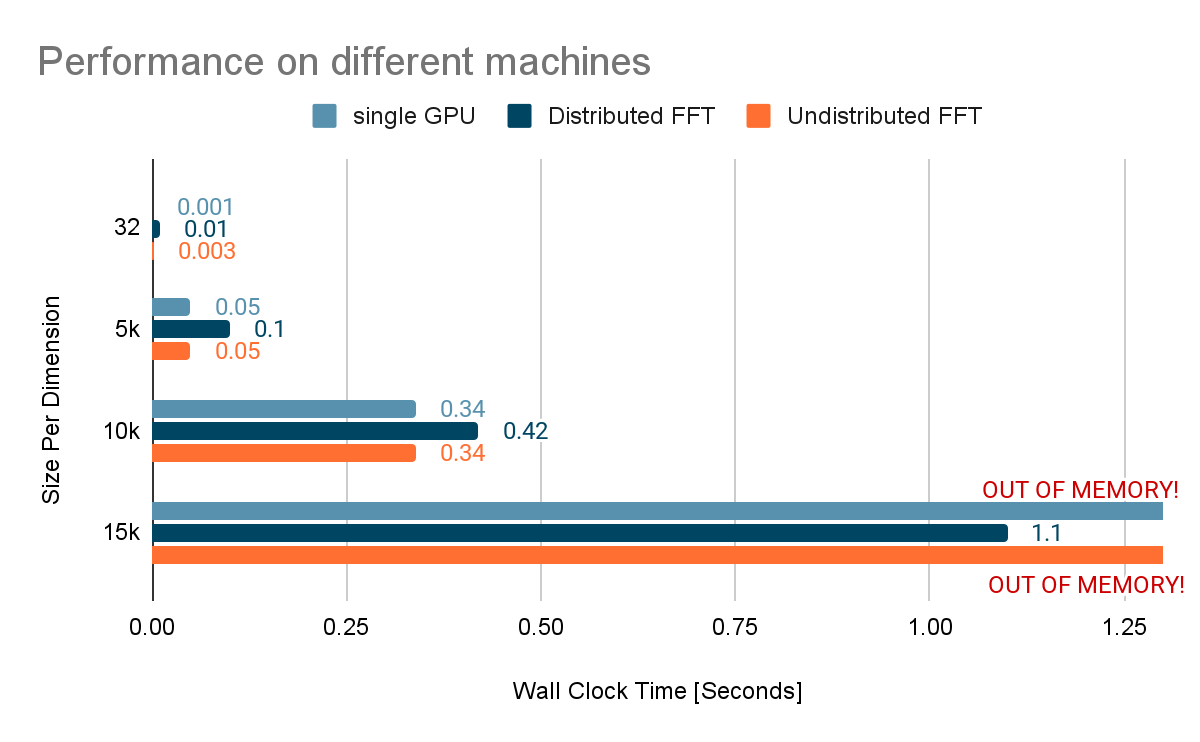


Graph of performance on different machines, measuri8ng wall clock time in seconds by size per dimension across single GPU, Distributed FFT and Undistributed FFT


This phenomenon is shown in detail from the profiling result of the 10K*10K distributed FFT experiment. The current implementation of distributed FFT in TensorFlow follows the simple shuffle+local FFT method, which is also used by other popular distributed FFT libraries such as . Notably, the two local FFT ops only take 3.6% of the total time (15ms). This is around 1/3 of the time for non-distributed fft2d. Most of the computing time is spent on data shuffling, represented by the ncclAllToAll Operation. Note that these experiments were conducted on an 8xV100 GPU system.
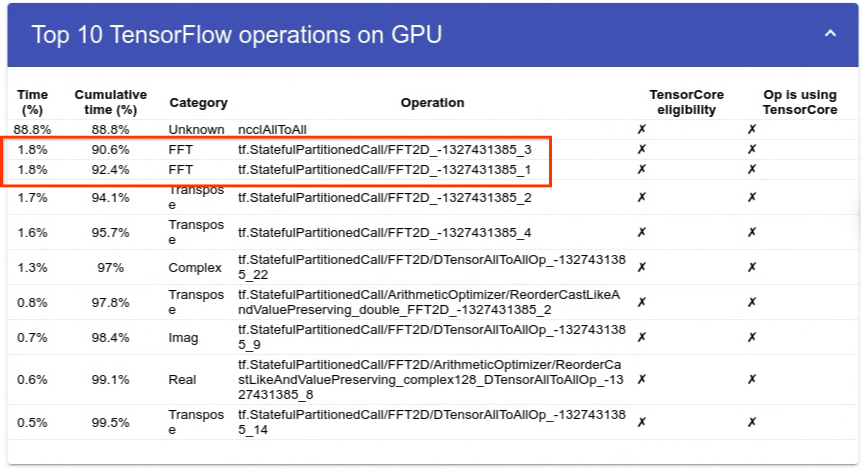


Table of Top 10 TensorFlow operations on GPU highlighting two local FFT ops in the top 3


Next steps


The feature is new and we have adopted a simplest distributed FFT algorithm. A few ideas to fine tune or improve the performance are:


  • Switch to a different DFT/FFT algorithm.

  • Tweaks on the NCCL communication settings for the particular FFT sizes may improve utilization of the network bandwidth and increase the speed.

  • Reducing the number of collectives to minimize bandwidth requirements.

  • Use N-d local FFTs, rather than multiple 1-d local FFTs.


Try the new distributed FFT! We welcome your feedback on the TensorFlow Forum and look forward to working with you on improving the performance. Your input would be invaluable!

Vollständiger Original-Bericht
Ausführliche Details, Code-Beispiele & Hersteller-Stellungnahme auf blog.tensorflow.org.
↗ Original-Artikel auf blog.tensorflow.org lesen
Wie bewertest du diesen Beitrag?
1 Klick Feedback
Teilen mit Netzwerk & Team:

Community-Analysen & Experten-Meinungen 0

Verfasse deine eigene Analyse, teile Workarounds oder diskutiere diesen Vorfall im Blog.
Noch keine Community-Analyse verfasst. Markiere einen Textabschnitt oder klicke oben auf Eigene Analyse verfassen“!
Community Pulse: Relevanz-Einschätzung
1 Klick Experten-Votum
🔴 Akute Relevanz 0%
🟡 In Evaluierung 0%
🟢 Keine Auswirkung 0%
Spannende Innovation 0%
Verwandte Story-Cluster & Quellen (Vektor-KI)
Port 8095 Engine
1 Quelle
Hackers Just Poisoned the Rust Supply Chain | Threat Wire
1 Quelle
Hackers Found a Way Into Humanoid Robots | Threat Wire
1 Quelle
Bits und so #1021 (Passwort für Laufwerk)
Ähnliche Beiträge
🔍 Verwandte News

Auch interessante Nachrichten Distributed Fast Fourier Transform in TensorFlow

Thematisch verwandte Begriffe: Distributed, Fast, Fourier, Transform · 6 Treffer

Laden...

Videos werden geladen ...

Laden...

Beiträge werden geladen ...

Laden...

Videos werden geladen ...

Laden...

Beiträge werden geladen ...

Laden...

Videos werden geladen ...

Laden...

Beiträge werden geladen ...

Laden...

Videos werden geladen ...

Laden...

Beiträge werden geladen ...

Laden...

Videos werden geladen ...