From the theory of the original academic paper to its Python implementation with OpenAI, Weaviate, and LangChain
Since the realization that you can supercharge large language models (LLMs) with your proprietary data, there has been some discussion on how to most effectively bridge the gap between the LLM’s general knowledge and your proprietary data. There has been a lot of debate around for orchestration, vector database.
What is Retrieval-Augmented Generation
Retrieval-Augmented Generation (RAG) is the concept to provide LLMs with additional information from an external knowledge source. This allows them to generate more accurate and contextual answers while reducing hallucinations.
Problem
State-of-the-art LLMs are trained on large amounts of data to achieve a broad spectrum of general knowledge stored in the neural network's weights (parametric memory). However, prompting an LLM to generate a completion that requires knowledge that was not included in its training data, such as newer, proprietary, or domain-specific information, can lead to factual inaccuracies (hallucinations), as illustrated in the following screenshot:
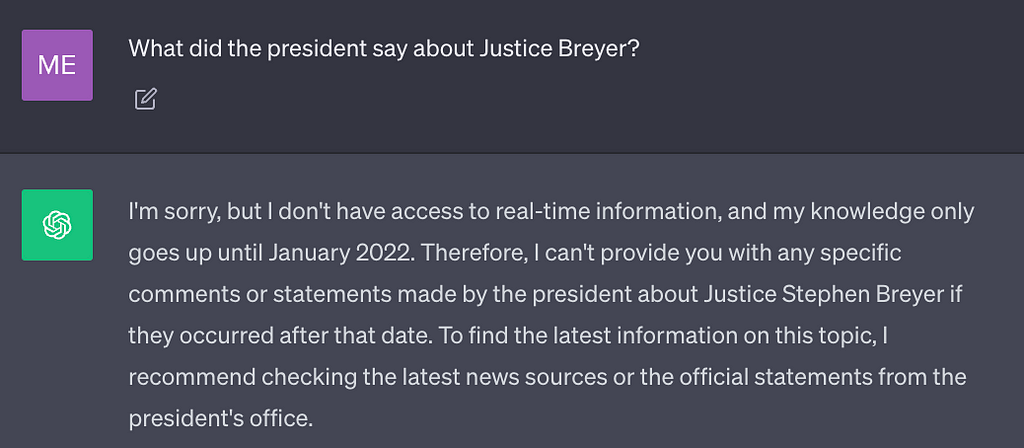
Thus, it is important to bridge the gap between the LLM’s general knowledge and any additional context to help the LLM generate more accurate and contextual completions while reducing hallucinations.
Solution
Traditionally, neural networks are adapted to domain-specific or proprietary information by fine-tuning the model. Although this technique is effective, it is also compute-intensive, expensive, and requires technical expertise, making it less agile to adapt to evolving information.
In 2020, Lewis et al. proposed a more flexible technique called Retrieval-Augmented Generation (RAG) in the paper .)
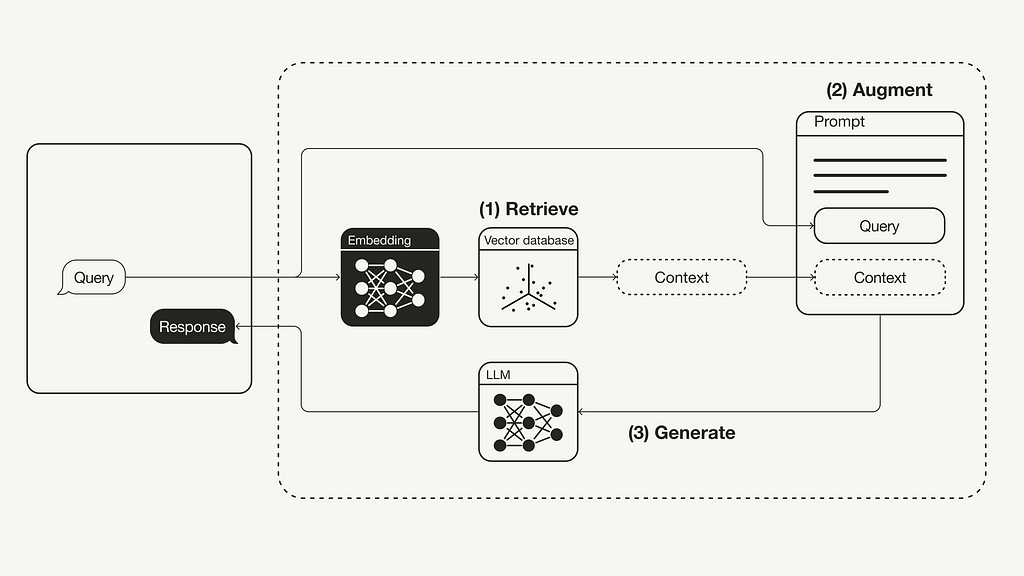
The vanilla RAG workflow is illustrated below:
- Retrieve: The user query is used to retrieve relevant context from an external knowledge source. For this, the user query is embedded with an embedding model into the same vector space as the additional context in the vector database. This allows to perform a similarity search, and the top k closest data objects from the vector database are returned.
- Augment: The user query and the retrieved additional context are stuffed into a prompt template.
- Generate: Finally, the retrieval-augmented prompt is fed to the LLM.
Retrieval-Augmented Generation Implementation using LangChain
This section implements a RAG pipeline in Python using an vector database and an is used for orchestration.
If you are unfamiliar with LangChain or Weaviate, you might want to check out the following two articles:
Prerequisites
Make sure you have installed the required Python packages:
- langchain for orchestration
- openai for the embedding model and LLM
- weaviate-client for the vector database
#!pip install langchain openai weaviate-client
Additionally, define your relevant environment variables in a .env file in your root directory. To obtain an OpenAI API Key, you need an OpenAI account and then “Create new secret key” under as additional context. The raw text document is available in s. A Document is a dictionary with text and metadata. To load text, you will use LangChain’s TextLoader.
import requests
from langchain.document_loaders import TextLoader

url = "https://raw.githubusercontent.com/langchain-ai/langchain/master/docs/docs/modules/state_of_the_union.txt"
res = requests.get(url)
with open("state_of_the_union.txt", "w") as f:
    f.write(res.text)

loader = TextLoader('./state_of_the_union.txt')
documents = loader.load()
Next, chunk your documents — Because the Document, in its original state, is too long to fit into the LLM’s context window, you need to chunk it into smaller pieces. LangChain comes with many built-in [1] from 2020. After covering some theory behind the concept, including motivation and problem solution, this article converted its implementation in Python. This article implemented a RAG pipeline using an vector database and an was used for orchestration.
Enjoyed This Story?
Find me on , and was originally published in Towards Data Science on Medium, where people are continuing the conversation by highlighting and responding to this story.

SOCIAL SHARE CARD GENERATOR