



As I was working on another email part of my Modern Ruby course via email I wanted to make some micro benchmarks on Data.define vs Struct vs OpenStruct
They are not a production-level benchmark, so take them with a grain of salt.
I added all code and results in a repo at https://github.com/lucianghinda/value-object-in-ruby-benchmarks
Creating new objects
When creating a new object, Struct (with keyword_init: true)and Data.define behave almost the same (the differences are with error margin or so small that they are probably due to my setup), while OpenStruct seems to be the slowest.
Having defines the following keys and values:
keys = 1000.times.map { |i| "key#{i}".to_sym }

values = 1000.times.map { |i| "value#{i}" }

keys_and_values = Hash[keys.zip(values)]
The creation benchmarks are testing the following code:
DataStruct = Struct.new(*keys, keyword_init: true)

DataStruct.new(**keys_and_values)


# vs


DataDefine = Data.define(*keys)

DataDefine.new(**keys_and_values)


# vs


OpenStruct.new(**keys_and_values)
Here is a `bmbm` benchmark result:
Creating a new object - Benchmark with bmbm

Rehearsal --------------------------------------------------

Struct.new       0.000023   0.000003   0.000026 (  0.000024)

Data.define      0.000020   0.000001   0.000021 (  0.000022)

OpenStruct.new   0.001705   0.000075   0.001780 (  0.001780)

----------------------------------------- total: 0.001827sec


                     user     system      total        real

Struct.new       0.000020   0.000000   0.000020 (  0.000020)

Data.define      0.000022   0.000000   0.000022 (  0.000022)

OpenStruct.new   0.001069   0.000044   0.001113 (  0.001132)
Here is the ibs benchmark result:
Creating a new object - Benchmark with ips

ruby 3.3.0 (2023-12-25 revision 5124f9ac75) [arm64-darwin23]

Warming up --------------------------------------

          Struct.new     5.169k i/100ms

         Data.define     5.361k i/100ms

      OpenStruct.new    62.000 i/100ms

Calculating -------------------------------------

          Struct.new     50.086k (± 1.7%) i/s -    253.281k in   5.058450s

         Data.define     51.646k (± 1.1%) i/s -    262.689k in   5.086990s

      OpenStruct.new    607.447 (± 0.8%) i/s -      3.038k in   5.001584s


Comparison:

         Data.define:    51646.3 i/s

          Struct.new:    50085.7 i/s - 1.03x  slower

      OpenStruct.new:      607.4 i/s - 85.02x  slower
Here is the memory benchmark result.
Creating a new object - Benchmark with ips

Calculating -------------------------------------

          Struct.new    36.792k memsize (     0.000  retained)

                         2.000  objects (     0.000  retained)

                         0.000  strings (     0.000  retained)

         Data.define    36.792k memsize (     0.000  retained)

                         2.000  objects (     0.000  retained)

                         0.000  strings (     0.000  retained)

      OpenStruct.new   848.728k memsize (     0.000  retained)

                         8.005k objects (     0.000  retained)

                        50.000  strings (     0.000  retained)


Comparison:

          Struct.new:      36792 allocated

         Data.define:      36792 allocated - same

      OpenStruct.new:     848728 allocated - 23.07x more
Accessing attributes
Again Data.define and Struct with keyword arguments are the same. On the other side OpenStruct is almost twice as slow.
Having the following data defined:
keys = 1000.times.map { |i| "key#{i}".to_sym }

values = 1000.times.map { |i| "value#{i}" }

keys_and_values = Hash[keys.zip(values)]
And then defining the following structures:
BigDataS = Struct.new(*keys, keyword_init: true)

BigDataD = Data.define(*keys)
The benchmarks are comparing:
keys.each { struct_object.send(_1) }


keys.each { data_object.send(_1) }


keys.each { opens_struct_object.send(_1) }
Here is the bmbm benchmark result:
Accessing attributes - bmbm test

Rehearsal -----------------------------------------------

Struct        0.000069   0.000002   0.000071 (  0.000071)

Data.define   0.000069   0.000003   0.000072 (  0.000071)

OpenStruct    0.000110   0.000003   0.000113 (  0.000116)

-------------------------------------- total: 0.000256sec


                  user     system      total        real

Struct        0.000049   0.000001   0.000050 (  0.000046)

Data.define   0.000046   0.000001   0.000047 (  0.000046)

OpenStruct    0.000091   0.000001   0.000092 (  0.000094)
Here is the ibs benchmark result:
Accessing attributes - ips test

ruby 3.3.0 (2023-12-25 revision 5124f9ac75) [arm64-darwin23]

Warming up --------------------------------------

              Struct     2.857k i/100ms

         Data.define     2.828k i/100ms

          OpenStruct     1.384k i/100ms

Calculating -------------------------------------

              Struct     28.420k (± 0.9%) i/s -    142.850k in   5.026906s

         Data.define     28.691k (± 0.5%) i/s -    144.228k in   5.027131s

          OpenStruct     13.475k (± 0.9%) i/s -     67.816k in   5.033315s


Comparison:

         Data.define:    28690.8 i/s

              Struct:    28419.6 i/s - same-ish: difference falls within error

          OpenStruct:    13474.6 i/s - 2.13x  slower
Context for understanding why Data.define and Struct are similar
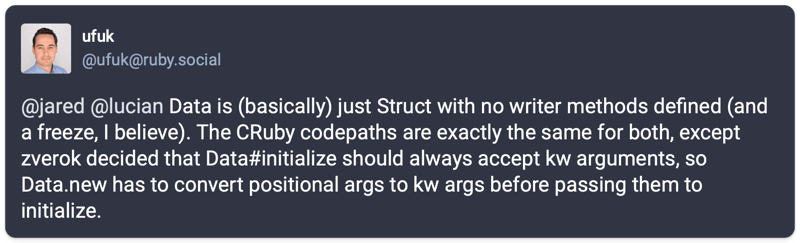
Ufuk Kayserilioglu explains why Data.define and Struct with keyword arguments have the same behavior:
A note about OpenStruct
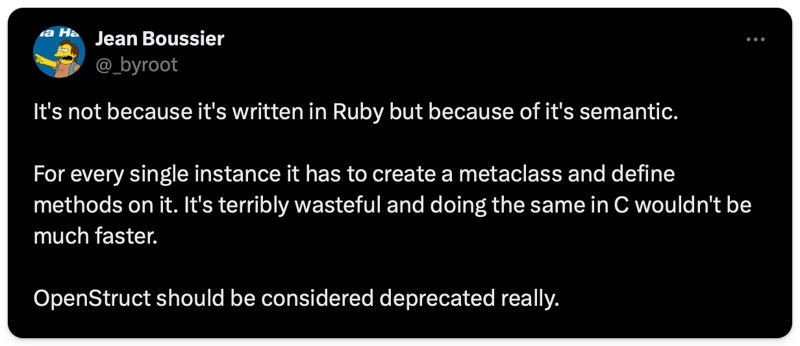
Jean Boussier answered a question about why OpenStruct is so slow:
Updates
This article was updated on 2024-03-23 after Ufuk Kayserilioglu added a PR to the repo after he noticed an error in my benchmarking where I was comparing Data.define with Struct with positional arguments. And I also added an explanation shared by Jean Boussier about the slowness of OpenStruct and an explanation by Ufuk about the similar behavior of Data.define and Struct.
Enjoyed this article?
👐 Subscribe to my Ruby and Ruby on Rails courses over email at learn.shortruby.com- effortless learning about Ruby anytime, anywhere
👉 Join my Short Ruby Newsnewsletter for weekly Ruby updates from the community and visit rubyandrails.info, a directory with learning content about Ruby.
🤝 Let's connect on Ruby.social or Linkedin or Twitter where I post mainly about Ruby and Rails.
🎥 Follow me on my YouTube channel for short videos about Ruby
SOCIAL SHARE CARD GENERATOR