
Zum Hauptinhalt springen
tsecurity.de LIVE
Echtzeit-Radar & Feeds
Alle RSS Feeds
👥 Community & Social
YouTube Security VideosGolemDE: Leben als IT-Freiberufler – zwei Perspektiven(24.09.2026 um 07:03 Uhr)
Sichere ProgrammierungOpenChamber 2.0: Skills ändern, Agent läuft weiter(24.09.2026 um 09:04 Uhr)
Sichere ProgrammierungBuilding Enterprise dApps with Smart Contracts and REST APIs(21.09.2026 um 11:34 Uhr)
Sichere ProgrammierungJavaScript Array Methods: 7 Essential Methods Every Developer Needs(24.09.2026 um 08:51 Uhr)
Sichere ProgrammierungCross-Chain Bridge Risk Assessment: Gauntlet(24.09.2026 um 08:53 Uhr)
Sichere ProgrammierungWe spent thirteen weeks about to buy a bigger database(24.09.2026 um 08:54 Uhr)
Sichere ProgrammierungHow to Choose a CDN for Asia in 2026: 7 Providers Compared(24.09.2026 um 08:54 Uhr)
Sichere ProgrammierungMy deploy said Success. It went to a URL nobody visits.(24.09.2026 um 09:00 Uhr)
YouTube Security VideosGolemDE: Leben als IT-Freiberufler – zwei Perspektiven(24.09.2026 um 07:03 Uhr)
Sichere ProgrammierungOpenChamber 2.0: Skills ändern, Agent läuft weiter(24.09.2026 um 09:04 Uhr)
Sichere ProgrammierungBuilding Enterprise dApps with Smart Contracts and REST APIs(21.09.2026 um 11:34 Uhr)
Sichere ProgrammierungJavaScript Array Methods: 7 Essential Methods Every Developer Needs(24.09.2026 um 08:51 Uhr)
Sichere ProgrammierungCross-Chain Bridge Risk Assessment: Gauntlet(24.09.2026 um 08:53 Uhr)
Sichere ProgrammierungWe spent thirteen weeks about to buy a bigger database(24.09.2026 um 08:54 Uhr)
Sichere ProgrammierungHow to Choose a CDN for Asia in 2026: 7 Providers Compared(24.09.2026 um 08:54 Uhr)
Sichere ProgrammierungMy deploy said Success. It went to a URL nobody visits.(24.09.2026 um 09:00 Uhr)
Intelligence View
⚡ tsecurity.de Intelligence

RAG with Embeddings in .NET: Enhancing Semantic Search

In this post, I present you a solution developed within the .NET ecosystem that shows how to integrate RAG with the ETL Medallion architecture using the Azure AI Document services, Pinecone vector database, Azure Cosmos DB, and the chat…

0
↗ Quelle (dev.to)
Reagiere als Erste:r — dein Feedback zählt!

In this post, I present you a solution developed within the .NET ecosystem that shows how to integrate RAG with the ETL Medallion architecture using the Azure AI Document services, Pinecone vector database, Azure Cosmos DB, and the chat and embeddings OpenAI API endpoints to create a system capable of providing good responses in the context of Mexican Tax legislation.


Theoretical Framework


Medallion Architecture


The Medallion architecture organizes data transformation into three distinct layers—bronze, silver, and gold—each optimized for specific roles in the data lifecycle from raw ingestion to business-ready "golden records."


Embeddings and Vector Databases


Embeddings are numeric representations of the text, capturing their semantic relationships. During the embedding process, a vector is created, and each vector is stored in Pinecone (vector database), This setup enables the system to efficiently pull contextually relevant data using semantic searches over the stored information.


Retrieval-Augmented Generation (RAG)


RAG combines the strengths of both retrieval-based and generative AI systems to enhance the model's response accuracy and relevance. By dynamically retrieving relevant document segments, RAG allows models to generate better responses to the user's needs.


Prompt Engineering


Prompt Engineering involves designing inputs that influence the behavior of LLMs. It is crucial for adapting LLM outputs to specific tasks or contexts, especially when direct training data is limited.


Few-Shot Learning Techniques

Few-shot learning involves introducing a minimal number of examples to a pre-trained model, enabling it to apply its generalized knowledge to new tasks. This technique is used in the project as part of the golden document creation.


Enhancing RAG with Contextual Prompts

For the (RAG) process, the system's effectiveness is improved by incorporating relevant information into the context window. This method involves crafting prompts that include specific contextual information, which guides the retrieval mechanism to produce precise and relevant outputs.


Hypothesis.


Enriching a vector database with synthetic or human-generated questions related to document content, along with structured summarizations (chunks) of these documents, significantly enhances the retrieval process in a Retrieval-Augmented Generation (RAG) system.


Synthetic or Human-Generated Questions:

These anticipate user queries, improving the retrieval model’s ability to match actual user questions with relevant stored queries, resulting in more accurate and rapid information retrieval.


Structured Summarizations:

Condensing content into coherent segments reduces computational load and focuses the retrieval on relevant text areas, speeding up the process and increasing precision.


Implementation


This section describes the three primary processes that underpin the solution: the ETL process, vector index creation, and the Retrieval-Augmented Generation (RAG) process.


1. ETL Process


The ETL (Extract, Transform, Load) process is the initial step where data from PDF documents containing Mexican tax laws, is extracted. The data is then transformed into a standardized format in the golden document, each golden document represents a chunk from the original PDF content enriched with bounding boxes of its position in the file, a short synthetic summary, and a set of synthetic questions related to the chunk.


ETL Process Architecture
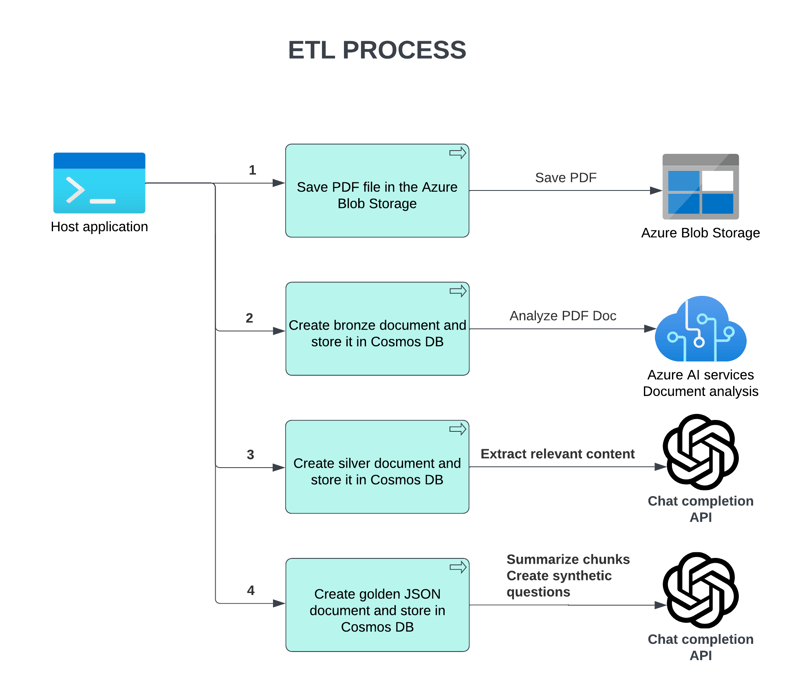
ETL Process Architecture

ETL Data Flow

ETL Data Flow

Documents JSON schema

JSON Documents schema


2. Vector Index Creation


In the vector index creation step, the process creates the vectors and metadata to store in Pinecone. For each golden document, one vector is created for the synthetic summary, and another one for each synthetic question, the metadata is populated with the golden document's unique identifier for future retrieval and enrichment purposes.


Vector index creation


3. RAG Process


The Retrieval-Augmented Generation (RAG) process utilizes the indexed vectors during the query phase. When a query is received, it is encoded into an embeddings vector to perform semantic search over the Pinecone database, with the retrieve data the chat process creates a contextualized prompt which is used to augment the chat completion response from the LLM.


RAG process


Ok, ok, now show me the code!


GitHub logo

erickbr15
/
palaven-llm-sat


LLM RAG with openAI / Pinecone / Azure


PALAVEN - Project Documentation


1. Introduction


This project leverages .NET 6 (Long Term Support) to create a backend-focused solution incorporating OpenAI's Chat and Embeddings services, Pinecone's HTTP API, and Azure AI for PDF text extraction. This phase does not include web APIs or Azure Functions but features three console applications for data ingestion, vector index creation, and testing interactions with OpenAI's Chat API.


2. Requirements and Setup


System and Software Requirements


  • .NET 6 (LTS) environment.

  • Access to OpenAI APIs.

  • Pinecone HTTP API setup.

  • Azure AI services for text extraction.


3. System Architecture


Palaven-vBeta-Deployment - Deployment (2)


4. OpenAI API Integration


Chat and Embeddings Services


The project integrates OpenAI's API through HTTP requests, utilizing the .NET IHttpClient for connectivity. Key components of this integration include:


  • Endpoints

    • Chat completion endpoint: Utilized for 1. Extracting the article text, 2. Generating the synthetic questions about each ingested article, 3. Generating responses based on user inputs

    • Embeddings creation…


Finally...


I encourage you to consider this work as a foundational reference for your projects. The methodologies and technologies detailed here offer a robust framework for enhancing the capabilities of AI-driven systems, particularly in specialized domains.


Thanks for reading and happy coding!

CTI Threat Relationship Graph2 Knoten / 1 Relationen
CVE / Incident Software MITRE ATT&CK CWE Weakness IoC
SOC Incident Playbook: Vulnerability Remediation & Verification
title: Detect Exploitation - RAG with Embeddings in .NET: Enhancing Semantic Search
id: 82ea2349-a4e5-43f1-899a-29921051a590
status: experimental
description: Automatisch generierte SIEM-Erkennungsregel basierend auf CTI Intelligence
references:
  - https://tsecurity.de/
author: iShareStuff CTI Automated Detection Engine
date: 2026-09-24
logsource:
  category: network_connection
  product: any
detection:
  selection:
      CommandLine|contains:
        - 'exploit'
  condition: selection
falsepositives:
  - Legitime administrative Zugriffe oder Penetrationstests
level: high
tags:
  - attack.initial_access
rule CTI_Threat_Indicator {
    meta:
        author = "iShareStuff CTI Automated Detection Engine"
        date = "2026-09-24"
        description = "YARA Signature for "
    strings:
        $str = "RAG with Embeddings in .NET: E" ascii wide
    condition:
        any of them
}
tsecurity.de Cognitive Threat RAG
Fokus-Vektor:

Kognitive Analyse für identifizierte Bedrohung: Erhöhte Bedrohungslage im Bereich RAG with Embeddings in .NET: Enhancing S.... Basierend auf 368k Vektor-Korrelationen werden sofortige Isolationsmaßnahmen für betroffene Endpunkte empfohlen.

🛡️ Angriffsfläche & Exposure

Netzwerk/Remote-Zugriff ohne Vorauthentifizierung möglich.

Empfohlene Sofortmaßnahmen
  • 1. Perimeter-Inspektion: Relevante Portfreigaben und exponierte Endpunkte unverzüglich scannen.
  • 2. Patch-Applikation: Hersteller-Hotfix einspielen oder betroffene Daemons in isolierte DMZ-Segmente überführen.
  • 3. Telemetrie & EDR-Alerts: Prozessaufrufe und Child-Processes auf anomale Shell-Spawns überwachen.
🔗 Semantisch verwandte Zero-Days MariaDB 11.7 VEC
Ähnliche Beiträge
🔍 Verwandte News

Auch interessante Nachrichten RAG with Embeddings in .NET: Enhancing Semantic Search

Thematisch verwandte Begriffe: with, Embeddings, Enhancing, Semantic · 6 Treffer

Laden...

Videos werden geladen ...

Laden...

Beiträge werden geladen ...

Laden...

Videos werden geladen ...

Laden...

Beiträge werden geladen ...

Laden...

Videos werden geladen ...

Laden...

Beiträge werden geladen ...

Laden...

Videos werden geladen ...

Laden...

Beiträge werden geladen ...

Laden...

Videos werden geladen ...

Zum Aktualisieren ziehen
ZERO-DAY CVE-2026-96772 | A security flaw has been discovered in Intelliants Subrion CMS up to 4.2…
Advisory →
TTS Reader • tsecurity.de Voice
tsecurity.de Icon
tsecurity.de App
Offline-Lesen, Eilmeldungen & 0ms Ladezeit

Installiere tsecurity.de direkt auf deinen Home-Bildschirm für das ultimative Vollbild-Magazinerlebnis ohne Browser-Leisten.

Nächster Beitrag
Themen-Radar & Intelligence Matrix
Echtzeit-Taxonomie nach Angriffsvektoren & Plattformen

tsecurity.de Live Threat Radar

🔴 LIVE RADAR
MONITORING
AKTIV
CVE-DATENBANK
LIVE
🔍
Community Radar & Live Chat
Sentinel Bot online • Live-Stream
Dein Cluster: Security Explorer
Match:
lädt…
Verbindung zum Community-Stream wird aufgebaut...
Bearbeitungsmodus — Senden überschreibt deine Nachricht
Community-Puls — was gerade passiert
lädt…
Aktivitäten deiner Analysten
lädt…
Neues Thema oder Eilmeldung einreichen

Reiche interessante Links, Zero-Days oder Debatten ein. Die Community entscheidet per Upvote über die Veröffentlichung.

Heiß diskutierte Einreichungen
🔖 Gespeicherte Artikel
📂 Keine gespeicherten Artikel vorhanden.
Zurück Ziehen Vor
Links: vorheriger Artikel Rechts: nächster Artikel unten: schließen
News NIS-2 Frühwarnung Tier-1 Intel TTP ⏱️ 3 Min vor 10 Min
Artikeldaten werden geladen...

Zurück: vorheriger Vor: nächster
↗ Original-Quelle
Social Reaktionen Deine Reaktion zählt
Einstufung & Relevanz-Poll 0 Stimmen
In sozialen Netzwerken teilen 1-Klick