What exactly do you put in, what exactly do you get out, and how do you generate text with it?
Last week I was listening to an Acquired . And way back I worked on a grammar checker powered by an older style language model. So maybe.
The transformer was invented by a team at Google working on automated translation, like from English to German. It was introduced to the world in 2017 in the now famous paper
Hmm…if I understood, it was only at the most hand-wavy level. The more I looked at the diagram and read the paper, the more I realized I didn’t get the details. Here are a few questions I wrote down:
- During training, are the inputs the tokenized sentences in English and the outputs the tokenized sentences in German?
- What exactly is each item in a training batch?
- Why do you feed the output into the model and how is “masked multi-head attention” enough to keep it from cheating by learning the outputs from the outputs?
- What exactly is multi-head attention?
- How exactly is loss calculated? It can’t be that it takes a source language sentence, translates the whole thing, and computes the loss, that doesn’t make sense.
- After training, what exactly do you feed in to generate a translation?
- Why are there three arrows going into the multi-head attention blocks?
I’m sure those questions are easy and sound naive to two categories of people. The first is people who were already working with similar models (e.g. RNN, encoder-decoder) to do similar things. They must have instantly understood what the Google team accomplished and how they did it when they read the paper. The second is the many, many more people who realized how important transformers were these last seven years and took the time to learn the details.
Well, I wanted to learn, and I figured the best way was to build the model from scratch. I got lost pretty quickly and instead decided to trace code someone else wrote. I found this terrific with annotations by author
How did (2,3,8) become (2,2,3,4)? We did a linear transformation, then took the result and split it into number of heads (8 / 2 = 4) and rearranged the tensor dimensions so that our second dimension is the head. Let’s look at some actual tensors:
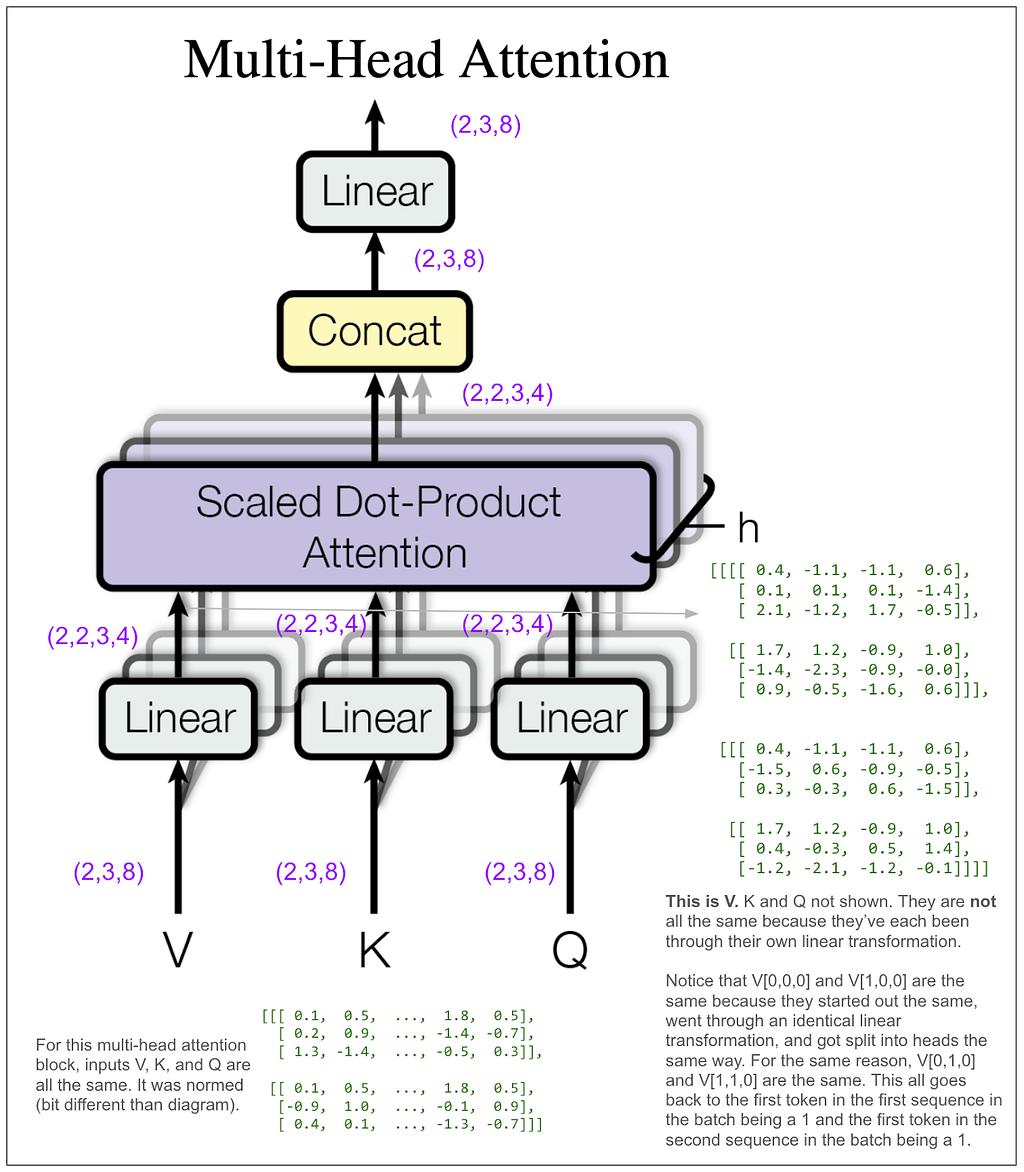
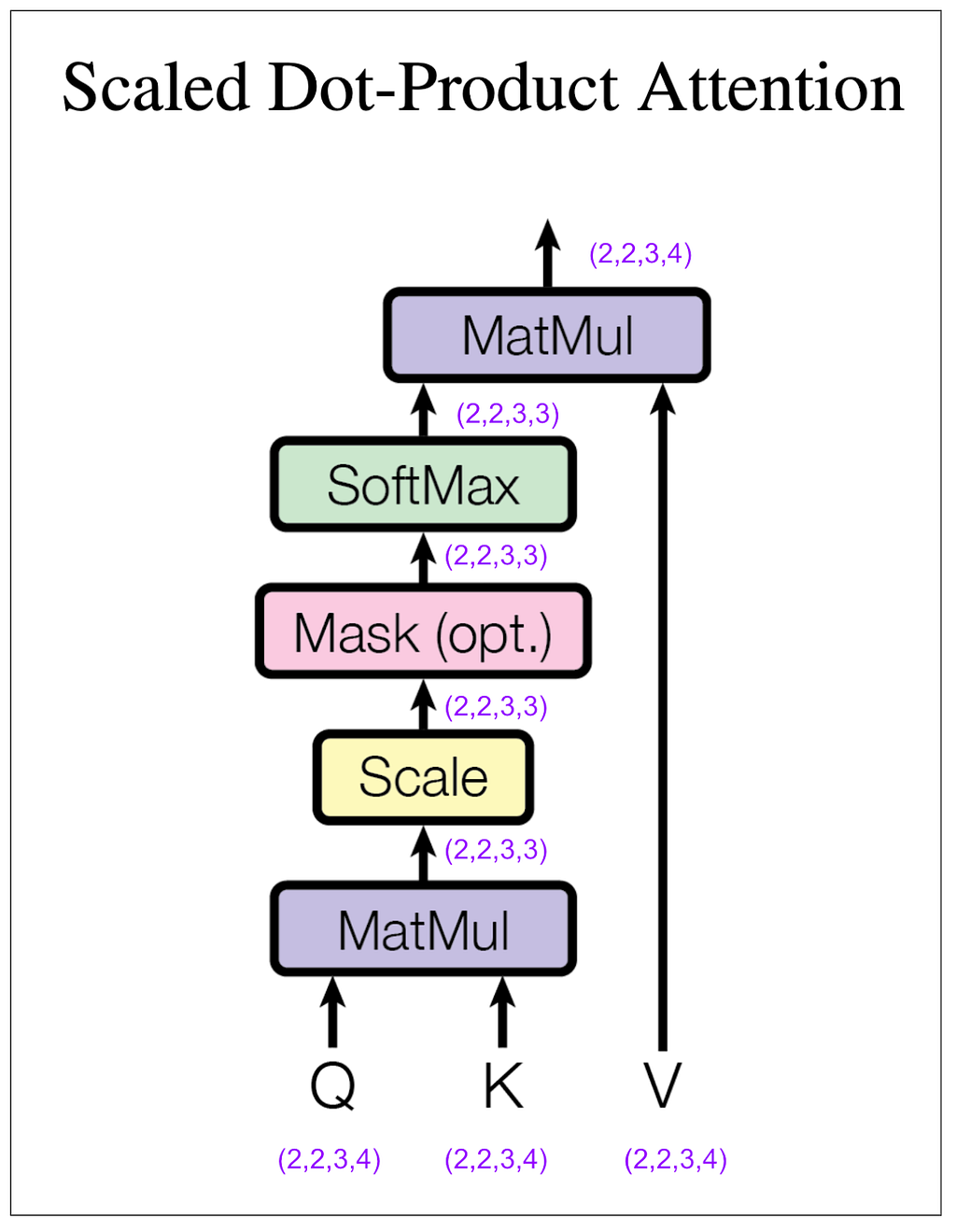
We still haven’t done anything that mixes information among positions. That’s going to happen next in the scaled dot-product attention block. The “4” dimension and the “3” dimension will finally touch.
on Medium, where people are continuing the conversation by highlighting and responding to this story.

SOCIAL SHARE CARD GENERATOR