Frugal RLHF with multi-adapter PPO on Amazon SageMaker

Note: All images, unless otherwise noted, are by the author.
What is this about and why is it important?
Over the last 2 years, research and practice have delivered plenty of proof that preference alignment (PA) is a game changer for boosting Large Language Models (LLMs) performance, especially (but not exclusively) for models directly exposed to humans. PA uses (human) feedback to align model behavior to what is preferred in the environment a model is actually living in, instead of relying solely on proxy datasets like other fine-tuning approaches do (as I explain in detailed in . For a comprehensive overview about fine-tuning you might want to check it out as well.
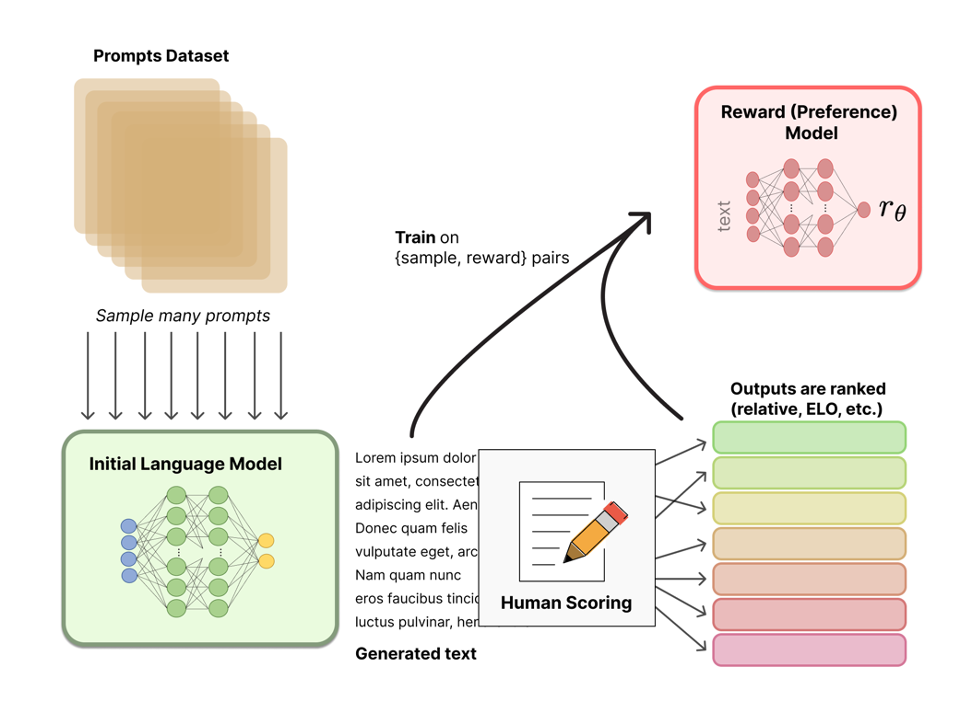
RLHF works in a two-step process and is illustrated in Figures 13 and 14:
Step 1 (Figure 1): First, a reward model needs to be trained for later usage in the actual RL-powered training approach. Therefore, a prompt dataset aligned with the objective (e.g. chat/instruct model or domain-specific task objective) to optimize is being fed to the model to be fine-tuned, while requesting not only one but two or more inference results. These results will be presented to human labelers for scoring (1st, 2nd, 3rd, …) based on the optimization objective. There are also a few open-sourced preference ranking datasets, among them ), instead of gradient descent, this approach leverages gradient ascent (or gradient descent over 1 — reward) since we are now trying to maximize an objective (reward). For increased algorithmic stability to prevent too heavy drifts in model behavior during training, which can be caused by RL-based approaches like PPO, a prediction shift penalty is being added to the reward term, penalizing answers diverging too much from the initial language model’s predicted probability distribution on the same input prompt.
Challenges with RLHF
The way how RLHF is working poses some core challenges to implementing and running it at scale, amongst them the following:
- Cost of training the reward model: Picking the right model architecture and size for the reward model is still current state of research. These models are usually transformer models similar to the model to be fine-tuned, equipped with a modified head delivering reward scores instead of a vocabular probability distribution. This means, that independent from the actual choice, most reward models are in the billions of parameters. Full parameter training of such a reward model is data and compute expensive.
- Cost of training cluster: With the reward model (for the reward values), the base model (for the KL prediction shift penalty) and the model actually being fine-tuned three models need to be hosted in parallel in the training cluster. This leads to massive compute requirements usually only being satisfied by a multi-node cluster of multi-GPU instances (in the cloud), leading to hardware and operational cost.
- Orchestration of training cluster: The RLHF algorithm requires a combination of inference- and training-related operations in every training loop. This needs to be orchestrated in a multi-node multi-GPU cluster while keeping communication overhead minimal for optimal training throughput.
- Training/inference cost in highly specialized setups: PA shines through aligning model performance towards a user group or target domain. Since most professional use cases are characterized by specialized domains with heterogenous user groups, this leads to an interesting tradeoff: Optimizing for performance will lead in training and hosting many specialized models excelling in performance. However, optimizing for resource consumption (i.e. cost) will lead to overgeneralization of models and decreasing performance.
RLHF with multi-adapter PPO
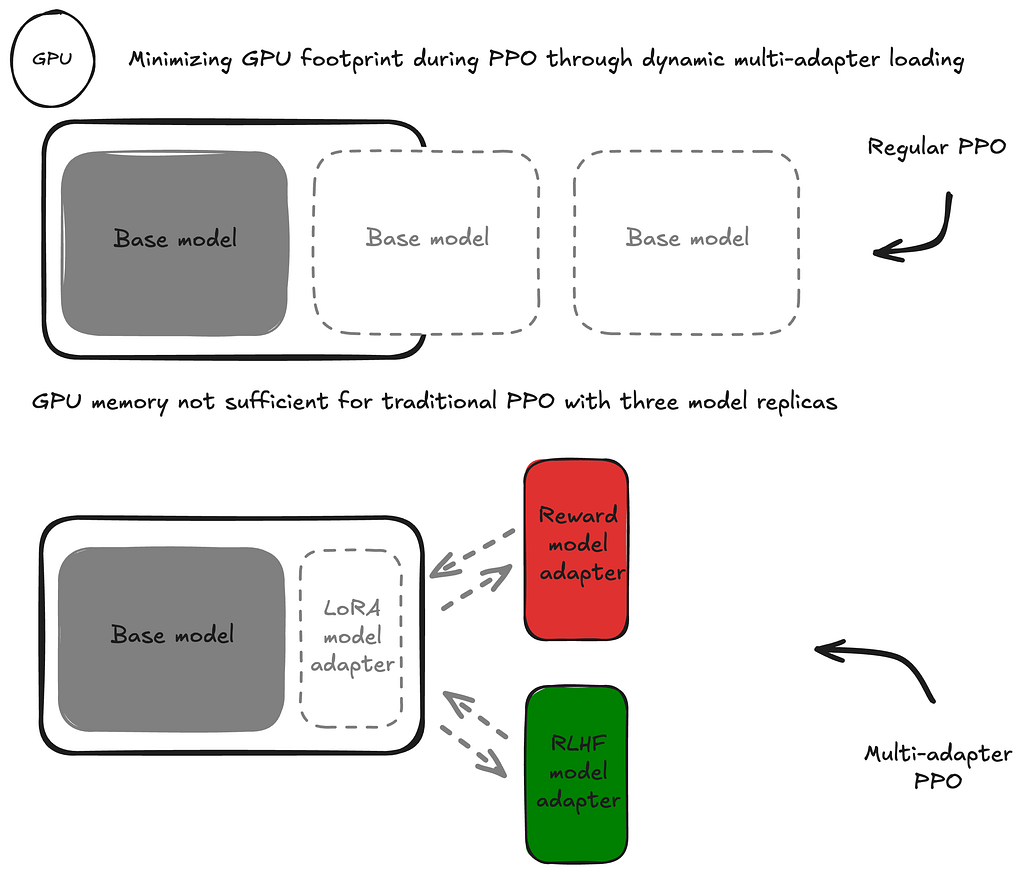
Multi-adapter PPO is a particularly GPU-frugal approach to the second step of the RLHF training process. Instead of using full-parameter fine-tuning, it leverages parameter-efficient fine-tuning (PEFT) techniques to reduce the infrastructure and orchestration footprint drastically. Instead of hosting three distinct models (model being fine-tuned, reward model, reference model for KL prediction shift penalty) in parallel in the training cluster this approach leverages Low Rank Adaptation (LoRA) adapters during the fine-tuning which are dynamically loaded and unloaded into the accelerators of the training cluster.

While this approach’s goal is ultimately a resource and orchestration frugal approach to the second step of RLHF, it has implications on the first step:
- Reward model choice: A reward model with the same model architecture as the model to be fine-tuned is picked and equipped with a reward classification head.
- Reward model training approach: As illustrated in figure 4(2), instead of full-parameter reward model training, a reward model LoRA adapter is being trained, leading to a much leaner training footprint.
Similarly to the this, the RLHF fine-tuning of the model being performed in the second step is not done in a full-parameter fine-tuning manner. Instead, a LoRA adapter is trained. As depicted in figure 4, during a training iteration, first the RLHF model adapter is being loaded to generate model responses to the prompts of the current training batch (4a). Then, the reward model adapter is loaded to calculate the corresponding raw reward values (4b). To complete the reward term, the input prompt is fed through the base model for calculation of the KL prediction shift penalty. Therefor, all adapters need to be unloaded (4c, 4d). Finally, the RLHF model adapter is loaded again to perform the weight updates for this iteration step (4e).
This approach to RLHF reduces the memory footprint as well as orchestration complexity significantly.
Running RLHF with multi-adapter PPO with HuggingFace and Amazon SageMaker
In what follows we will go through a notebook showcasing RLHF with multi-adapter PPO in an E2E fashion. Thereby we use HuggingFace and Amazon SageMaker for an especially user-friendly interface towards the implementation, orchestration and compute layers. The entire notebook can be found in the Meta homepage and in the . This is a handcrafted preference dataset Anthropic has open-sourced. It consists of chosen and rejected model completions to one and the same prompt input. Further, it comes in different fashions, targeting alignment areas like harmlessness, helpfulness and more. For our demonstration we will use the ”helpful” subset to preference align our Llama model towards helpful answers.
For the actual PA step with PPO and the previously trained reward model we need an additional dataset representing the target domain of our model. Since we are fine-tuning an instruct model towards helpfulness we need a set of instruction-style prompts. , provides us with question — context — answer pairs across a broad range of different areas of expertise. For our experiment we will aim for single-turn open Question&Answering. Hence we will use only the “question” feature of the dataset.
Code repository
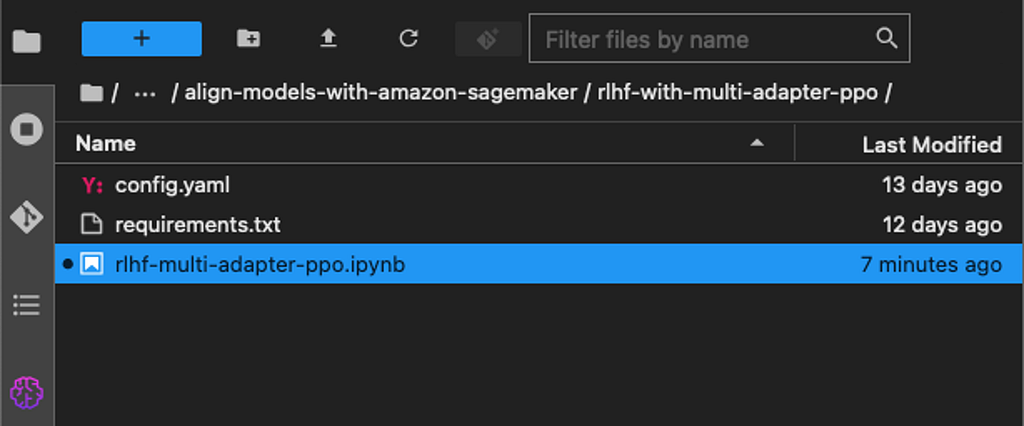
After having looked into the datasets we will use let‘s take a look into the directory structure and the files we will use in this demonstration. The directory consists of 3 files: config.yaml, a configuration file for running SageMaker jobs through the remote decorator and requirements.txt for extending the dependencies installed in the training container. Finally, there is the rlhf-multi-adapter-ppo.ipynb notebook containing the code for our E2E PA.
The previously mentioned config.yaml file holds important configurations for the training jobs triggered by the remote decorator, e.g. training instance type or training image.
Notebook
Now, let’s open the rlhf-multi-adapter-ppo.ipynb notebook. First, we install and import the required dependencies.
Data preprocessing reward model training dataset
As previously discussed, we will be using the Anthropic/hh-rlhf dataset for training our reward model. Therefore, we need to convert the raw dataset into the above specified structure, where “input_ids” and “attention_mask” are the outputs of input tokenization. This format is specified as interface definition by the HuggingFace trl RewardTrainer class and makes the accepted and rejected answers easily accessible during reward model training.
DatasetDict({
    train: Dataset({
        features: ['input_ids_chosen', 'attention_mask_chosen', 'input_ids_rejected', 'attention_mask_rejected'],
        num_rows: ...
    })
    test: Dataset({
        features: ['input_ids_chosen', 'attention_mask_chosen', 'input_ids_rejected', 'attention_mask_rejected'],
        num_rows: ...
    })
})
We login to the HuggingFace hub. Then, we retrieve the “helpful-base” of the „Anthropic/hh-rlhf“ dataset. The raw dataset structure looks as follows, we also take a look into an example dataset item.
Next, we parse the conversations into an array seperated by conversation turn and role.
def extract_dialogue(input_text):
    # Split the input by lines and initialize variables
    lines = input_text.strip().split("\n\n")
    dialogue_list = []

    # Iterate through each line and extract the dialogue
    for line in lines:
        # Check if the line starts with "Human" or "Assistant" and split accordingly
        if line.startswith("Human:"):
            role = "user"
            content = line.replace("Human: ", "").strip()
        elif line.startswith("Assistant:"):
            role = "assistant"
            content = line.replace("Assistant: ", "").strip()
        else:
            # If the line doesn't start with "Human" or "Assistant", it's part of the previous message's content
            # Append it to the last message's content
            dialogue_list[-1]["content"] += "\n\n" + line.strip()
            continue

        # Append the extracted dialogue piece to the list
        dialogue_list.append({"role": role, "content": content})

    return dialogue_list

def process(row):
        row["chosen"] = extract_dialogue(row["chosen"])
        row["rejected"] = extract_dialogue(row["rejected"])
        row["prompt"] = row["chosen"][0]["content"]
        return row

ds_processed = ds.map(
        process,
        load_from_cache_file=False,
    )
Based on it’s pre-training process, every model has a specific set of syntax and special tokens prompts should be optimized towards — this is the essence of prompt engineering and needs to be considered when fine-tuning. For the Meta Llama models this can be found in the llama-recipes with the I recently published with my esteemed colleagues .
on Medium, where people are continuing the conversation by highlighting and responding to this story.

SOCIAL SHARE CARD GENERATOR