The Economics of Artificial Intelligence — What Does Automation Mean for Workers?
Despite tremendous progress in AI, the economic implications of AI remain inadequately understood, with unsatisfactory insights from AI practitioners and economists

Table of Contents
Jump to the
∘
∘
∘
∘
∘
∘
As a result, there is a growing recognition that AI will fundamentally reshape society and the economy in profound, unprecedented ways.
But what impact will AI have on the economy? Unfortunately, this is a significant question that, in my view, remains unanswered in any satisfactory manner.
The current focus of the AI community is on designing new architectures and developing cutting-edge products. AI practitioners and builders concentrate on improving model performance, only considering economic factors when it concerns potential users and the market for their innovations.
Economists, on the other hand, develop rigorous models and theories on automation, substitution, and complementarity. Yet, as they often operate outside the AI space, they are out of sync with the latest AI advancements and how organisations are adopting these technologies. This disconnect can lead to fundamental misunderstandings of AI’s potential, resulting in pessimistic assessments: 2024 Nobel Prize winner Daron Acemoglu recently ” ⁵ or “⁷ underscores the growing acknowledgment within the AI industry of the critical role that economics plays in shaping its trajectory.
This is the first of, hopefully, a series of articles exploring the economic impacts of AI. In this piece, I will investigate the impact of AI on jobs through the lens of a widely-used economic framework by David Autor and Daron Acemoglu, while introducing a novel extension that incorporates the latest findings from the AI field.
Future articles will explore AI’s effects on: 1) the production of inputs for AI (such as chips and energy), 2) innovation and R&D, and 3) macroeconomic outcomes like productivity growth. Together, these explorations aim to provide a comprehensive and nuanced view of AI from an economist’s lens.
Introduction to Economic Model
To ground our discussion in an economic framework, let me explain the task-based framework that ¹⁰, an AI video generation tool that can make realistic videos in minutes. Let’s analyse the impact of this innovation on a firm that helps businesses create marketing videos. This firm’s production process involves two tasks: creating and editing videos (Task A) and customer service with clients (Task B).
An AI innovation increases the productivity of AI, in Task A of generating videos, increasing the Marginal Product of AI. What is the impact on employment? As I hinted earlier, it depends on how substitutable labour and AI are for this task, or the value of sigma.
Employment decreases if labour and AI are highly substitutable. In this case, because producing a given video has become relatively cheaper for AI as compared to labour, firms will replace labour with AI in that task’s production. Hence, the share of labour in the production of Task A declines, and the share of AI increases. In general, this means that more tasks become completely automated (i.e., wholly using AI as input). Holding the production structure (i.e., share of each task in the final output) constant, the quantity of labour demanded decreases (e.g., cashiers being replaced by self-checkout counters in supermarkets).
So, is this all doom and gloom for workers? Not so fast. There are several potential mechanisms which could lead to an increase in employment.
There could be strong complementarities between labour and AI within the same task. Taking the case of the economist, perhaps computer software becomes more efficient and produces 10 times as many economic simulations at the same cost. This means that more economists will be needed to interpret and publish the increased number of results¹¹. Other examples of jobs that have strong complementarities include knowledge workers such as consultants, doctors and lawyers.
Additionally, the increased Marginal Product of AI will reduce costs of production. This allows the firm to produce more output, also known as the productivity effect¹². Hence, even if a task has been automated, the productivity effect leads to increased hiring in non-automated tasks. In situations which output increases substantially, due to high elasticity of demand (I will elaborate on this in a later section), then overall employment could indeed increase.

Lastly, there is the reinstatement effect, or the creation of new tasks that humans specialise in. Using the video-generation example, perhaps Task C will be created: previous video editors will turn into creative consultants advising clients on their brand’s creative direction. ¹⁴. However, the host Nathaniel Whittemore recognised that he had completely no clue about whether Sora will displace or augment video creators, and that we had to “wait and see”.
Secondly, classifying technology as augmenting or automating assumes a uniform effect across all workers, which oversimplifies the reality of heterogeneous workers. Workers differ in skills, experiences, and productivity levels. Hence, it is more likely that a certain technology will augment some types of labour and automate others.
My framework: AI performance relative to humans
Most of the economic literature assumes that labour is homogenous. Some try to account for labour heterogeneity, by assuming two types of labour: high-skilled and low-skilled, which is still quite reductionist. Homogeneity of labour is a necessary assumption to solve for workers’ wages at equilibrium and ‘solve’ the theoretical model.
However, this is at odds with the labour market in reality, in which there is huge dispersion of productivity and skill levels between workers. Within a single task, different workers have varying levels of productivity (e.g., some people can edit videos much faster than others). Additionally, workers possess unique combinations of skills across multiple tasks (e.g., some workers can both edit videos and market their video editing services to customers, while others can only edit videos).
This reminds me of the stats assigned to soccer players in FIFA (shooting, positioning, finishing, penalties etc.) These all contribute to a wide dispersion of overall scores (think productivity), and hence wages across workers even within the same occupation.
This underscores a common critique of economists: the tendency to construct models based on what is analytically tractable and gives ‘clean’ findings, rather than the realism of the modelling assumptions. Hence, their results are elegant and theoretically rigorous under strict conditions, but risk becoming disconnected from reality, offering limited utility for understanding real-world issues.
It is at this time that I introduce my framework for classifying labour into augmented or automated, recognising the heterogeneity of workers yet fitting tractably in the task-based economic framework.
The core principle underlying my framework is straightforward: whether labour is augmented or automated depends on the relative performance of AI compared to worker in a given task. An AI technology automates labour in a certain task if labour performs worse than AI in the task, while it augments labour if labour performs better than AI in the task.
For example, if OpenAI’s Sora model can generate videos at the 75th percentile of video editors in productivity (loosely defined as quality relative to inputs of time and money), then it would displace any video editor worse than the 75th percentile (assuming its marginal cost of AI is lower than the cost of employing a 75th percentile video editor). However, for the 90th percentile video editor, Sora becomes a tool for augmenting. This editor could use Sora to instantly get a first draft with quality equivalent to a 75th percentile video editor, and then leverage their superior skills to refine the draft into a higher-quality final product.
Measuring AI’s performance relative to humans
The elegance of this approach lies on its reliance on readily-available, up-to-date data of AI performance relative to humans on a wide range of tasks.
This is because AI model creators test their models’ performance by evaluating them against human-curated benchmarks on a multitude of different tasks. Some examples of benchmarks are MATH (a compilation of high-school competition math problems), GPQA (PhD-level questions written by domain experts in biology, physics and chemistry), and SWE-bench (a collection of real-world software issues from GitHub).
This practice ensures that every new AI model or product release comes with publicly shared performance metrics, providing a timely and detailed understanding of AI capabilities.
In contrast, traditional economic indicators for tracking the progress and impact of technology, such as patent data or wage and employment statistics, are inherently lagging. Patent data often omits key innovations, since many AI firms do not patent their new products. Wage and employment data, while useful, are available only with a significant delay and are inherently ex-post, limiting their ability to forecast the future impacts of cutting-edge AI on the workforce.
Additionally, AI models have their performance benchmarked on standardised exams (APs, SAT, GRE, and even competitive math from AIME to IMO)¹⁶. Since standardised exams provide a well-documented distribution of student scores across time as well as cross-sectionally, this data can leveraged to approximate the skill distribution of the workforce.
By correlating AI performance data with occupational task descriptions and comparing it to the estimated skill distribution of workers in each occupation, we can thus construct a metric of AI’s relative performance compared to humans in each occupation, and hence, the displacement or augmentation potential of workers in each occupation. I believe that this is possible — OECD’s PIAAC is the premier internationally-comparable database of adult skills, I myself having used it on an economics project on adult skills and ageing. OECD has also ¹⁸: In one of the first experiments to investigate the impact of generative AI on work, the authors found that customer support agents using AI experienced a 14% increase in productivity on average. Crucially, less experienced or lower-skilled workers saw the greatest productivity gains of 35%, while the most experienced workers saw minimal gains.
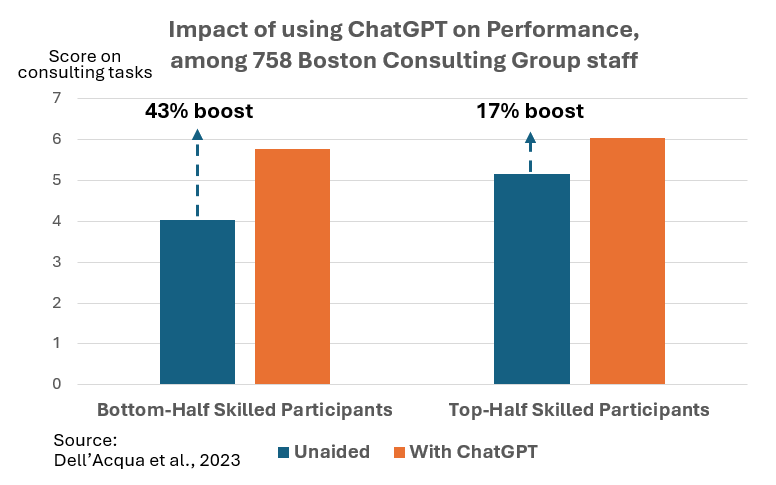
· ²¹: Studying 187,000 developers using GitHub Copilot, the authors found that Copilot enabled software developers to shift task allocation, towards their core coding activities and away from non-core project management tasks, and that lower-ability ²² coders experienced greater effects.
At first glance, these findings may seem to contradict my framework, which posits that worse workers would be displaced and worse-off. Let me explain using my framework and the example of a video-creating firm again.
In this scenario, the occupation of video editor comprises two complementary tasks: Task A (video editing) and Task B (customer service). Even though Task A has been automated, Task B is non-automatable, as it requires human negotiation and discussion with clients. If Task B takes up the bulk of the time, a worker’s overall productivity will be constrained by the inefficiencies in Task B. For example:
· A worker at the 5th percentile in Task A can use AI to achieve the productivity level of the 75th percentile, significantly boosting their overall output.
· Conversely, a 75th-percentile worker may see little improvement from AI, as their bottleneck lies in Task B, where no gains are made.
In economics terminology, there are strong complementarities between the automated Task A and inefficient Task B. The inefficiency of Task B effectively caps overall productivity gains, creating what , top software engineering leads can now design the architecture for and implement 100 apps with AI assistance, a task that previously required hiring numerous junior software engineers. This illustrates how AI can amplify the productivity of highly-skilled workers, rather than replace them.
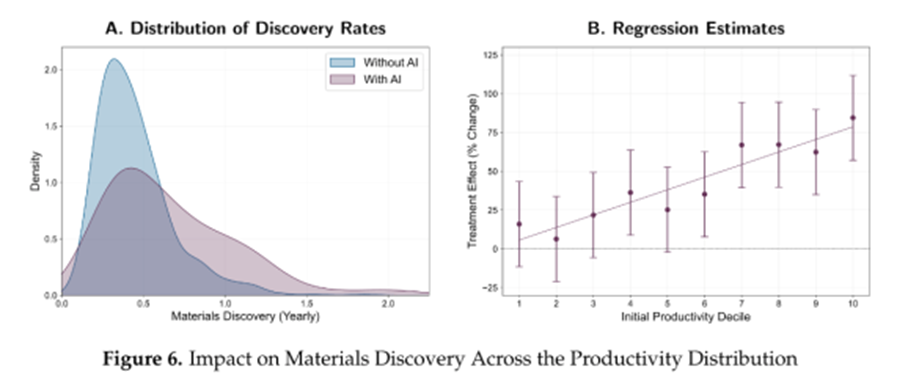
Another recent study by for its positive findings on AI and scientific innovation, found that when researchers gained access to an AI-assisted materials discovery tool, the output of top researchers doubled, while the bottom third of scientists saw little benefit. The authors attribute this disparity to the complementarity between AI and human expertise in the innovation process. Top scientists leveraged their domain knowledge to prioritise promising AI suggestions, whereas others wasted substantial resources testing false positives.
Furthermore, as individuals gain experience and skills on the job, they often take on roles involving leadership and management — areas where AI remains relatively weak. These roles require strategic thinking, emotional intelligence and interpersonal skills, which complement AI rather than substitute it. The positive correlation between experience and AI complementarity suggests that higher-skilled, more experienced workers are more likely to thrive an AI-enhanced labour market.
. He might never have become who he is today if studios had replaced these opportunities in favour of AI. AI is like a tsunami — those who fail to make it to “higher ground” during the short window of opportunity pre-automation may be irreversibly devastated when the wave of automation hits. This dynamic risks driving irreversible polarisation between the skilled and the unskilled.
Evidence of this phenomenon is already emerging in the tech industry, where job openings for entry-level software developer roles are plummeting.
While there is compelling evidence supporting both sides of the debate, I personally believe that AI will eventually widen, rather than close, disparities between workers. This underscores the urgency of addressing the socioeconomic challenges posed by AI.
More about the Productivity Effect
Let’s dig deeper into the productivity effect I mentioned earlier, which underpins much of the optimism about AI having a positive impact on jobs. Understanding this would shed light into which occupations are most likely to remain future-proof from AI, and even benefit from AI advancements (I will cover my framework of which occupations are good in the final section!)
The key insight here is that automation-driven cost reductions and productivity improvements can lead to a substantial increase in demand for the final output, leading to an increase in employment for non-automatable tasks that potentially outweigh the employment decline due to the first task’s automation.
How do we determine the types of products that are likely to see this effect?
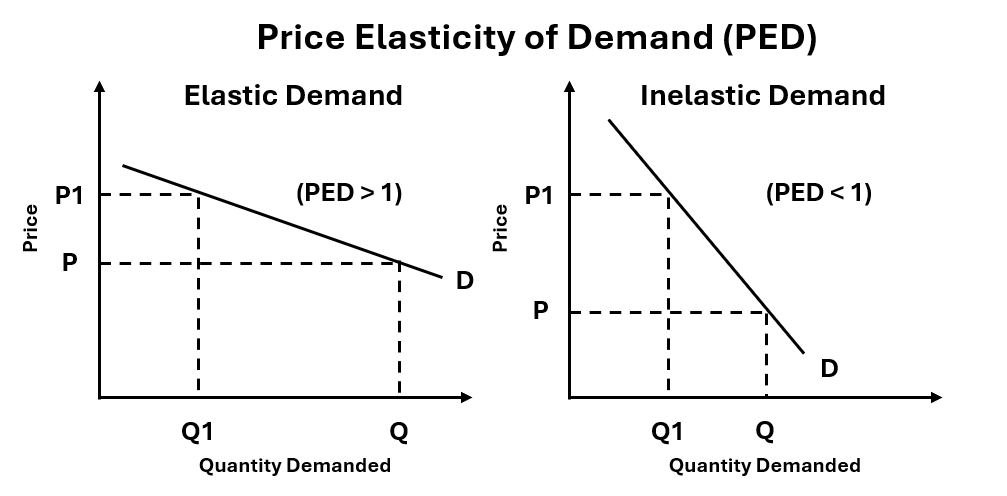
This is the point in which I invoke a concept from introductory microeconomics — price elasticity of demand. To refresh your memory, a product has price-elastic demand, if a price decrease leads to a more than proportionate increase in quantity demanded, ultimately leading to an increase in total value of output demanded.
To explain simply, for price-elastic products, consumers would actually demand much more of these products, but are constrained by the current price point.
One reason for this is if there is potential for new markets to be unlocked when cost declines — if the existing product has a low market penetration.
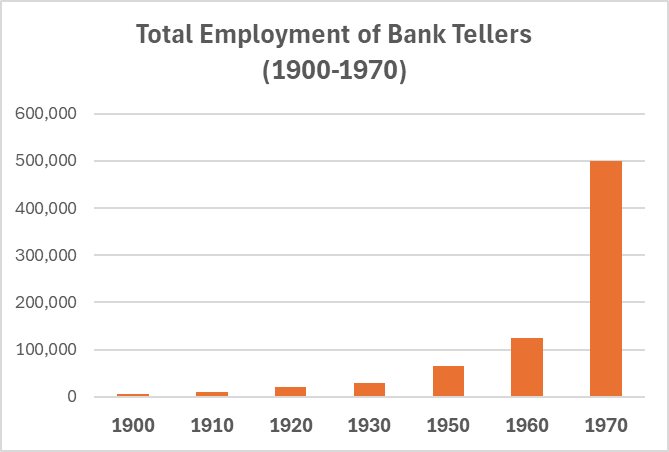
An example that is often cited by proponents of automation is ATMs and bank tellers ²⁸. In the post-WW2 era, demand for banking services surged, and human tellers were critical for routine tasks like cashing checks and depositing money. When ATMs became ubiquitous in the 1990s, they automated many of these routine tasks, significantly reducing the cost of operating bank branches. As a result, banks could open many more branches nationwide, serving a much wider population. Consequently, teller employment increased, with their roles evolving from manual tasks to a focus on customer service, sales and specialised client requests.
Other examples of increasing affordability making products much more accessible were cars and televisions in the 20th century, and now, perhaps new tech products such as drones, augmented reality home cinemas, which are becoming more accessible to average consumers due to continuous improvements in quality and reductions in cost.
Additionally, network effects can amplify the effect of cost reductions, as the value of the product increases as more people use it. For example, platforms like Slack, Google Docs and Zoom, which have reduced the complexity and hence cost of remote collaboration, driving adoption. As more users gain, the utility of these platforms only increases, creating a virtuous cycle of increased adoption and value.
Perhaps this is also why TikTok is very interested in developing AI tools to simplify video-making. It ³⁰.
On the flip side, some products exhibit price-inelastic demand, meaning that demand will not increase even if costs dramatically decrease. These products are characterised by market saturation and low potential to create new applications.
One example is tax-filing software. Consumers and businesses will not suddenly file 10x more taxes if the price of tax filing software drops by 90%. For these cases, automation in the tax-filing process would likely lead to a decline in employment, as demand would not increase.
Another example is fast food, which has reached market saturation in the Western world. People are limited by the amount they can eat, with affordability of fast food rarely a limiting factor. Even if fast food were to become 10x cheaper, due to the automation of 90% of the service staff in fast food restaurants, I don’t think that the demand for fast food would increase by nearly enough to prevent service staff from being displaced. (though Americans’ desire for fast food may well surprise me!)
AI as a General Purpose Technology
This year, rising cynicism has emerged regarding the actual economic benefits of AI. Despite rising business adoption of AI products, companies are not seeing the substantial advances in productivity that proponents of AI had promised.
However, I posit that this is because we are early in the adoption cycle of a General Purpose Technology, and organisational mindsets mean that we are in the price-inelastic, AI = cost-cutting state of the world right now.
AI is considered by many to be a , arguing that currently, AI is being predominantly used as a drop-in replacement for efficiency purposes, rather than driving a fundamental overhaul of production systems. As long as businesses view AI primarily as an information technology for cost savings, they will focus on substituting humans with AI in existing tasks, rather than reimagining their production functions. This approach, naturally, leads to labour displacement rather than transformative economic gains.
In the long-term, enterprises will shift from viewing AI as a simple efficiency tool to integrating it as a core feature of entirely new production models. Some examples could be autonomous supply chains, or AI personal assistants coordinating between knowledge workers. This shift will also give rise to a new class of AI-first products, potentially driving massive productivity improvements and prompting a reimagination of labour’s role in these systems, or a mega version of the reinstatement effect. Perhaps workers will now all be ‘quality control experts’, checking AI-generated outputs for errors or customising them for niche user needs.
Linking this with our framework, we know that price-elasticity tends to increase in the long-term, precisely because firms can adapt their production processes. As AI advances, firms are likely to move beyond using it primarily as a cost-cutting, labour-displacing tool. Instead, they would leverage AI to overhaul production systems, develop entirely new products, and tap into new markets, capturing significantly greater demand. This evolution could ultimately lead to the productivity and reinstatement effects dominating, bringing substantial benefits to both workers and consumers.
So what are the best jobs?
Let me consolidate the insights from the article thus far and provide guidance on identifying the desirable jobs to be in during this period of AI advancement. Unlike other papers, I don’t have a list of occupations ranked by their score to recommend you, because this would require deeper analysis and research using my proposed framework. Instead, I will outline the key criteria for identifying “AI-proof” roles.
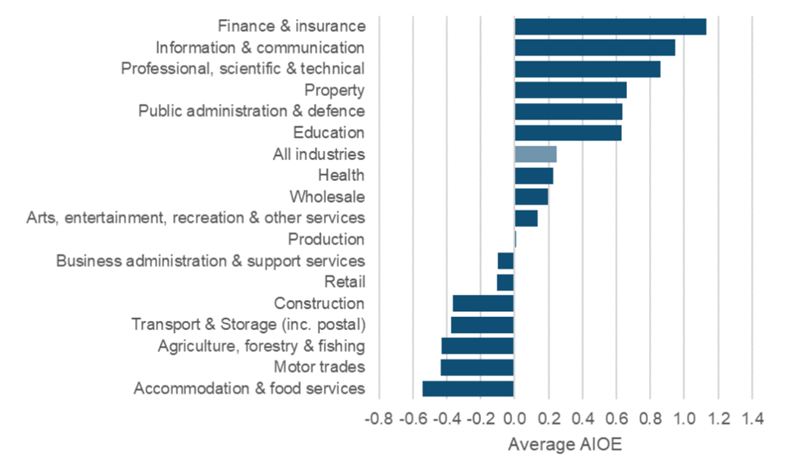
The naive recommendation is to say that the least AI-exposed occupations are the best, taking the ³⁸, become “machines of loving grace”, transforming the world for the better.
Executive Summary
The pace of AI advancements is unprecedented, with significant improvements in both model capabilities and cost efficiency. However, the economic implications of AI remain inadequately understood, with unsatisfactory insights from AI practitioners, economists and think-tanks. Economists often underestimate AI’s potential impact due to limited engagement with cutting-edge developments.
Acemoglu and Restrepo (2018)’s task-based framework is commonly used in the economics literature to analyse the impact of automation.
Automation: AI displaces labor in tasks where it is highly substitutable, reducing employment in those areas (e.g., cashiers replaced by self-checkout).
Complementarity: AI can augment labor in tasks where human expertise is still essential (e.g., economists interpreting data generated by advanced software).
Productivity Effect: Lower costs from AI can increase demand for non-automated tasks, potentially raising employment overall.
Reinstatement Effect: New tasks may emerge as AI automates existing ones, creating roles that require uniquely human skills.
I introduce my framework: AI augments or automates labor based on its performance relative to workers in a given task. If AI is better than labour, labour is automated, but if labour is better than AI, AI augments labour. These information is readily available — AI models are benchmarked against human performance in various tasks, providing timely insights into their relative capabilities. These benchmarks can be mapped to workforce skill distributions (e.g., using OECD PIAAC data) to assess which workers are most at risk of automation or likely to be augmented.
Whether AI will benefit high or low-skilled workers remains uncertain. Early empirical evidence on customer support agents, consultants and software developers suggest that lower-skilled workers benefit more. Economically, this is due to strong complementarities between automated tasks, and other non-automated, inefficient tasks, leading to performance ceiling hindering productivity gains.
However, I personally believe that higher-skilled workers benefit more because: i) within a task, they are more likely to be augmented than automated, ii) AI can be complementary to human expertise in the innovation process, as shown by Toner-Rodgers (2024), iii) there is a positive correlation between experience and AI complementarity of tasks, as workers take on management roles as they advance, iv) the commoditisation of automated tasks can lower task prices, even if skill gaps shrink due to AI, v) lower-skilled jobs face declining job opportunities due to AI, depriving them of opportunities to gain skills on the job, creating a vicious cycle.
Products with price-elastic demand (e.g., semiconductors, consumer tech products) see significant demand increases when AI reduces costs, increasing employment in complementary tasks. This can happen when: i) new markets are unlocked by cost decreases, ii) there are network effects, iii) the products enable innovation. On the other hand, products with price-inelastic demand (e.g., tax software, fast food), due to i) market saturation and ii) low potential for new applications, lead to job displacement as demand does not increase due to cost decreases.
AI is a General Purpose Technology with the potential to reshape economic structures, similar to electricity and the steam engine. In the current early stage, firms use AI for cost-cutting, limiting AI’s impact to displacing labour. Long-term integration could lead to new systems and products, offering significant productivity gains.
The best jobs are those with a mix of non-automatable tasks and automatable tasks where AI is rapidly advancing, in fields with high potential for productivity-driven demand growth (e.g., tech product managers). Workers should seek roles offering capital ownership (e.g., equity in tech companies) to benefit from AI-driven productivity gains.
Automated activities can be pursued for leisure and are still valuable, similar to running, music and art, and this could be more enjoyable due to the lack of profit motive. However, achieving equitable redistribution of AI’s benefits is critical to ensuring AI delivers broad-based benefits for all.
If you found this post helpful:
- Check out my other Medium articles: , , which transcribes and summarises podcasts and YouTube videos, and — I post more on economics and AI! And Source: Aschenbrenner, Leopold. (2024). Situational Awareness — The Decade Ahead
Image source: Source: Acemoglu, D. (2024). The Simple Macroeconomics of AI (No. w32487). National Bureau of Economic Research.
Source: Acemoglu, D., & Restrepo, P. (2018). The race between man and machine: Implications of technology for growth, factor shares, and employment. American economic review, 108(6), 1488–1542.
Source: This assumes that the computing improvements only affect the speed of the statistical software. In reality, the improvement of computer performance leads to the development of AI systems like ChatGPT Advanced Data Analysis which automate more previously manual roles of an economist.
Source: Autor, D., Chin, C., Salomons, A., & Seegmiller, B. (2024). New frontiers: The origins and content of new work, 1940–2018. The Quarterly Journal of Economics, qjae008.
Source: Dell’Acqua, F., McFowland III, E., Mollick, E. R., Lifshitz-Assaf, H., Kellogg, K., Rajendran, S., … & Lakhani, K. R. (2023). Navigating the jagged technological frontier: Field experimental evidence of the effects of AI on knowledge worker productivity and quality. Harvard Business School Technology & Operations Mgt. Unit Working Paper, (24–013).
Ability was proxied using GitHub achievements, follower count, tenure on GitHub, and centrality across ranked repositories.
Source: Acemoglu, D. (2024). The Simple Macroeconomics of AI (No. w32487). National Bureau of Economic Research.
Image source: Source: Mollick, Ethan. (2024). AI in Organisations: Some Tactics. Link: Source: Mollick, Ethan. (2024). Latent Expertise: Everyone is in R&D. Link: Source: Impact of AI on UK jobs and training. Source: Source: Amodei, Dario. (2024). Machines of Loving Grace. Link: was originally published in Towards Data Science on Medium, where people are continuing the conversation by highlighting and responding to this story.
↗ Original-Artikel auf towardsdatascience.com lesenVollständiger Original-BerichtAusführliche Details, Code-Beispiele & Hersteller-Stellungnahme auf towardsdatascience.com.

SOCIAL SHARE CARD GENERATOR