



Table of contents
- What is AWS Proton?
- AWS Proton & AWS Cloudformation is same?
- How AWS Proton Works?
- conclusion
Hey folks 👋,
maybe you just found out that AWS has released one of the new services again in 2020 which even I forgot about the new update :) AWS gave the name of the service called AWS Proton. maybe this proton is similar to the Cloudformation model infrastructure as code.
in this post I will introduce you to AWS Proton and the difference with cloudformation. 🌟
What is AWS Proton? 🤔
✅ AWS Proton is a powerful automation solution that simplifies infrastructure management and application deployment for both administrators and developers.
✅ For administrators, AWS Proton provides a comprehensive framework to create and maintain service templates containing complete application stacks.
✅ For developers, AWS Proton offers a self-service interface where they can easily choose pre-defined service templates that fit their project needs.
What is the difference between AWS Proton & AWS Cloudformation? ⚙
AWS CloudFormation :
✅ A general-purpose infrastructure as code (IaC) service
✅ Allows you to define and provision infrastructure resources using templates
✅ Supports a wide range of AWS resources and can be used for almost any infrastructure setup
✅ Primarily focused on infrastructure provisioning
✅ Works at a lower-level of abstraction, giving developers more granular control
AWS Proton :
✅ A higher-level, more opinionated service specifically for container and serverless applications
✅ Provides standardized, pre-approved templates for entire application stacks
✅ Includes built-in CI/CD pipeline configuration
✅ Focuses on creating a self-service platform for developers
✅ Automates not just infrastructure provisioning, but also deployment pipelines
How AWS Proton Works ? 👨💻
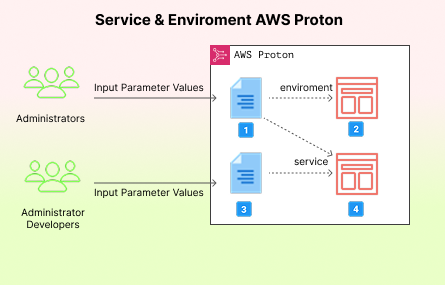
- When you choose an environment template with AWS Proton, you provide values for the relevant input parameters.
- AWS Proton prepares your environment based on the environment template and parameter settings.
- When you use AWS Proton to pick a service template, you supply values for the relevant input parameters. You also pick an environment in which to deploy your application or service.
- To supply your service, AWS Proton utilizes the service template as well as the values of your service and the environment parameters you have defined.
You choose the input parameters to modify your template for reuse and numerous use cases, applications, or services.
To make this work, you generate environment or service template bundles and submit them to the appropriate registered environment or service templates.
Conclusion 📃
AWS Proton emerges as an innovative cloud infrastructure automation solution that transforms how organizations manage and deploy serverless and container-based applications, providing administrators with a powerful framework for creating standardized templates and developers with a self-service interface to streamline application deployments.
Unlike the more generic CloudFormation, Proton takes a more opinionated approach with features like version management, automatic CI/CD pipeline configuration, and one-click infrastructure updates, allowing businesses to create more efficient, consistent, and scalable cloud deployment strategies.
By bridging the gap between infrastructure management and application development, AWS Proton enables technology teams to optimize development processes, reduce manual configuration overhead, and ensure alignment with organizational best practices, ultimately changing the way modern cloud-native applications are designed, provisioned, and maintained.