
Zum Hauptinhalt springen
Echtzeit-Radar & Feeds
Alle RSS Feeds ➔
👥 Community & Social
••••••••
Sichere ProgrammierungI built a tool that makes images bigger, not smaller – here's why(25.09.2026 um 05:56 Uhr)
••••••••••
Sichere ProgrammierungI built a tool that makes images bigger, not smaller – here's why(25.09.2026 um 05:56 Uhr)
••
Intelligence View
⚡ tsecurity.de Intelligence

Stop Abusing – Use the Right HTML Elements Instead!

Let's be honest—most developers have misused <div> at some point. It starts innocently: a quick wrapper here, a flex container there. Before you know it, your entire page is buried under a mountain of <div> elements, turning y…

0
↗ Quelle (dev.to)
Reagiere als Erste:r — dein Feedback zählt!

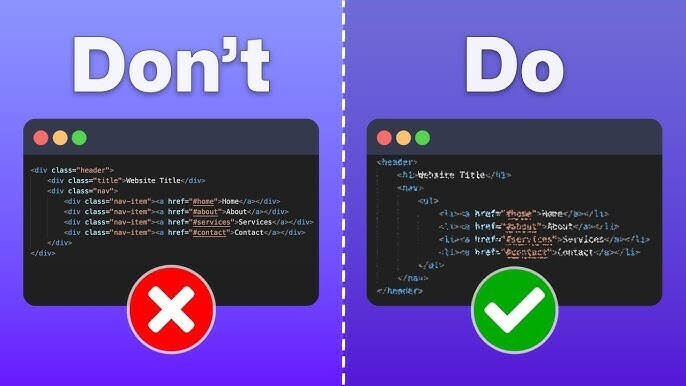
Image description


Let's be honest—most developers have misused <div> at some point.


It starts innocently: a quick wrapper here, a flex container there. Before you know it, your entire page is buried under a mountain of <div> elements, turning your HTML into an unmanageable mess.


And sure, it might work, but at what cost? Overusing <div> leads to accessibility issues, poor SEO, and painful maintenance.


Let’s fix this.


Why Developers Overuse <div> (And Why It's a Problem)


Many developers default to <div> because:


✅ It’s neutral and doesn’t impose styles.

✅ It’s a flexible generic container.

✅ It requires no extra thought.


But here’s the issue: Not everything should be a <div>.


Using <div> for everything is like writing an entire book without paragraphs—it might be readable, but it’s far from optimal.


The Downsides of <div> Overuse


🚨 Accessibility Issues: Screen readers treat <div> elements as meaningless containers. Overusing them creates a frustrating experience for visually impaired users.


⚡ SEO Problems: Search engines rely on meaningful HTML elements to understand page structure. A page overloaded with <div> elements can hurt rankings.


😵 Difficult Maintenance: Ever tried debugging a <div> soup? It’s a nightmare.


What to Use Instead of <div>


HTML provides semantic elements that add meaning to your content. Using them makes your code cleaner, more accessible, and SEO-friendly.


1. Use <section> for Sections


Instead of wrapping large content sections in a <div>, use <section>.


❌ Bad:


<div class="about-us">
<h2>About Us</h2>
<p>We build amazing things.</p>
</div>


✅ Good:


<section>
<h2>About Us</h2>
<p>We build amazing things.</p>
</section>


Why? <section> clearly defines a section of content, making it easier for both developers and search engines to understand the page structure.


2. Use <article> for Independent Content


If a piece of content can stand alone (e.g., a blog post, news article, or product listing), use <article>.


❌ Bad:


<div class="blog-post">
<h2>Why HTML Matters</h2>
<p>HTML makes the web work.</p>
</div>


✅ Good:


<article>
<h2>Why HTML Matters</h2>
<p>HTML makes the web work.</p>
</article>


Why? <article> helps search engines recognize self-contained pieces of content, improving discoverability and SEO.


3. Use <nav> for Navigation Menus


A <div class="nav"> is meaningless. Use <nav> instead.


❌ Bad:


<div class="nav">
<a href="/">Home</a>
<a href="/about">About</a>
</div>


✅ Good:


<nav>
<a href="/">Home</a>
<a href="/about">About</a>
</nav>


Why? <nav> explicitly indicates that these links are for site navigation, enhancing accessibility and usability.


Use <header> for page or section headers and <footer> for footers.


❌ Bad:


<div class="header">
<h1>My Website</h1>
</div>


✅ Good:


<header>
<h1>My Website</h1>
</header>


Why? These elements provide clear meaning and improve document structure.


When Is It Okay to Use <div>?


<div> isn’t evil—it has its place. Use it when:


✅ You need a generic wrapper with no semantic meaning.

✅ You're creating flex/grid-based layouts.

✅ No appropriate semantic alternative exists.


Example: A Flexbox Wrapper


<div class="card-container">
<article class="card">Card 1</article>
<article class="card">Card 2</article>
</div>


Here, <div> is fine because it purely serves as a layout container.


Use <div> Wisely


Think of <div> like seasoning in cooking—necessary in moderation but disastrous when overused.


Before wrapping everything in <div>, ask yourself:


“Is there a more meaningful HTML element for this?”


If the answer is yes, use it. Future-you (and everyone interacting with your site) will thank you.


🔥 P.S. If your HTML looks like a <div> jungle, don’t worry. Start small—replace key sections with semantic elements and iterate from there.


A cleaner, more accessible web starts with better code. 🚀


Are you guilty of <div> overuse? Share your experiences in the comments! 👇

1. Sofort-Triage & Abwehrmaßnahmen

SOC Incident Playbook: Vulnerability Remediation & Verification
Syntax validiert (0 Fehler)
title: Detect Exploitation - Stop Abusing – Use the Right HTML Elements Instead!
id: 2c758ea8-cb01-4492-b991-bc6fb7b92cc2
status: experimental
description: Automatisch generierte SIEM-Erkennungsregel basierend auf CTI Intelligence
references:
  - https://tsecurity.de/
author: iShareStuff CTI Automated Detection Engine
date: 2026-09-25
logsource:
  category: network_connection
  product: any
detection:
  selection:
      CommandLine|contains:
        - 'exploit'
  condition: selection
falsepositives:
  - Legitime administrative Zugriffe oder Penetrationstests
level: high
tags:
  - attack.initial_access
Syntax validiert (0 Fehler)
rule CTI_Threat_Indicator {
    meta:
        author = "iShareStuff CTI Automated Detection Engine"
        date = "2026-09-25"
        description = "YARA Signature for "
    strings:
        $str = "Stop Abusing – Use the Right H" ascii wide
    condition:
        any of them
}
Syntax validiert (0 Fehler)
index=security sourcetype IN ("cisco:asa", "pan:traffic", "zeek_conn", "suricata", "WinEventLog:Security")
("Stop Abusing  Use the Right HTML Element")
| stats count earliest(_time) as first_seen latest(_time) as last_seen by src_ip, dest_ip, dest_host, signature
| eval first_seen=strftime(first_seen, "%Y-%m-%d %H:%M:%S"), last_seen=strftime(last_seen, "%Y-%m-%d %H:%M:%S")
| sort - count
Syntax validiert (0 Fehler)
message: "*Stop Abusing  Use the Right HTML Element*"
Syntax validiert (0 Fehler)
CommonSecurityLog
| where Message has "Stop Abusing  Use the Right HTML Element"
| summarize EventCount = count(), FirstSeen = min(TimeGenerated), LastSeen = max(TimeGenerated) by SourceIP, DestinationIP, DestinationPort, Activity
| extend DetectionRule = "iShareStuff-CTI-Compiled"
| sort by EventCount desc

2. Cyber Threat Intelligence & Forensik

🎯
MITRE ATT&CK Matrix Navigator 14 Taktiken
Reconnaissance
-
Resource Development
-
Initial Access
Execution
Persistence
-
Privilege Escalation
Defense Evasion
Credential Access
-
Discovery
-
Lateral Movement
-
Collection
-
Command and Control
Exfiltration
-
Impact
tsecurity.de Cognitive Threat RAG
Fokus-Vektor:

Kognitive Analyse für identifizierte Bedrohung: Erhöhte Bedrohungslage im Bereich Stop Abusing – Use the Right HTML Elemen.... Basierend auf 368k Vektor-Korrelationen werden sofortige Isolationsmaßnahmen für betroffene Endpunkte empfohlen.

🛡️ Angriffsfläche & Exposure

Netzwerk/Remote-Zugriff ohne Vorauthentifizierung möglich.

⚡ Empfohlene Sofortmaßnahmen
  • 1. Perimeter-Inspektion: Relevante Portfreigaben und exponierte Endpunkte unverzüglich scannen.
  • 2. Patch-Applikation: Hersteller-Hotfix einspielen oder betroffene Daemons in isolierte DMZ-Segmente überführen.
  • 3. Telemetrie & EDR-Alerts: Prozessaufrufe und Child-Processes auf anomale Shell-Spawns überwachen.
🔗 Semantisch verwandte Zero-Days MariaDB 11.7 VEC
Ähnliche Beiträge
🔍 Verwandte News

Auch interessante Nachrichten Stop Abusing – Use the Right HTML Elements Instead!

Thematisch verwandte Begriffe: Stop, Abusing, ltdivgt, Right · 6 Treffer

Laden...

Videos werden geladen ...

Laden...

Beiträge werden geladen ...

Laden...

Videos werden geladen ...

Laden...

Beiträge werden geladen ...

Laden...

Videos werden geladen ...

Laden...

Beiträge werden geladen ...

Laden...

Videos werden geladen ...

Laden...

Beiträge werden geladen ...

Laden...

Videos werden geladen ...

Zum Aktualisieren ziehen
ZERO-DAY CVE-2026-87722 | Uncontrolled Resource Consumption (CWE-400 / CWE-1333) in regex search q…
Advisory →
tsecurity.de Icon
Offline-Lesen, Eilmeldungen & 0ms Ladezeit

Installiere tsecurity.de direkt auf deinen Home-Bildschirm für das ultimative Vollbild-Magazinerlebnis ohne Browser-Leisten.

Nächster Beitrag