
Introduction
Have you ever found yourself drowning in thousands of photos, desperately looking for pictures of specific people? In this article, I'll walk you through building Quick Face Sort, an automated solution that uses AWS's facial recognition capabilities to organize your images.
The Problem: Digital Photo Overload
Most of us accumulate thousands of images through messaging apps like WhatsApp. While a lot of these are memes or screenshots we don't need to keep, some contain precious moments with family and friends. Manually sorting through this digital pile is time-consuming and tedious.

The Solution: Quick Face Sort
Quick Face Sort is a serverless application that:
- Takes reference photos of people you want to find
- Scans through your image collection
- Automatically groups photos containing those people
The entire process is event-driven and serverless, meaning it scales automatically and you only pay for what you use.
Architecture Overview
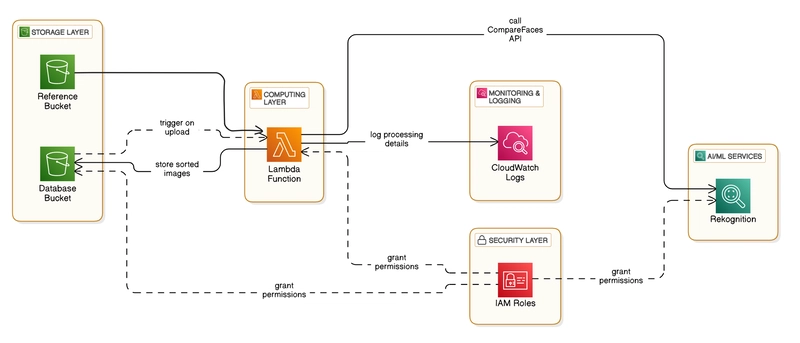
The solution uses these AWS services:
S3: Two buckets, one for reference faces and another for images to be sorted
Lambda: Serverless function that processes images using facial recognition
Rekognition: AWS's AI service for image analysis
CloudWatch: For monitoring and logging
How It Works
- You upload reference photos to the reference S3 bucket
- You upload your unsorted photos to the database S3 bucket
- S3 event notifications trigger the Lambda function
- The Lambda function uses AWS Rekognition to compare faces
- Images with matching faces (>95% similarity) are organized into folders
- Results are logged to CloudWatch for monitoring
Building the Solution with Terraform
Let's dive into the code. We'll use Terraform to define our infrastructure as code:
1. S3 Buckets for Image Storage
resource "aws_s3_bucket" "reference_bucket" {

  bucket = "quicksort-reference-bucket-20250404"

}


resource "aws_s3_bucket" "database_bucket" {

  bucket = "quicksort-database-bucket-20250404"

}


# Set security controls

resource "aws_s3_bucket_public_access_block" "reference_access_block" {

  bucket = aws_s3_bucket.reference_bucket.id


  block_public_acls       = true

  block_public_policy     = true

  ignore_public_acls      = true

  restrict_public_buckets = true

}
2. Lambda Function with Python
The Lambda function uses Python and the Boto3 SDK to:
- List images in both buckets
- Compare faces using Rekognition
- Organize matches into folders
def compare_faces(source_image, target_image, similarity_threshold=90):

    try:

        response = rekognition.compare_faces(

            SourceImage={

                'S3Object': {

                    'Bucket': reference_bucket,

                    'Name': source_image

                }

            },

            TargetImage={

                'S3Object': {

                    'Bucket': database_bucket,

                    'Name': target_image

                }

            },

            SimilarityThreshold=similarity_threshold

        )

        return response

    except Exception as e:

        logger.error(f"Error comparing faces: {str(e)}")

        return None
3. IAM Roles and Permissions
resource "aws_iam_role" "lambda_role" {

  name = "quicksort_lambda_role"


  assume_role_policy = jsonencode({

    Version = "2012-10-17",

    Statement = [{

      Action = "sts:AssumeRole",

      Principal = {

        Service = "lambda.amazonaws.com"

      },

      Effect = "Allow"

    }]

  })

}


# Custom policy for S3 and Rekognition access

resource "aws_iam_policy" "lambda_policy" {

  name = "quicksort_lambda_policy"


  policy = jsonencode({

    Version = "2012-10-17",

    Statement = [

      {

        Action = [

          "s3:GetObject",

          "s3:PutObject",

          "s3:CopyObject",

          "s3:ListBucket",

        ],

        Resource = [

          aws_s3_bucket.reference_bucket.arn,

          "${aws_s3_bucket.reference_bucket.arn}/*",

          aws_s3_bucket.database_bucket.arn,

          "${aws_s3_bucket.database_bucket.arn}/*"

        ],

        Effect = "Allow"

      },

      {

        Action = ["rekognition:CompareFaces"],

        Resource = "*",

        Effect = "Allow"

      }

    ]

  })

}
4. S3 Event Notifications
resource "aws_s3_bucket_notification" "bucket_notification" {

  bucket = aws_s3_bucket.database_bucket.id


  lambda_function {

    lambda_function_arn = aws_lambda_function.quicksort_function.arn

    events              = ["s3:ObjectCreated:*"]

  }

}
Deployment and Usage
Deploying the solution is straightforward:
1. Clone the repository:
git clone https://github.com/sin4ch/quick-face-sort.git

cd quick-face-sort
2. Deploy with Terraform:
cd terraform

terraform init

terraform plan

terraform apply
Cost Considerations
This solution uses several AWS services that incur costs:
- S3 storage for your images
- Lambda function invocations
- Rekognition API calls
- CloudWatch Logs
The good news is that AWS's pricing model means you only pay for what you use. For personal photo libraries, costs should be minimal.
Security Notes
The application uses best practices for security:
- Private S3 buckets with no public access
- Least-privilege IAM permissions
- No long-term storage of facial recognition data
Conclusion
Quick Face Sort demonstrates the power of combining serverless computing and AI services to solve real-world problems. With minimal code and maintenance, you can build a solution that automatically organizes thousands of photos, saving hours of manual work.
The complete code is available on GitHub - feel free to use it, contribute, or adapt it for your needs.
Have you built something similar? How do you organize your photo collections? I'd love to hear your thoughts and questions in the comments! 😊🧡