



Each activity developed in a tech company has its own peculiarities and challenges. Without a doubt, overengineering is one of the common fears across practically every area of software development.
In the constant race of the tech market, companies face a “natural pressure” to adopt new solutions. Overthinking before implementing a more robust architecture or an innovative new tool — one that offers superior performance and significantly lower costs — can be decisive in achieving a competitive edge or falling behind the competition. However, we often forget that an excess of features can be just as harmful as their absence.
I'd like to reflect on how costly — or even deadly — the pursuit of perfection can be for a product. I think most developers will relate to the cycle below:
Brilliant idea pops up:
“Wow, this would solve a real problem! No one’s done this yet??”
Market/competitor research:
“Hmm, there's something similar… but I think I can do it better.”
Stack and architecture selection:
“Okay, I’ll use the most modern stack I know, with clean architecture, DDD, CQRS, event sourcing, monorepo with turborepo, microservices with gRPC, and of course, full TypeScript.”
Overstructuring:
“Before writing any feature, I’ll set up all the folders just right, configs, pipelines, tests, linter, husky, commitizen, docker-compose, etc.”
Fatigue/anxiety/overload:
“Ugh… just thinking about doing all of this is exhausting. And I still have that other job/freelance/deadline…”
Silent abandonment:
“One day I’ll come back…”
The repo stays there, with an unfinished README and three commits.
Now imagine the impact of this cycle on a company. In the example above, the developer decides to become their own boss and put an original idea into practice — but the only difference between this and a scenario where the same developer works for a company is the last step. In that case, the project usually isn’t abandoned — on the contrary, it grows.
Why Can Too Much Be Worse Than Too Little?
“The difference between a remedy and a poison is the dose.”
This quote, attributed to the physician Paracelsus, goes far beyond medicine and perfectly applies to software development. The system you’re building might have deficiencies or pathologies; however, applying every possible “remedy” without understanding the real needs or rationale behind each solution might worsen the situation.
To illustrate, here are the downsides of each extreme:
Too Little:
Maintenance difficulties: Lack of organization and standardization in the codebase can turn debugging into a nightmare — even for the developer who wrote it.- Lack of scalability;
- Low reliability;
- Inefficient performance;
- Slower delivery pace.
Too Much:
Maintenance difficulties: Unnecessary complexities can make the code confusing and hard to update.- Need for a highly skilled team;
- A combination of the problems mentioned in the “Too Little” section, amplified by additional complexity.
Causes and “Technical Mirages”
The causes of under- and overengineering may go in opposite directions. While a lack of engineering is often linked to technical debt or short-term thinking, excess usually stems from a relentless pursuit of perfection, mixed with a shallow understanding of various tools and an overly cautious mindset.
A developer with a “toolbox full of tools” doesn’t necessarily know the right time to use each one. In today’s fast-paced information world, it’s common to learn about many solutions through short videos or quick courses. However, having a superficial understanding of a concept — as explained in a five-minute video — is not the same as mastering its real-world application.
We must be careful not to confuse “knowing” with “mastering.” Especially when learning a new framework, it’s important to avoid “technical mirages” that trick us into thinking we understand enough to apply complex solutions without deep analysis.
Speculations and Their Branches
While researching this topic, I noticed that many articles and videos (I'll link some at the end) highlight “speculation” as a common factor. Speculation leads to several consequences, such as:
Poorly defined scope: The vaguer the requirements, the broader the code tends to be, in an attempt to “protect” against uncertainties.
Excessive coverage: Developers, trying to cover all scenarios, may end up turning simple tasks into bigger problems — especially when there are no exciting challenges or tight deadlines.
Moreover, boredom can lead to overengineering. There are two common developer profiles:
- The one who completes tasks on time, but whose idle habits lead to unproductive behavior;
- The one who is always looking to learn and apply new technologies.
While the second profile is generally more productive, if not challenged with stimulating tasks, they may turn a simple solution into a complex one just to try out something new.
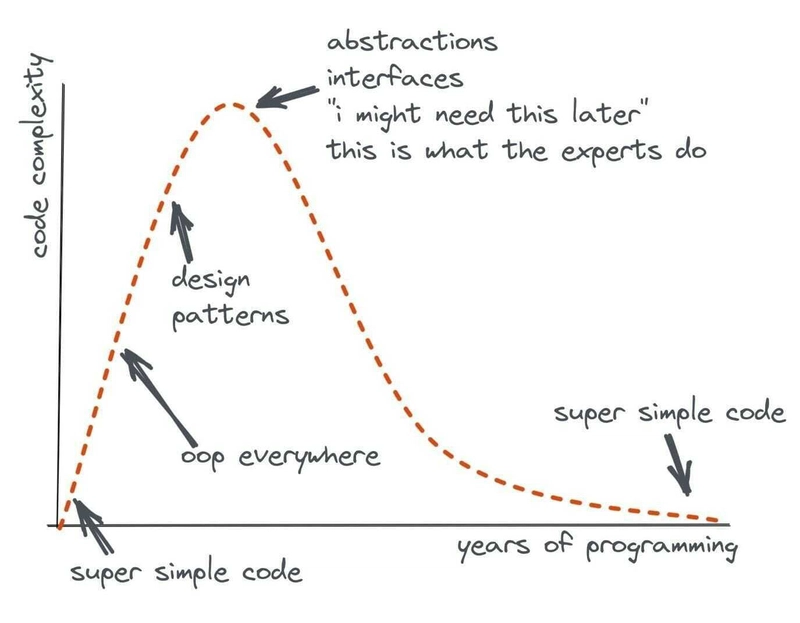
(Overengineering can kill your product)
Another classic example is premature optimization. Preparing a system for high traffic with an overly complex infrastructure — before having any users — is a trap. Fancy and complex architectures may be unnecessary if their strengths don’t match the current context. A good, scalable solution is one that paves a clear path for growth and simplifies future decisions without trying to cover every possible scenario.
Exploring the Consequences
Every decision involves trade-offs. Growing complexity increases the onboarding curve for new team members, raising costs. In some cases, this may pay off in the long run. But often, excessive complexity creates dependency on senior developers and makes work harder for junior ones, increasing technical debt. This shows up in harder debugging, expensive maintenance, and rising infrastructure costs.
Stepping a bit outside the coding side and into process management, in Scrum, simply breaking down tasks more effectively has a direct impact on the INVEST rule (Independent, Negotiable, Valuable, Estimable, Small, Testable). This significantly improves refinement and allows for more precise, realistic estimations. Here’s a simple example:
-- Card 1 --


Name: Develop a login screen


Description:

[ ] The user should be able to log in and recover their password.
-- Card 2 --


Name: Develop a login screen


Description:

[ ] Must include an Email field with format validation and visual feedback;

[ ] Must include a Password field with length validation (minimum 6 characters) and visual feedback;

[ ] Must include a “Recover password” link that redirects the user to another page (this page will be developed later).
When faced with Card 1, developers immediately think of many questions and scenarios: will the login use email or username? Will validation happen only on the backend or also on the frontend? What are the exact validation rules? How long would it take to develop the password recovery page? Will the link be sent via email or SMS? Maybe it’s better to make something flexible now to allow future changes...
This scenario often leads to inflated estimates, more effort required for delivery, a high risk of scope creep, a greater chance of adding unnecessary features, and, of course, overengineering. The feeling is similar to those classic cartoon scenes, where a shadow on the wall looks like a scary monster — but when the light comes on, it turns out to be just a stuffed toy.
This psychological effect directly impacts the team’s proactiveness and raises stress levels, seriously undermining adherence to the Scrum values: focus, courage, commitment, respect, and openness.
How to Avoid Overengineering?
The key to avoiding overengineering is questioning the “why” behind each decision and staying focused on solving real problems. Some guidelines that help in this process are:
Keep It Simple, Stupid (KISS): Always aim for the simplest solution that meets the requirements. This ensures more readable code and reduces the need for high technical knowledge for maintenance and understanding.
You Ain’t Gonna Need It (YAGNI): If there’s no concrete demand for a feature, don’t implement it. Solutions for imaginary problems generate unnecessary code and wasted time. Studies — such as the one from Pennsylvania State University — show that about 91% of speculated problems never materialize.
There are more specific ways to avoid overengineering depending on your role in the development cycle. For those in leadership, talk to your team and stay open to new perspectives. If you find yourself explaining your solution at length to justify it, that might be a sign that it’s more complex than necessary. Focus on optimizing the areas that have the greatest impact on the product — that 1% of code that could potentially improve 90% of results — instead of investing effort in less relevant areas.
In management roles, being as specific as possible when passing along requirements tends to create “guard rails” for the dev team, preventing developers from having to overthink all the possible problems/scenarios a new solution might involve.
Conclusion
This text wasn’t written to justify differences of opinion regarding architectures or tools in collaborative projects, but to emphasize the importance of understanding the impact of each decision. Balance is essential for healthy development. Seek knowledge, gain experience, test and train — but always remember that a good sailor doesn’t use their experience to sail through more storms, but to avoid them.
Share your experiences, review your projects with this perspective in mind, and stay focused on delivering real value through simple, effective solutions.
Links and References
SOCIAL SHARE CARD GENERATOR