



Modern ticketing platforms like BookMyShow and DISTRICT handle massive traffic spikes (100k+ users) while maintaining fairness and real-time updates. This guide explores how to architect such a system using WebSockets, Redis, and a scalable backend.
📌 Problem Statement & Requirements
When selling limited tickets for high-demand events (concerts, festivals), we need:
✔ Massive Scalability – Handle 100k+ concurrent users.
✔ Fair Queueing – First-come-first-served (FCFS) using a real-time queue.
✔ Resilience – Survive server crashes, network issues.
✔ Real-Time Updates – Users see their live position in the queue.
✔ Purchase Notifications – Alert users when it's their turn to buy.
🏗 System Architecture Overview
🔹 Core Components
- Client (Web/Mobile) – Connects via WebSocket for real-time updates.
- Load Balancer (NGINX, AWS ALB) – Distributes WebSocket connections.
- WebSocket Servers (Node.js, Go, etc.) – Maintain live connections.
- API Server (REST/GraphQL) – Handles ticket purchases.
- Redis – Manages queue (Sorted Set) and Pub/Sub for real-time sync.
Sequence Diagram - LLD
Let's understand the whole flow with the help of sequence diagram:
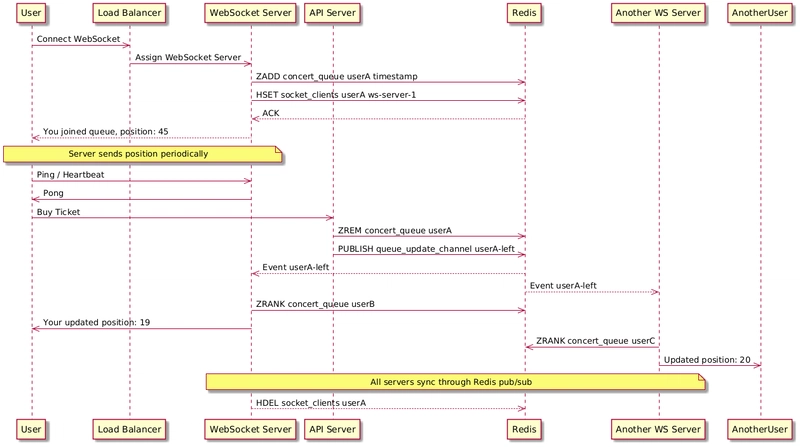
Explaining the Sequence Diagram (Detailed Full Lifecycle Flow)
This sequence diagram represents a complete lifecycle of a user joining the queue, getting updates in real time, buying a ticket, and how the system maintains synchronization across multiple servers.
Let's break it down step by step:
👤 1. User Connects to Queue via WebSocket
- A user opens the app or website and initiates a WebSocket connection.
- The Load Balancer (e.g., NGINX, AWS ALB) routes this connection to one of the WebSocket servers (WS).
➕ 2. User is Added to the Queue in Redis
- The WebSocket server adds the user to the sorted set (ZADD) in Redis.
- Additionally, it stores a mapping of user to server (HSET socket_clients) for monitoring/debugging (optional).
✅ 3. User Receives Confirmation & Position
- Redis acknowledges the insert.
- The server calculates the user's rank in the queue (ZRANK) and sends the initial position to the user.
🔁 4. Periodic Heartbeat (Health Check)
- Client sends periodic ping messages to keep the connection alive.
- Server responds with pong. This prevents timeout and helps detect disconnections.
🎟️ 5. User Buys a Ticket via API
- User clicks “Buy Ticket”.
- The API (can be same as WS or separate) removes them from the queue using ZREM.
- Publishes an event via PUBLISH to the queue_update_channel in Redis.
📢 6. Redis Pub/Sub Broadcasts to All Servers
- All WebSocket servers are subscribed to queue_update_channel.
- They receive the published message (userA-left) and act accordingly.
📬 7. Servers Calculate and Send Updated Queue Positions
- After someone leaves the queue, everyone behind them needs a new position.
- Each WebSocket server queries Redis (ZRANK) for the latest positions of their connected users.
- Sends updates via WebSocket.
🧹 8. Cleanup After Leaving
Once the user leaves or buys the ticket, we remove their socket mapping (optional).
🤝 Server-to-Server Communication (Why This Works)
- Servers don’t talk to each other directly — instead:
- All servers are subscribers to the same Redis Pub/Sub channel.
- When a queue change happens (buy/leave), a message is published to Redis.
- Redis broadcasts it to all subscribers (all WS servers).
- Each server reacts
🚀 Benefits of This Architecture
- No tight coupling between servers.
- Highly scalable — just add more WS servers.
- Single source of truth (Redis).
- Can easily recover from failure (via reconnect + Redis state).
🔌 Deep Dive: Key Mechanisms
1️⃣ Redis Data Structure (Sorted Set - ZSET)
- ZADD concert_queue
- ZRANK concert_queue → Returns position (0 = first).
- ZREM concert_queue → Removes user after purchase.
✅ Why Sorted Set?
- O(log N) time complexity for inserts/removals.
- Atomic operations prevent race conditions.
2️⃣ WebSocket Flow (Real-Time Updates)
Client-Side Connection
const socket = new ReconnectingWebSocket("wss://tickets.example.com/queue");


socket.onopen = () => {

  socket.send(JSON.stringify({

    type: "join_queue",

    userId: "user123",

    authToken: "Bearer xyz"

  }));

};


socket.onmessage = (event) => {

  const data = JSON.parse(event.data);

  if (data.type === "position_update") {

    console.log(`Your position: ${data.position}`);

  }

};
Server-Side Handling
const WebSocketMap = new Map(); // userId → WebSocket


wss.on("connection", (socket) => {

  socket.on("message", async (msg) => {

    const { type, userId } = JSON.parse(msg);


    if (type === "join_queue") {

      WebSocketMap.set(userId, socket);

      const position = await redis.zrank("concert_queue", userId);

      socket.send(JSON.stringify({ type: "position_update", position }));

    }

  });

});
3️⃣ Pub/Sub for Cross-Server Sync
When a user buys a ticket (or leaves), we remove them from the queue and notify all servers:
// API Server (after ticket purchase)

await redis.zrem("concert_queue", userId);

await redis.publish("queue_updates", JSON.stringify({

  event: "user_left",

  userId

}));


// All WebSocket Servers (subscribed)

redis.subscribe("queue_updates");

redis.on("message", (channel, msg) => {

  const { event, userId } = JSON.parse(msg);

  if (event === "user_left") {

    // Recalculate & broadcast positions

    WebSocketMap.forEach(async (socket, userId) => {

      const position = await redis.zrank("concert_queue", userId);

      socket.send(JSON.stringify({ type: "position_update", position }));

    });

  }

});
Let's Understand it by going one step more deeper
🔌 WebSocket Flow (Client ↔️ Server)
- Client Connects to WebSocket
const socket = new WebSocket("wss://ticket.com/ws");

socket.send(JSON.stringify({ type: "join", userId: "userA" }));
- Server Handles Connection
wss.on("connection", (socket) => {

  socket.on("message", async (msg) => {

    const data = JSON.parse(msg);

    if (data.type === "join") {

      WebSocketMap.set(data.userId, socket);

      const position = await redis.zrank("concert_queue", data.userId);

      socket.send(JSON.stringify({ type: "queue_update", position }));

    }

  });

});
- Queue Position Update (Purchase or Leave)
// Example: userB buys ticket

await redis.zrem("concert_queue", "userB");


// Publish event

redis.publish("queue_update_channel", JSON.stringify({ userId: "userB" }));
- Pub/Sub Broadcasting
Every server listens:
redis.subscribe("queue_update_channel");


redis.on("message", async (channel, msg) => {

  const data = JSON.parse(msg);

  // broadcast to all WebSocket clients

  WebSocketMap.forEach(async (socket, userId) => {

    const position = await redis.zrank("concert_queue", userId);

    socket.send(JSON.stringify({ type: "queue_update", position }));

  });

});
🧩 Handling Edge Cases
🔴 1. WebSocket Server Crashes
Problem: In-memory WebSocketMap is lost.
Solution:
- Clients auto-reconnect using ReconnectingWebSocket.
- On reconnect, server re-fetches position from Redis.
🔴 2. Client Disconnects (Network Issues)
Solution:
- Heartbeat checks (ping/pong).
- If no response for 30s, remove from queue:
await redis.zrem("concert_queue", userId);

redis.publish("queue_updates", JSON.stringify({ userId }));
🔴 3. Redis High Availability
Solution:
- Use Redis Cluster + Persistent Storage.
- Fallback to database-backed queue if Redis fails.
⚡ Scaling Strategies
Component Scaling Approach
- WebSocket Servers -> Horizontal scaling + sticky sessions.
- Redis -> Sharding (if queue exceeds memory).
- API Servers -> Stateless, auto-scaling (Kubernetes).
✅ Final Architecture - FlowChart Diagram

🚀 Conclusion
This architecture ensures:
✔ Real-time queue updates via WebSockets.
✔ Scalability with Redis + horizontal scaling.
✔ Resilience against crashes and disconnects.
Used by: DICE, DISTRICT, Ticketmaster’s virtual queues.
*What are Next Steps - *
- Add rate limiting to prevent abuse.
- Implement priority queues (e.g., premium users).
- Use Kubernetes for auto-scaling.
This is how we can make scalable, reliable and maintable real time artitechtures where we can handle millions of traffic!
Read this far ? hope you liked the article 😊 Yes ? Give the thumps Up! and leave your feedback. It gives me motivation to write more and share with the community!