



QUIC (Quick UDP Internet Connections) is a modern network protocol that redefines how data is transmitted over the internet. It is designed to overcome the limitations of TCP and UDP, while integrating security and multiplexing features that were previously handled separately by protocols like TCP and TLS. In this article, we’ll take a deep dive into how QUIC works, its integration with HTTP/3, its place in the OSI model, and how it’s already deployed on sites like hwiki.xyz.
What is QUIC?
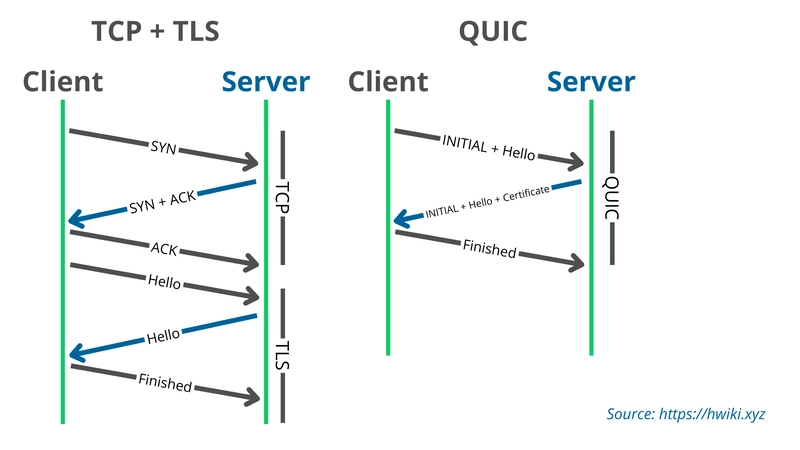
QUIC is a transport protocol developed by Google to improve the performance of web applications. It relies on UDP (User Datagram Protocol) instead of TCP, allowing it to reduce latency and optimize data flow management. QUIC was designed to address the classic problems of TCP, such as the 3-way handshake latency and head-of-line blocking, where the loss of a single packet blocks the entire connection.
How QUIC Works
QUIC operates with several key features that set it apart:
- No 3-way handshake: QUIC reduces the connection establishment process to 1 or 0 RTT (Round Trip Time), unlike TCP which requires 3 RTT to establish a connection.
- Efficient multiplexing: Unlike TCP, QUIC allows multiple independent data streams to be sent over the same connection. The loss of one packet does not block the others.
- Native encryption: QUIC integrates TLS 1.3 directly into the protocol, ensuring that all communications are encrypted from the start of the connection.
QUIC and HTTP/3
The HTTP/3 protocol is entirely dependent on QUIC for data transport, providing major improvements over previous versions of HTTP. Unlike HTTP/2, which relies on TCP, HTTP/3 uses QUIC to establish connections faster, while improving the handling of simultaneous connections and security.
Note: Adopting HTTP/3 does not mean your site will be "quic://" instead of "https://". The "https://" URL remains the same in browsers, but under the hood, the connection is made using HTTP/3, which relies on QUIC as the transport protocol.
QUIC in the OSI Model
The OSI model is a layered framework used to describe how networks function. It consists of seven layers, from Layer 1 (Physical) to Layer 7 (Application). QUIC primarily fits into Layer 4 (Transport), but its functionality extends beyond this traditional layer. Here’s how QUIC fits into the OSI model:
| Element | OSI Layer |
|---|---|
| QUIC (transport) | 4 |
| QUIC (integrated encoding, TLS handshake) | 6 |
| QUIC (multiplexing / sessions) | 5 |
Deploying QUIC: hwiki.xyz and Other Sites
Today, QUIC and HTTP/3 are already used by many websites, including giants like Google, Facebook, YouTube, and many others. On hwiki.xyz, for example, connections between the client and server pass through Cloudflare, which supports HTTP/3 and QUIC. This means hwiki.xyz is already benefiting from QUIC, with lower latency and secure-by-default connections.
Note: If you’re using Cloudflare for your website, it’s likely that you already benefit from HTTP/3 without needing additional configuration.
Testing QUIC on Your Website
If you want to check if your site is using HTTP/3 and QUIC, you can use tools like your browser DevTools (F12) or curl with the --http3 option:
curl -I --http3 https://your-site.com
This will let you see if HTTP/3 is being used for the connection.
QUIC’s Pros and Cons
Pros
Reduced Latency: Faster connections thanks to 1 or 0 RTT.
Improved Multiplexing: Multiple independent data streams without interference.
Secure: Built-in encryption with TLS 1.3, no plaintext data.
Connection Migration: Allows maintaining a connection even when the client changes its IP address.
Cons
Limited compatibility with some firewalls: QUIC uses UDP, which can be filtered by firewalls.
Complex management: Diagnosing QUIC connections requires special tools and packet decryption.
Conclusion
QUIC is a revolutionary change in how data is transported on the Internet. With its ability to reduce latency, its built-in encryption, and its handling of multiplexed connections, it paves the way for a faster and more secure web. The adoption of HTTP/3, which relies entirely on QUIC, is already well underway, and sites like hwiki.xyz are reaping its benefits.
Looking Ahead
As HTTP/3 adoption continues to grow, QUIC will become an increasingly essential part of the web. Its integration into browsers, servers, and cloud infrastructures like Cloudflare makes it a major player for the future.