



If you're building AI applications and concerned about outdated knowledge in your models, Retrieval Augmented Generation (RAG) offers a smarter solution.
Instead of relying solely on static training data, RAG enables AI systems to retrieve real-time information and generate more contextually accurate outputs.
This article breaks down what RAG is, why it's crucial, and how it actually works — especially from a developer’s point of view.
Originally published on the Zestminds blog: What is Retrieval Augmented Generation
What is Retrieval Augmented Generation (RAG)?
At its core, RAG is a hybrid approach that combines:
Retrieval: Finding relevant documents from an external knowledge base.
Generation: Using a language model (like GPT) to produce coherent and context-rich responses based on the retrieved documents.
In short:
RAG = Search + Generate
Instead of depending only on pre-trained knowledge, the model dynamically pulls information when needed — making outputs more reliable and up-to-date.
Why Retrieval Augmented Generation Matters
Traditional language models face several challenges:
- Knowledge cut-off dates restrict their information.
- Hallucination can occur when they lack verified facts.
- Static learning means they require costly re-training to update knowledge.
RAG solves these problems by allowing models to:
- Fetch updated, external information dynamically.
- Reduce hallucination risks.
- Deliver more accurate and context-aware answers.
- Stay scalable without frequent re-training cycles.
How a Basic RAG System Works
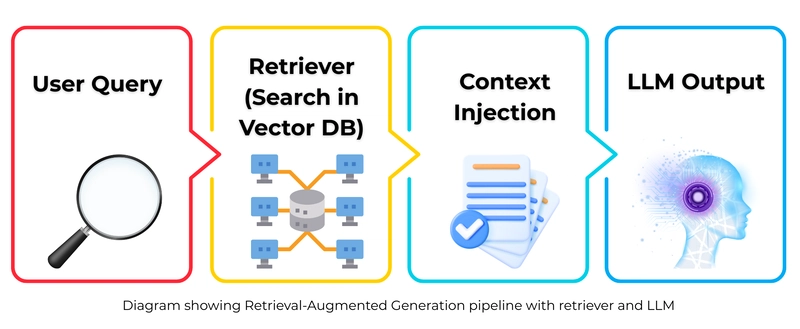
Here’s how a typical RAG system handles a user query:
User Input:
A query or prompt is submitted by the user.Retriever Stage:
The system searches a knowledge base or database to find relevant documents using methods like vector search.Passing to Generator:
Retrieved documents are fed into a language model along with the original user query.Response Generation:
The model uses both the query and retrieved data to produce a final, more accurate answer.
Visualizing a Simple RAG Architecture
Technologies commonly used:
Retrieval: BM25 search, dense vector embeddings (e.g., OpenAI, Hugging Face), vector databases like Pinecone, Weaviate, FAISS.
Generation: Language models such as OpenAI GPT-3.5/GPT-4, Meta's LLaMA, Anthropic's Claude.
Example Use Case
Consider a financial advisory chatbot.
Without RAG:
It might suggest outdated regulations or products based on stale training data.
With RAG:
It retrieves the latest financial regulations, product information, or market news — providing users with updated advice.
This makes the AI significantly more trustworthy for mission-critical domains.
Benefits of Using RAG
- Real-time knowledge updates
- Reduced hallucinations
- Domain adaptability
- Lower operational costs (compared to re-training)
- Better user trust and reliability
RAG vs Traditional Fine-Tuning: Quick Comparison
| Feature | Fine-Tuning | RAG |
|---|---|---|
| Knowledge Update | Requires retraining | Dynamic, real-time retrieval |
| Cost | High | Lower |
| Flexibility | Limited | High |
| Scalability | Challenging | Easier |
Getting Started with RAG Development
Here are some tools and libraries to explore if you’re building your own RAG system:
Frameworks
- LangChain (Python)
- Haystack (Python)
- LangChain (Python)
Vector Databases
- Pinecone
- Weaviate
- FAISS
- Pinecone
Language Models
- OpenAI GPT
- Hugging Face Transformers
- LLaMA by Meta
- OpenAI GPT
Web APIs / Backends
- FastAPI
- Flask
- FastAPI
You can build prototypes that combine these tools to suit your specific domain needs.
Final Thoughts
Retrieval Augmented Generation is a major advancement in AI. It bridges the gap between static pre-trained models and the dynamic, real-time world we live in.
For developers building the next generation of intelligent apps — whether it's in legal tech, health, finance, or SaaS — RAG provides a powerful and scalable framework for delivering more reliable AI outputs.
Originally published on Zestminds Blog: What is Retrieval Augmented Generation