



TLDR: We built livesync for Postgres to solve the analytics-vs-stability dilemma. Stream data from any Postgres instance directly into Timescale Cloud with zero downtime and no application changes. It performs historical backfills at 150GB/hour while capturing live changes through CDC, automatically converting tables to hypertables. Your production database remains untouched while you gain columnar storage, compression, and time-partitioning capabilities that dramatically accelerate queries. No more complex ETL pipelines or risky migrations, just high-performance analytics without compromising system reliability. Read the full article.
Scaling real-time analytics on Postgres has always been a balancing act. Timescale was built to solve this problem, to make Postgres scalable, fast, and analytics-ready without sacrificing reliability.
But teams with production applications on vanilla Postgres (or locked into other database-as-a-service platforms) often find themselves stuck. They face an impossible choice: risk downtime to migrate, build brittle ETL (extract-transform-load) pipelines, or live with the slow drag of overloaded systems.
We built Timescale livesync for Postgres to break this cycle—and today, we’re excited to kick off a Timescale Launch Week by introducing it.
Livesync lets you stream data from any Postgres database, whether it's running on Amazon RDS for PostgreSQL, Amazon Aurora, Azure PostgreSQL, self-hosted, or elsewhere, into Timescale Cloud with zero downtime, no application rewrites, and no disruption to your existing systems.
You get the analytical speed of Timescale’s hypertables and hypercore, providing seamless time-based partitioning, automatic columnar storage, and unbeatable compression without sacrificing the production stability you’ve worked hard to build. If you’re after a refresher on what Timescale can do, then check out our whitepaper.
You get speed without sacrifice.
Why Use Livesync for Real-Time Analytics?
When your application needs to deliver real-time insights, your options have traditionally been limited:
Risky full migrations , often requiring downtime windows that never feel safe enough.
Heavy, custom-built ETL pipelines that introduce complexity, lag, and new points of failure.
Overloaded production systems , where even simple dashboards slow down, and you risk impacting your critical transactional workloads.
In an ideal world, every application that faces these problems would migrate directly to Timescale (we are just Postgres after all!), but we understand that’s not always realistic. For many teams, the stakes are too high to move fast and break things. Systems powering financial transactions, IoT networks, and SaaS platforms can’t tolerate disruption, yet they can't ignore the need for analytics.
Livesync offers a new path forward: keep your existing Postgres exactly as it is , but stream your data in real time to a dedicated Timescale Cloud instance optimized for analytical workloads.
No downtime. No risk. No performance hits to production. To get the most out of Timescale Cloud, we’d still advise that you start planning to fully migrate in the future, but for now you have blazing-fast real-time analytics.
How Livesync for Postgres Works
Livesync uses Postgres’ logical replication protocol to stream changes from your production database into Timescale Cloud. But rather than simply duplicating your data, livesync extends logical replication with high-throughput ingestion, automatic hypertable creation, and a cloud-native architecture that prepares your data for real-time analytics at scale.
Zero-downtime setup and continuous replication
When you first connect livesync for Postgres, it performs an initial historical backfill, copying your existing data into Timescale at speeds of up to 150 GB per hour.
At the same time, it begins capturing and streaming live changes through change data capture (CDC), recording every insert, update, and delete from your source Postgres database as they happen. You can choose exactly which tables to replicate, moving only the data you need for analytics, while the rest of your production system continues operating normally, with no maintenance windows, no locks, and no downtime risk.
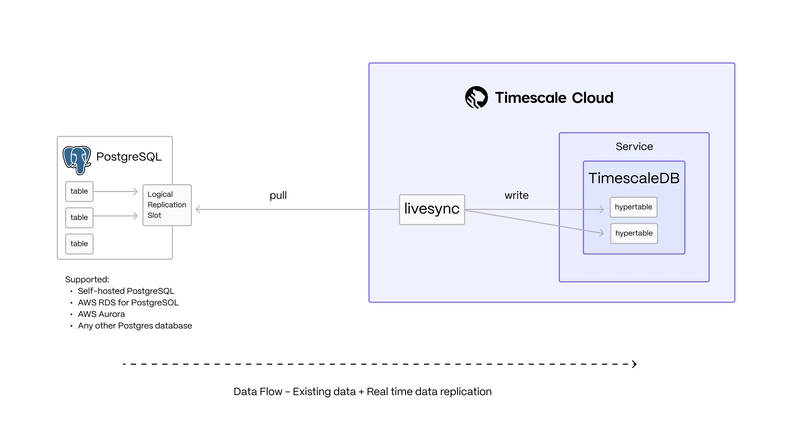
Behind the scenes, livesync uses a microservice that connects to your source database as a logical replication subscriber, consuming changes directly from your Postgres publication.
Unlike pure logical replication, livesync for Postgres automatically prepares your data for high-performance analytics: It can create corresponding tables inside Timescale Cloud and configure them as hypertables, unlocking immediate benefits like native time-based partitioning and faster time-series queries.
Once your data is live in Timescale Cloud, you can optionally enable columnar storage and compression to further accelerate analytics and optimize storage, without modifying your ingestion or sync setup. This tight integration ensures that Livesync for Postgres doesn't just mirror your data—it sets it up to scale.
Non-Invasive, Read-Only Architecture for Real-Time Analytics
Livesync is designed to be as non-invasive as possible. It creates a lightweight publication and replication slot on your Postgres database but does not alter your existing schemas, application code, or database connections.
Your production environment remains fully operational at all times. Livesync simply observes and streams changes without interfering, making it especially well-suited for production systems with strict stability, compliance, or uptime requirements.
High-Performance, Scalable by Design
Livesync for Postgres is engineered for high throughput across both historical and live data.
During the initial backfill, livesync achieves historical copy speeds of up to 150 GB per hour. During live operations, it can sustain 30,000 to 40,000 DML operations per second.
Future improvements, including intra-table parallelization and adoption of logical replication protocol v2 (which allows streaming of in-flight transactions rather than send on commit semantics), are already on our roadmap to push these limits even further.
Seamless Integration with Existing Architectures
Livesync fits cleanly into your existing infrastructure, whether you're running RDS, Aurora, Azure Database for PostgreSQL, or a self-managed instance.
Your operational systems continue working exactly as they do today. Livesync simply adds a Timescale-powered analytics layer next to your source database, letting you redirect analytical queries to Timescale by switching to a new connection string when you're ready.
No replatforming, no rewrites, no downtime. Just faster SQL real-time analytics.
When to Choose Livesync
Livesync is the right choice when:
Zero downtime is non-negotiable , such as in financial systems, healthcare apps, production SaaS platforms.
You need real-time insights today , but can't risk application rewrites or complex migrations.
You want to incrementally adopt Timescale , starting small and expanding over time.
You’re evaluating Timescale performance before committing to full migration.
Whether you're monitoring 10,000 IoT sensors, analyzing 50 million transactions, or building dashboards for end users, livesync gets you there—without the "lift and pray" gamble of traditional migration projects.
(That said, if you're open to consolidating on a single database, check out our migration tooling which takes the risk out of full migrations to Timescale.)
Real-World Livesync Applications
Livesync is built for real-world systems where uptime, performance, and gradual adoption matter. Here’s how different verticals might use it to accelerate analytics without disruption:
Financial services : Offload heavy historical queries to Timescale without risking downtime or introducing disruptive schema changes. Keep OLTP workloads fast and stable while running complex analytics separately.
IoT environments : Send millions of time-series events daily directly into hypertables, enabling real-time rollups, faster trend analysis, and storage optimizations like compression—without custom ETL pipelines or manual partitioning.
AWS-native architectures : Layer Timescale Cloud analytics on top of existing RDS or Aurora deployments, delivering sub-second analytical performance without replatforming or disrupting operational systems.
In every case, livesync removes the traditional pain of "faster analytics" projects, delivering immediate real-world results without sacrificing production stability.
Setting Up Livesync
Getting started is simple!
Create a Timescale Cloud service.
Connect livesync to your existing Postgres—no code changes required (see the Actions tab when you manage your service).
Configure your source database , either by providing your host, port, user and database or a Postgres connection string.
Select your tables , configure hypertables, and hit start.
Watch your data flow into Timescale—with full visibility, full control, and no disruption.
Once live, you can redirect your analytical queries to Timescale’s battle-tested storage engine, unlocking sub-second dashboards and deep insights without impacting your production system.
And For Our Next Trick...
Connecting any Postgres to real-time analytics is just the start. This week is a Timescale Launch Week, a celebration of new features and new ways to move faster without compromise. Every day, we’re showing how you can deliver speed without sacrifice across your entire stack:
Day 1 : Connect Any Postgres to Real-Time Analytics — Start using livesync for Postgres and add real-time analytics to your existing stack.
Day 2 : Compare Pgvector and Qdrant — See a side-by-side breakdown of two popular open-source vector databases.
Day 3 : Connect S3 Data to Postgres — Use livesync for S3 and the pgai Vectorizer to work with external data directly inside Postgres.
Day 4 : Supercharge Your Developer Experience — Use our SQL Assistant’s new AI agent mode, get recommendations to tune your instance, and explore new query visibility tools with Timescale Insights.
Day 5 : Strengthen Security and Compliance — Maintain control while scaling your analytics performance.
Try Livesync Today
Start your free Timescale trial and set up livesync for Postgres today.
And stay tuned, in the coming weeks we'll dive deeper into how we built our livesync products.
SOCIAL SHARE CARD GENERATOR