




Three weeks ago, renewed activity involving Ploutus ATM malware surfaced, prompting an alert from the Federal Bureau of Investigation (FBI). At the time, we published an initial breakdown covering the threat and its implications for financial institutions — an analysis that was later recognized as a Top Perspective on LinkedIn, reflecting the growing industry concern around ATM-targeted attacks.

Uptick in ATM jackpotting incidents prompts FBI warning | LinkedIn
The recent warning has since reignited discussions across financial security circles. But beyond the headlines, a more important question emerges:
Why are ATMs still vulnerable to jackpotting in 2026 — and what actually works to stop it?
ATM attacks are no longer about fraud. They are about direct cash extraction via system-level manipulation.
Ploutus enables attackers to bypass:
- Card authentication
- Banking systems
- Transaction validation
And directly command the ATM to dispense cash.
This follow-up article goes beyond surface-level analysis — delivering a deep technical breakdown of how these attacks work, why they continue to succeed, and what actually stops them in real-world environments.
ATM Architecture: Why Jackpotting Is Possible
Modern ATMs are not simple machines — they are specialized endpoints.
Typical characteristics:
- Windows Embedded / IoT operating systems
- XFS (Extensions for Financial Services) middleware
- Limited CPU, memory, and storage
- Often network-isolated or semi-isolated
- Maintained by third-party vendors
The Critical Layer: XFS Middleware
XFS acts as the bridge between software and hardware:
- Cash dispenser
- Card reader
- PIN pad
- Receipt printer
Ploutus targets this layer directly.
Instead of attacking banking systems, it speaks the ATM’s native language. Once XFS is compromised, the attacker can issue dispense commands without any transaction validation.
Ploutus Attack Chain (End-to-End)
Phase 1: Initial Access
Most real-world attacks begin with physical compromise:
- ATM cabinet opened
- USB payload inserted
- Boot process manipulated
- Administrative access obtained
Less frequently:
- Network pivot via weak segmentation
Phase 2: Malware Deployment
The payload:
- Injects into ATM processes
- Hooks XFS APIs
- Disables protections
- May establish persistence
Advanced capabilities:
- Obfuscation
- Vendor-specific targeting
- Encrypted triggers
- Log manipulation
Phase 3: Execution
Attackers trigger the malware via:
- Keypad sequences
- External input devices
- Time-based triggers
The ATM:
- Executes rapid dispense commands
- Bypasses transaction flow
- Operates without card interaction
Phase 4: Cash-Out
- Rapid cassette emptying
- $20K–$200K loss per machine
- Operation completed within minutes
The Real Issue: Not Advanced — Just Uncontrolled
Despite its reputation, Ploutus often succeeds due to basic failures:
- No full-disk encryption
- Shared or weak credentials
- USB ports left exposed
- Disabled or ignored alarms
- Poor physical security
This aligns with industry feedback:
“Nothing super high-tech — just basics that shouldn’t exist.”
Attackers don’t need zero-days. They need gaps in enforcement.
Why Traditional Anti-Malware Fails in ATMs
ATM environments impose constraints:
- Network isolation limits cloud-based detection
- PCI compliance restricts architecture
- Low hardware resources limit EDR deployment
- Patch cycles are slow
From the AppGuard case study:
ATMs are “network isolated & low-power”, making traditional detection-heavy tools impractical .
This creates a mismatch:
- Detection tools expect connectivity and resources
- ATMs provide neither
Detection vs Prevention: The Industry Divide
Detection-Based Approaches
- Signature AV
- Machine learning AV
- EDR / behavioral analytics
Challenges:
- Alert fatigue
- Requires human triage
- Delayed response
Prevention-Based Approaches
- Application whitelisting
- Zero-trust execution control
Advantages:
- Blocks unknown binaries
- Minimal overhead
- Works offline
Advanced Detection Engineering (Multi-Layer Model)
Effective detection requires correlation across three layers:
OS-Level Detection
Key telemetry:
- Event ID 4688 → Process creation
- Event ID 7045 → Service install
- Event ID 1102 → Log clearing
- Sysmon Event ID 1
Indicators:
- Execution from USB paths
- Unknown binaries
- Suspicious parent-child chains
USB & Physical Interaction Monitoring
- Kernel-PnP logs
- Device insertion anomalies
- Activity outside maintenance windows
XFS Middleware Monitoring
Monitor:
- DLL injection into ATM processes
- Unauthorized module loading
- API hooking behavior
Dispense Behavior Detection (Most Reliable)
Normal:
- One dispense per transaction
Malicious:
- Rapid repeated dispenses
- No card interaction
Rule: IF
- Multiple dispense events
AND - No card/PIN validation
→ Trigger lock immediately
Cash Dispenser Telemetry
Correlate:
- High dispense volume
- Null transaction IDs
- After-hours activity
Detection must happen locally and instantly.
Sigma-Style Detection Rules
Suspicious USB Execution
Process from removable media
AND not signed by trusted vendor
→ Alert
Log Clearing
EventID = 1102
→ High severity alert
Abnormal Dispense
dispense_count > threshold
AND transaction == null
→ Critical alert + auto lock
XFS Injection
Unknown DLL in ATM process
→ Block / Alert
MITRE ATT&CK Mapping (ATM Context)
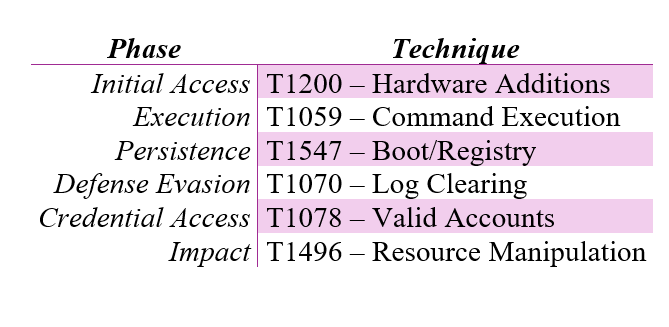
Extension: Direct Cash Extraction (ATM-specific impact)
Proof-of-Concept (Simulation Model)
Lab Setup:
- Windows Embedded VM
- XFS simulator
- Dispenser emulator
- Isolated network
Simulated Events:
- USB insertion
- Unauthorized execution
- Multiple dispense calls
- Log clearing
Evaluating:
- Was anomaly detected?
- Was execution blocked?
- Was ATM locked automatically?
If response requires human triage → failure.
Case Study: AppGuard Deployment in ATM Infrastructure (NuSource Financial, LLC)
To understand how prevention-first security performs in real-world ATM environments, we examine an official case study provided by AppGuard documenting its deployment at NuSource Financial, LLC — a banking technology provider supporting over 700 financial institutions in the United States.
This case provides a rare operational view into how ATM malware defenses perform at scale.
Operational Context
NuSource Financial operates as a managed service provider for ATM infrastructure, delivering:
- ATM deployment and lifecycle management
- Branch transformation solutions
- Security services for financial institutions
Their customers rely on them to ensure:
- Continuous ATM availability
- Minimal operational complexity
- Strong security without requiring internal expertise
As noted in the case study, financial institutions do not want their ATMs to become IT or cybersecurity burdens .
The Core Problem
NuSource faced increasing pressure from:
- ATM jackpotting attacks
- Evolving malware threats
- Ineffective traditional anti-malware tools
The key limitations identified were:
Detection-Based Security Was Reactive
- Detected threats after execution
- Required investigation and remediation
- Created operational overhead
Internet Dependency Conflicted with ATM Design
Many tools required:
- Continuous Internet access
- Real-time threat intelligence updates
But ATM environments are:
- Network-isolated
- Managed through controlled access
- Restricted by PCI compliance
Hardware Constraints
ATMs typically have:
- Low CPU and memory
- Limited storage capacity
This makes heavy EDR or ML-based tools impractical.
Operational Simplicity Requirements
NuSource emphasized that:
- End customers “abhor complexity”
- Security must not interfere with operations
Evaluation and Decision
NuSource evaluated multiple security models:
- Signature-based antivirus
- Machine learning AV
- Endpoint Detection & Response (EDR)
- Application control solutions
Findings included:
- ML-based AV provided only marginal improvements
- EDR introduced excessive alerts and investigation overhead
- Most solutions required Internet connectivity
This led to a strategic conclusion: Detection-heavy models were not aligned with ATM operational realities
AppGuard Approach: Prevention Over Detection
NuSource selected AppGuard based on a prevention-first, zero-trust execution model.
Key Design Principles
- Block malicious activity before execution
- Eliminate reliance on signatures
- Operate without Internet connectivity
- Remove need for alert triage
From the case study:
AppGuard “blocks attacks in real-time” and does not require analysts for investigation or remediation
Deployment Characteristics
Resource Efficiency
AppGuard demonstrated:
- ~10 MB disk usage
- ~10 MB memory usage
- ~0% CPU overhead (average)
This is critical in ATM environments where resources are constrained.
Operational Compatibility
NuSource reported:
- No disruption to patching or configuration
- No interference with system migrations
- Minimal deployment complexity
Measured Outcomes
Across deployment:
- Protection applied to ATMs from NCR, Hyosung, and Nautilus
- No malware compromises reported
- No alert triage or incident response required
- No PCI compliance issues introduced
From the case study:
“Four years malware-free… no bloat, no burden, no disruptions.”
Technical Interpretation
This case demonstrates a shift in security philosophy:
Execution Control Instead of Detection
Rather than identifying malware: The system enforces what is allowed to execute
Offline-First Security Model
- No dependency on cloud intelligence
- Suitable for isolated ATM environments
Operational Simplicity
- No alert fatigue
- No SOC dependency for routine operations
Real-Time Prevention
- Stops threats before impact
- Eliminates delay between detection and response
What Actually Stops Ploutus
Layered defense:
- Physical hardening
- Full-disk encryption
- USB lockdown
- Application whitelisting
- XFS monitoring
- Dispense anomaly auto-stop
- SOC visibility
Future Threat Evolution
Expect:
- Kernel-level malware
- Firmware attacks
- Supply chain compromise
- Lateral movement via ATM networks
Detection must evolve into: Autonomous interruption systems
Final Assessment
Ploutus is not unstoppable. It is successful because:
- Fundamentals are ignored
- Detection replaces prevention
- Physical security is underestimated
Security that alerts after cash is dispensed is not security. Real defense requires:
- Execution control
- Behavioral detection
- Immediate response
Because once malware reaches XFS, the ATM is no longer in control.
Ploutus Malware: Uptick in ATM jackpotting incidents prompts FBI warning was originally published in InfoSec Write-ups on Medium, where people are continuing the conversation by highlighting and responding to this story.
SOCIAL SHARE CARD GENERATOR