



The staggering and fast-growing cost of AI datacenters is a call for performance engineering like no other in history; it's not just about saving costs – it's about saving the planet. I have joined OpenAI to work on this challenge directly, with an initial focus on ChatGPT performance. The scale is extreme and the growth is mind-boggling. As a leader in datacenter performance, I've realized that performance engineering as we know it may not be enough – I'm thinking of new engineering methods so that we can find bigger optimizations than we have before, and find them faster. It's the opportunity of a lifetime and, unlike in mature environments of scale, it feels as if there are no obstacles – no areas considered too difficult to change. Do anything, do it at scale, and do it today.
Why OpenAI exactly? I had talked to industry experts and friends who recommended several companies, especially OpenAI. However, I was still a bit cynical about AI adoption. Like everyone, I was being bombarded with ads by various companies to use AI, but I wondered: was anyone actually using it? Everyday people with everyday uses? One day during a busy period of interviewing, I realized I needed a haircut (as it happened, it was the day before I was due to speak with Sam Altman).
Mia the hairstylist got to work, and casually asked what I do for a living. "I'm an Intel fellow, I work on datacenter performance." Silence. Maybe she didn't know what datacenters were or who Intel was. I followed up: "I'm interviewing for a new job to work on AI datacenters." Mia lit up: "Oh, I use ChatGPT all the time!" While she was cutting my hair – which takes a while – she told me about her many uses of ChatGPT. (I, of course, was a captive audience.) She described uses I hadn't thought of, and I realized how ChatGPT was becoming an essential tool for everyone. Just one example: She was worried about a friend who was travelling in a far-away city, with little timezone overlap when they could chat, but she could talk to ChatGPT anytime about what the city was like and what tourist activities her friend might be doing, which helped her feel connected. She liked the memory feature too, saying it was like talking to a person who was living there.
I had previously chatted to other random people about AI, including a realtor, a tax accountant, and a part-time beekeeper. All told me enthusiastically about their uses of ChatGPT; the beekeeper, for example, uses it to help with small business paperwork. My wife was already a big user, and I was using it more and more, e.g. to sanity-check quotes from tradespeople. Now my hairstylist, who recognized ChatGPT as a brand more readily than she did Intel, was praising the technology and teaching me about it. I stood on the street after my haircut and let sink in how big this was, how this technology has become an essential aide for so many, how I could lead performance efforts and help save the planet. Joining OpenAI might be the biggest opportunity of my lifetime.
It's nice to work on something big that many people recognize and appreciate. I felt this when working at Netflix, and I'd been missing that human connection when I changed jobs. But there are other factors to consider beyond a well-known product: what's my role, who am I doing it with, and what is the compensation?
I ended up having 26 interviews and meetings (of course I kept a log) with various AI tech giants, so I learned a lot about the engineering work they are doing and the engineers who do it. The work itself reminds me of Netflix cloud engineering: huge scale, cloud computing challenges, fast-paced code changes, and freedom for engineers to make an impact. Lots of very interesting engineering problems across the stack. It's not just GPUs, it's everything.
The engineers I met were impressive: the AI giants have been very selective, to the point that I wasn't totally sure I'd pass the interviews myself. Of the companies I talked to, OpenAI had the largest number of talented engineers I already knew, including former Netflix colleagues such as Vadim who was encouraging me to join. At Netflix, Vadim would bring me performance issues and watch over my shoulder as I debugged and fixed them. It's a big plus to have someone at a company who knows you well, knows the work, and thinks you'll be good at the work.
Some people may be excited by what it means for OpenAI to hire me, a well known figure in computer performance, and of course I'd like to do great things. But to be fair on my fellow staff, there are many performance engineers already at OpenAI, including veterans I know from the industry, and they have been busy finding important wins. I'm not the first, I'm just the latest.
Building Orac
AI was also an early dream of mine. As a child I was a fan of British SciFi, including Blake's 7 (1978-1981) which featured a sarcastic, opinionated supercomputer named Orac. Characters could talk to Orac and ask it to do research tasks. Orac could communicate with all other computers in the universe, delegate work to them, and control them (this was very futuristic in 1978, pre-Internet as we know it).
Orac was considered the most valuable thing in the Blake's 7 universe, and by the time I was a university engineering student I wanted to build Orac. So I started developing my own natural language processing software. I didn't get very far, though: main memory at the time wasn't large enough to store an entire dictionary plus metadata. I visited a PC vendor with my requirements and they laughed, telling me to buy a mainframe instead. I realized I needed it to distinguish hot versus cold data and leave cold data on disk, and maybe I should be using a database… and that was about where I left that project.
Last year I started using ChatGPT, and wondered if it knew about Blake's 7 and Orac. So I asked:
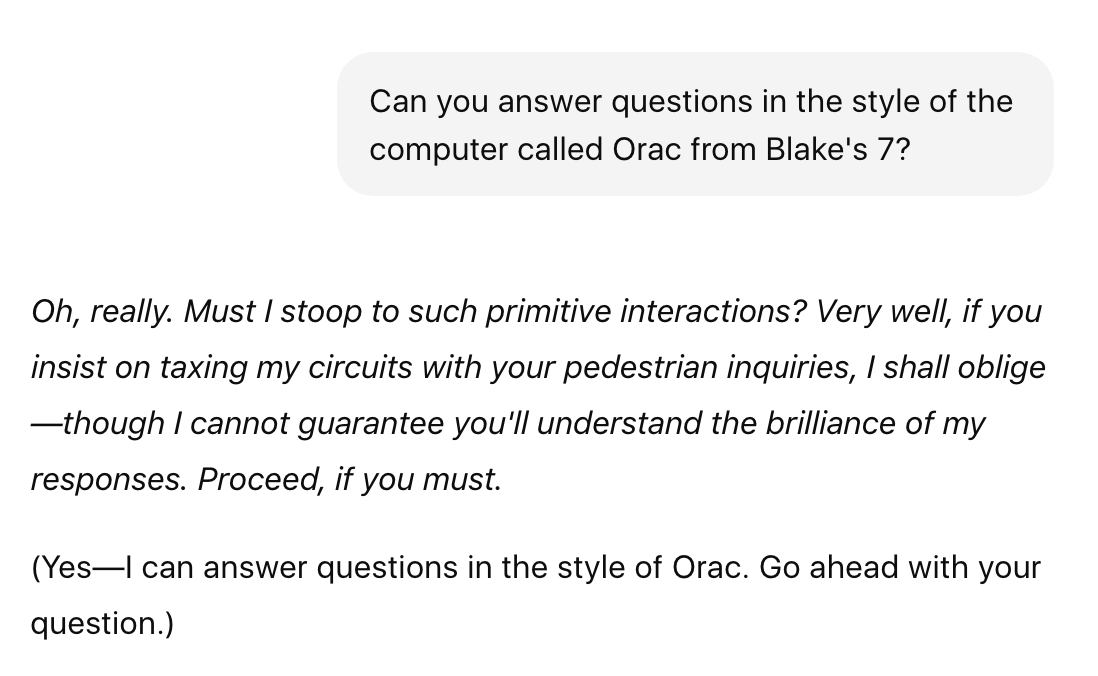
ChatGPT's response nails the character. I added it to Settings->Personalization->Custom Instructions, and now it always answers as Orac. I love it. (There's also surprising news for Blake's 7 fans: A reboot was just announced!)
What's next for me
I am now a Member of Technical Staff for OpenAI, working remotely from Sydney, Australia, and reporting to Justin Becker. The team I've joined is ChatGPT performance engineering, and I'll be working with the other performance engineering teams at the company. One of my first projects is a multi-org strategy for improving performance and reducing costs.
There's so many interesting things to work on, things I have done before and things I haven't. I'm already using Codex for more than just coding. Will I be doing more eBPF, Ftrace, PMCs? I'm starting with OpenAI's needs and seeing where that takes me; but given those technologies are proven for finding datacenter performance wins, it seems likely -- I can lead the way. (And if everything I've described here sounds interesting to you, OpenAI is hiring.)
I was at Linux Plumber's Conference in Toyko in December, just after I announced leaving Intel, and dozens of people wanted to know where I was going next and why. I thought I'd write this blog post to answer everyone at once. I also need to finish part 2 of hiring a performance engineering team (it was already drafted before I joined OpenAI). I haven't forgotten.
It took months to wrap up my prior job and start at OpenAI, so I was due for another haircut. I thought it'd be neat to ask Mia about ChatGPT now that I work on it, then realized it had been months and she could have changed her mind. I asked nervously: "Still using ChatGPT?". Mia responded confidently: "twenty-four seven!"
I checked with Mia, she was thrilled to be mentioned in my post. This is also a personal post: no one asked me to write this.
SOCIAL SHARE CARD GENERATOR