If you've look at any of the major bootkits such as TDL4 and Rovnix, you've probably noticed they employ certain self defense features to prevent removal; specifically, intercepting read/write requests to the boot sectors. While these defense mechanisms can fool some software, they may, in some cases, make infections even easier to spot.
Rovnix is probably the less stealthy of the two: It intercepts read/write requests to the boot disk by hooking the miniport driver, on read attempts it fills the buffer with zeros, resulting in the boot sectors appearing completely empty, on write requests it simply returns ACCESS_DENIED. Although this does prevent reading & writing the sectors, it's usually a sure sign of an infection when the boot sector is blank but your system boots, or you can't write the boot sector even with SYSTEM privileges.
On the other had we have TDL4, which goes a step further: Instead of filling the buffer with zeros during read attempts, it instead replaces the read data with the original, non-infected master boot record (MBR). As a result of TDL4's clever trickery, any tools attempting to read the MBR will just see the original windows MBR and assume nothing is wrong; however, TDL4 also opted for a similar method to Rovnix by just denies writes to the boot sector, but with the slightly more inconspicuous error: STATUS_INVALID_DEVICE_REQUEST.
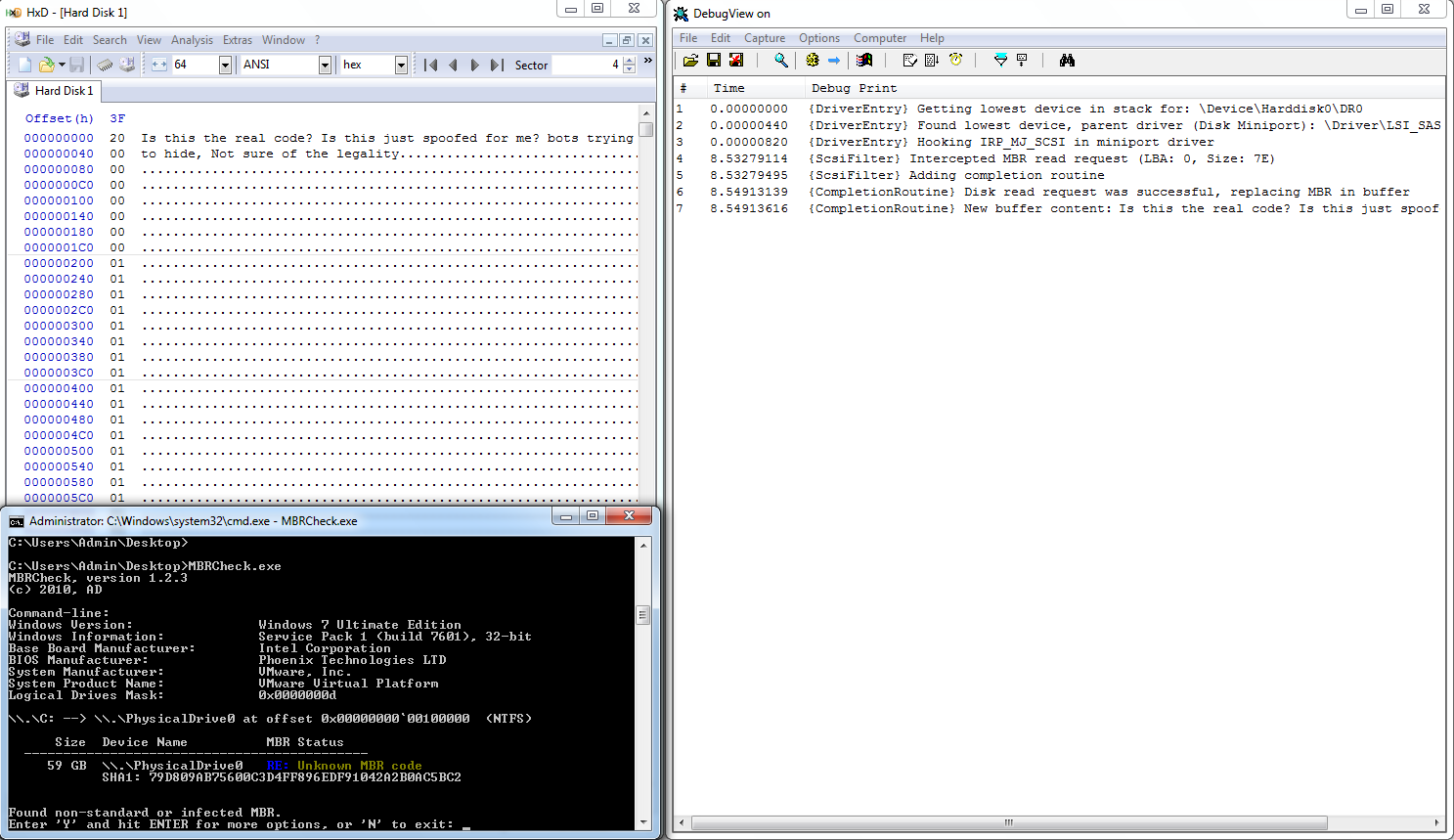
Obviously straight up denying write requests to the boot sector is going to raise some questions, so what if we improved upon TDL4's method and also allowed writing to the spoofed, non-infected MBR, instead of the real one on disk.
Intercepting Disk I/O
There's a lot of places in the kernel that disk I/O can be intercepted to trick user mode tools; however, any software using kernel drivers can bypass high level hooks. The first though would probably be to hook Disk.sys (the driver responsible for handling disk operations), but although this would work against some tools, there are trick to avoid it, I'll explain how.
Disk.sys handles disk I/O, it doesn't actually send any requests to the hard drive, it simply acts as a middleman translating kernel disk I/O requests into SCSI requests (the protocol used to communicate with the hard drive). Once Disk.sys has translated a request, it dispatches it to another, lower level driver (known as a Miniport driver), in the form of an SCSI_REQUEST_BLOCK, which the Miniport sends to the hardware via the Port driver.
The Miniport is generally operating system independent, whilst the port driver is specific to certain OS version and even hardware, making the Miniport the best place to hook without getting into hardware dependent territory. Finding a Miniport driver is pretty straight forward as all drivers/devices are stacked, so we simply walk down the device stack until we reach the bottom most device (The Miniport).
 Vollständiger Original-Bericht Ausführliche Details, Code-Beispiele & Hersteller-Stellungnahme auf malwaretech.com. Wie bewertest du diesen Beitrag? 1 Klick Feedback Teilen mit Netzwerk & Team: Hat Ihnen dieser Tipp / Anleitung geholfen? Community-Analysen & Experten-Meinungen 0Verfasse deine eigene Analyse, teile Workarounds oder diskutiere diesen Vorfall im Blog. Noch keine Community-Analyse verfasst. Markiere einen Textabschnitt oder klicke oben auf „ Eigene Analyse verfassen“! Community Pulse: Relevanz-Einschätzung 1 Klick Experten-Votum 🔴 Akute Relevanz 0% 🟡 In Evaluierung 0% 🟢 Keine Auswirkung 0% Spannende Innovation 0% Verwandte Story-Cluster & Quellen (Vektor-KI) Tipp: Mit Pfeiltasten [ ← ] und [ → ] blättern  Ähnliche Beiträge
🔍 Verwandte News
Ähnliche Beiträge zu Using Kernel Rootkits to Conceal Infected MBRThematisch verwandte Begriffe: Using, Kernel, Rootkits, Conceal · 6 Treffer ⚠️ Malware / Trojaner / Viren Elastic Security Labs Forget vulnerable drivers - Admin is all you need ⚠️ Malware / Trojaner / Viren Securelist Mirage Kitten targeting aviation and FinTech sectors across the Middle East and Africa with a new malware set ⚠️ Malware / Trojaner / Viren Reverse Engineering Tengu, a Mirai-style Linux and IoT botnet
Laden...
Videos werden geladen ...
Laden...
Beiträge werden geladen ...
Laden...
Videos werden geladen ...
Laden...
Beiträge werden geladen ...
Laden...
Videos werden geladen ...
Laden...
Beiträge werden geladen ...
Laden...
Videos werden geladen ...
Laden...
Beiträge werden geladen ...
Laden...
Videos werden geladen ... 🔖 Gespeicherte Artikel
📂
Keine gespeicherten Artikel vorhanden.
📂 News
⏱️ 3 Min
vor 10 Min
Artikeldaten werden geladen...
tsecurity.de AppOffline-Lesen, Eilmeldungen & 0ms Ladezeit
Installiere tsecurity.de direkt auf deinen Home-Bildschirm für das ultimative Vollbild-Magazinerlebnis ohne Browser-Leisten.
Nächster Beitrag
Community Radar & Live Chat
Sentinel Bot online • Live-Stream
Dein Cluster:
Security Explorer
Match:
lädt…
Aktivitäten deiner Analystenlädt…
Neues Thema oder Eilmeldung einreichenReiche interessante Links, Zero-Days oder Debatten ein. Die Community entscheidet per Upvote über die Veröffentlichung. Heiß diskutierte Einreichungen |
SOCIAL SHARE CARD GENERATOR