



YouTube Video
Try ChatLLM by Abacus AI - every top AI model in one place for $10/month:
https://chatllm.abacus.ai/evv
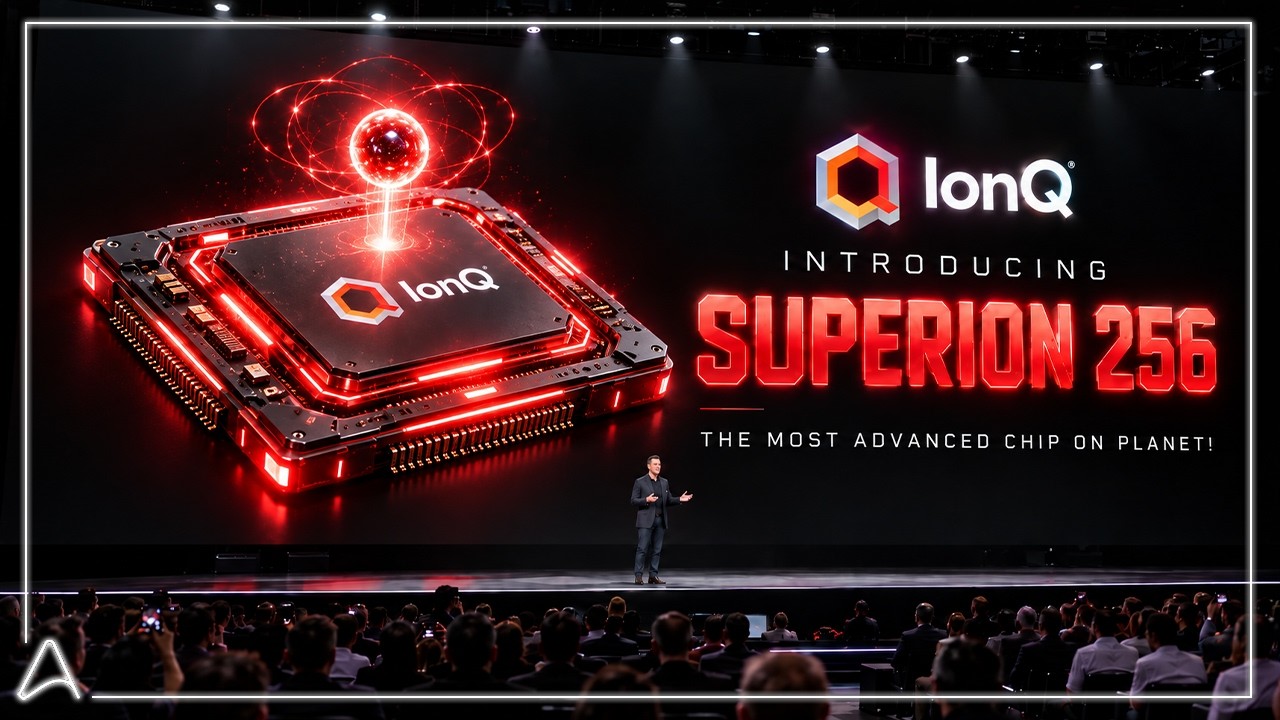
What is the most advanced chip on Earth? It might not be an NVIDIA GPU or even a traditional silicon processor. Trapped-ion quantum chips use individual atoms as qubits, holding them above a semiconductor chip with electric fields and controlling them with lasers to perform quantum computations.
In this video, we explore how trapped-ion quantum computers actually work, including quantum superposition, entanglement, ion traps, quantum gates, and photonic technology. We also look at how companies such as IonQ and Oxford Ionics are developing increasingly accurate and scalable quantum processors using manufacturing techniques borrowed from the existing semiconductor industry.
The potential applications are enormous. Quantum computing could eventually help researchers simulate molecules, accelerate drug discovery, design new materials, improve batteries and catalysts, and potentially work alongside artificial intelligence and AI models. IonQ and Oxford Ionics have already reported two-qubit gate fidelity above 99.99%, while future roadmaps aim to scale trapped-ion systems dramatically.
From a single trapped atom to potentially millions of qubits, this is a look inside one of the most advanced technologies being developed in quantum computing, semiconductor technology, and the future of computing.
#QuantumComputing #QuantumChip #IonQ #QuantumComputer #Qubits #Technology #AI
https://chatllm.abacus.ai/evv
What is the most advanced chip on Earth? It might not be an NVIDIA GPU or even a traditional silicon processor. Trapped-ion quantum chips use individual atoms as qubits, holding them above a semiconductor chip with electric fields and controlling them with lasers to perform quantum computations.
In this video, we explore how trapped-ion quantum computers actually work, including quantum superposition, entanglement, ion traps, quantum gates, and photonic technology. We also look at how companies such as IonQ and Oxford Ionics are developing increasingly accurate and scalable quantum processors using manufacturing techniques borrowed from the existing semiconductor industry.
The potential applications are enormous. Quantum computing could eventually help researchers simulate molecules, accelerate drug discovery, design new materials, improve batteries and catalysts, and potentially work alongside artificial intelligence and AI models. IonQ and Oxford Ionics have already reported two-qubit gate fidelity above 99.99%, while future roadmaps aim to scale trapped-ion systems dramatically.
From a single trapped atom to potentially millions of qubits, this is a look inside one of the most advanced technologies being developed in quantum computing, semiconductor technology, and the future of computing.
#QuantumComputing #QuantumChip #IonQ #QuantumComputer #Qubits #Technology #AI