
YouTube Video
OSDI '26 - Incr: Faster Re-Execution via Bolt-On Incrementalization
Yizheng Xie, Evangelos Lamprou, Jerry Xia, and Nikos Vasilakis, Brown University
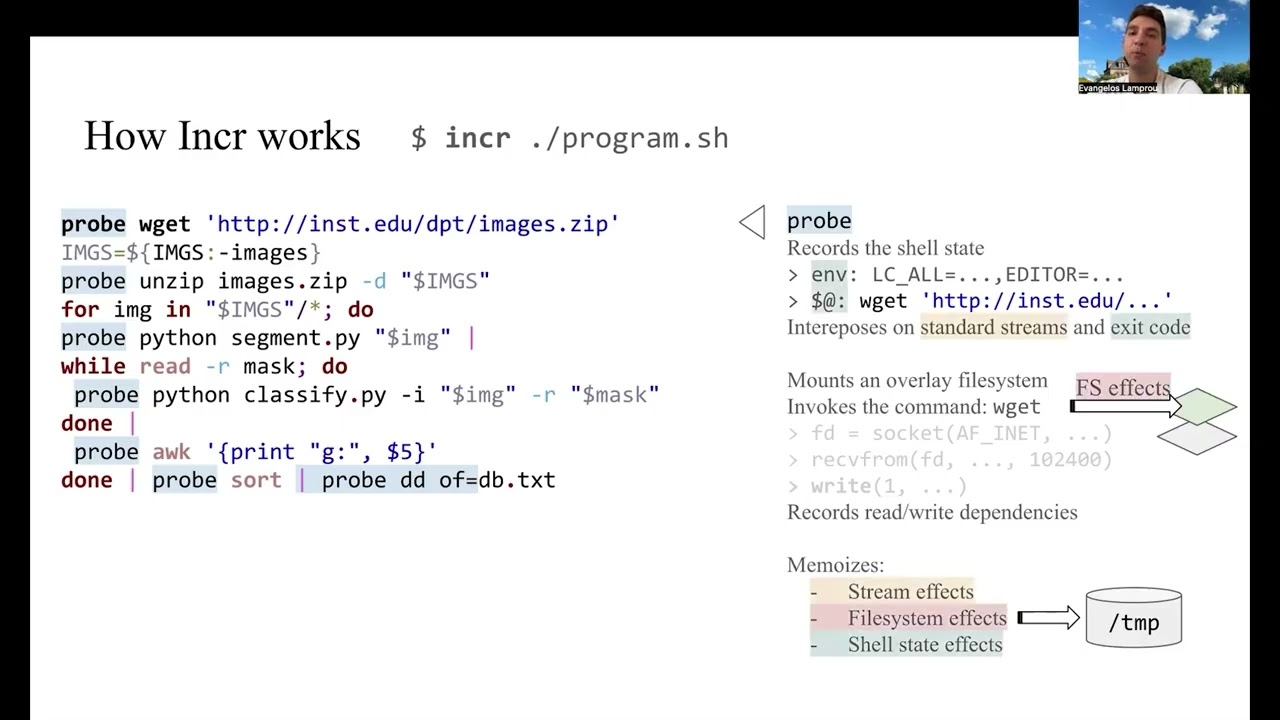
While most software development is incremental, most execution environments are not: even small program modifications fail to take advantage of prior executions, at worst requiring full re-execution of all computational stages in the modified program. Such full re-execution decelerates software development and debugging, especially in dynamic polyglot environments such as the Unix and Linux shell. This paper presents Incr, a system that accelerates the re-execution of unmodified shell programs by automatically incrementalizing their execution. Incr analyzes and tracks interdependencies to detect and store key intermediate results, reusing them on subsequent re-executions whenever possible. Incr’s effect analysis supports correct re-execution even for non-idempotent computations, and several static and dynamic optimizations reduce the runtime and storage overheads of incrementalization. Applied to diverse real-world scenarios, Incr accelerates re-execution by an average of 34.2× and a maximum of 373.3×—all while requiring no developer annotations or code modifications and remaining behaviorally indistinguishable on over 10,000 test cases.
View the full OSDI '26 program at https://www.usenix.org/conference/osdi26/technical-sessions