

Zum Hauptinhalt springen
Intelligence View
⚡ tsecurity.de Intelligence

Mozilla introduces Firefox Enterprise

Institutions are recalculating who controls the technology they rely on. Mozilla has an independent option to offer. For years, organizations consolidated…

Beitrag
0
Seite
0
↗ Quelle (The Mozilla Blog)
Quelle & Fakten · 4 Min. Lesezeit
Quelle: The Mozilla Blog (blog.mozilla.org)
Rubrik: Herramientas Admin y Dev


Institutions are recalculating who controls the technology they rely on. Mozilla has an independent option to offer.


For years, organizations consolidated technology around a small number of providers to make things simpler. Fewer systems. Tighter integrations. More economies of scale. But that consolidation went well beyond technology. It consolidated dependency, too. The resulting risks have been debated, studied, and challenged along the way, but concentration continued. More work, data and critical infrastructure kept moving to the same few providers, while credible alternatives narrowed.

The deeper that dependency runs, the harder and more costly it becomes to change course. When something fails, changes or falls outside an institution’s control, that dependency becomes a risk for CIOs and CISOs to manage.


Nowhere are these stakes more visible than in Europe. Now institutions are re-assessing. Governments are pushing for greater digital autonomy, while regulated industries face growing pressure to find and manage their dependencies. 


There’s a name for much of this debate about technological control: “sovereignty.” 


What digital sovereignty means in practice varies. Across Europe, governments are investing in the security and resilience of critical IT infrastructure, reducing strategic dependencies and putting technological autonomy higher on national agendas. Different approaches, same underlying concern. Strip away the regional policy definitions and industry distinctions and a pretty practical, universal question emerges: how much technological dependency should we risk?


And a very specific, very important layer has been largely missing from that conversation: the browser.


The overlooked layer of modern business


The browser. Applications run there. Employees authenticate in it. Sensitive data transits through it. Files are uploaded and downloaded and AI tools are increasingly used through it. That raises the same questions of dependency and control: whose browser technology are you relying on, and who controls the infrastructure used to manage it?


Introducing Firefox Enterprise
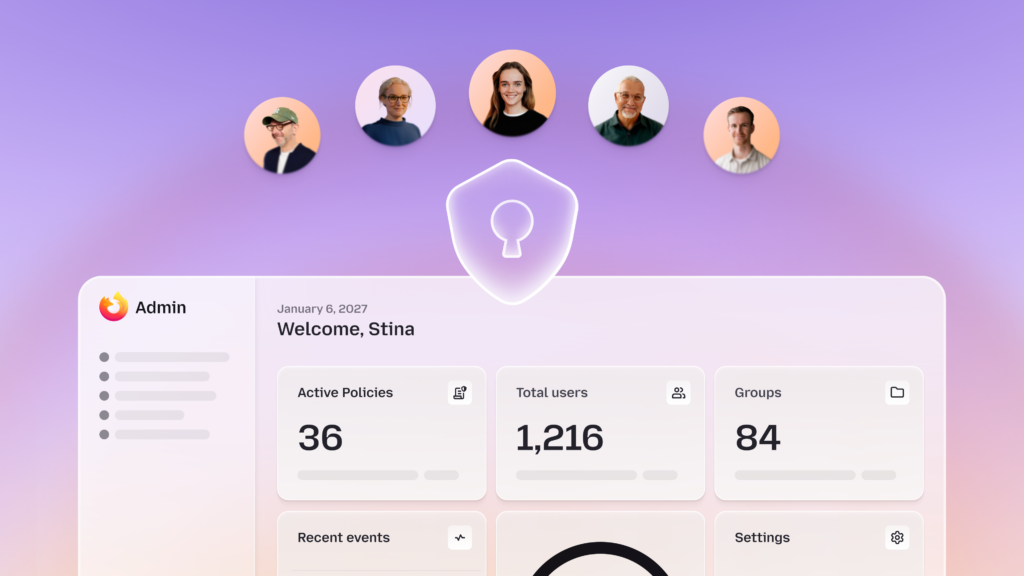


Firefox Enterprise is built for organizations with strict security, governance, and compliance requirements. It pairs the Firefox browser, built on Mozilla’s independent Gecko engine, with a management console organizations can run on their own infrastructure. From that console, IT teams can centrally manage browser policy and access, govern how data moves through the browser and set controls around AI use.


IT and security teams get more control over their data, IT infrastructure and browser environment — helping strengthen technological independence and operational resilience.


“If all your options are built with the same technology underneath, ‘choice’ is a lie. So is control,” said Anthony Enzor-DeMeo, CEO of Mozilla. “We built Firefox differently. And we’re bringing its independent architecture to institutions that are ready to rethink their dependencies and risk.”


Bringing the browser under control


We’re starting with the browser because we see it as a key, but under-governed, layer. Firefox Enterprise gives institutions more control over the browser and the infrastructure managing it.


And because Firefox runs on Gecko, the only major browser engine developed outside Google and Apple, institutions have another path towards reducing dependence on a single architecture.


Finally, Firefox Enterprise is built to live alongside the systems that IT operations already use. Keep your identity provider. Keep your SIEM. Keep your MDM. Just add a browser whose management infrastructure you operate, so you decide where data lives and have greater visibility into how it moves.


For us, supporting the goal of technological sovereignty comes down to four things: More control. More transparency. More choice. More resilience.


Learn more about Firefox Enterprise.


A big bet on familiar ground


We know this territory. Independence isn’t a new direction for Mozilla. We’ve spent more than 25 years building and securing browser technology that intentionally works outside of the dominant architecture of the day. Firefox is used by roughly 200 million people every month and is already deployed across thousands of organizations.

That independence has always mattered to the web. Now it has practical value for institutions looking to reduce technological concentration — and dependency — in their own environments. 


This is the beginning


Our ambition is big but simple: make technology independence practical.


That means putting institutions in real control of the infrastructure and data they depend on, without asking them to rebuild or start over. Closing blind spots. Defining where policies, access and data live. Keeping core management within the institution’s environment. And bringing an overlooked layer — the browser — under institutional control. 


Firefox Enterprise is unveiling across Europe with an initial sales focus on France, Germany, Austria and Switzerland, with more markets to follow. Thunderbird Enterprise is also in development, extending this customer-controlled approach to email and communications. We’ll have more to share as that work progresses.


If your organization wants greater control over its browser infrastructure, we’d like to work with you.


The post Mozilla introduces Firefox Enterprise appeared first on The Mozilla Blog.

Social ReaktionenReagiere als Erste:r — dein Feedback zählt!
Informations-Bewertung:
✏️ Information ergänzen
🛡️ Versioniert via CMS-Revisions-Engine (Freigabe-Queue für Gäste)

💬 Debate de la comunidad y comentarios

🌐 Unirse al chat principal

Inicia el debate en el stream de difusión del Social Chat o envía arriba una contribución experta mediante el formulario de ampliación.

🔍 CTI & Forensik

Inteligencia de Ciberamenazas y Forense

Navegador ATT&CK · Radar IoC · Evidencias de Exploit
CTI Threat Relationship Graph
Akteure · Techniken · Beziehungen
4 Knoten · 3 Relationen
CVE / Incident Threat Actor Software MITRE ATT&CK CWE Weakness IoC
Briefing de seguridad Gratis · baja en 1 clic

Intelligence Digest — gratis

Cada día las noticias de seguridad más importantes · baja en cualquier momento

Valoración de la comunidad & prueba social
⭐ Valoración de los lectores
–
Ø / 5.0
Aún no hay valoraciones de lectores
¿Le ha resultado útil este artículo?
0
Dejar una valoración ahora
Valoración detallada (opcional)
Contenido & calidad
Fuente & credibilidad
Actualidad

Clústeres de historias relacionados & fuentes (IA vectorial)

6 Cluster
18 fuentes
Black Friday bei VZMore: Bis 600 Euro Rabatt auf Power-Mini-PCs
WinFuture News hace 54 min.
17 fuentes más
Latest from TechRadarhace 1 hThe best Black Friday turntable deals, as picked by an audio editor Latest from TechRadarhace 21 min.40+ best Black Friday deals in the UK — Switch 2, Shark vacuums, iPhone 18, Lego, PS5 bundles, Samsung, LG OLED TVs, and more CNEThace 12 díasUpgrade Your Home Security for Less. Score Up to 65% Off With These Black Friday Ring Deals Giga.dehace 1 hVor Black Friday zu viel bezahlt? Mit einem Trick könnt ihr doch noch sparen t3n.dehace 34 min.Black Friday: Diese Samsung-Angebote bei Amazon und Media Markt lohnen sich netzwelt.dehace 2 hBlack-Friday-Kracher: Huawei-Smartwatch mit EKG für unter 150 Euro Golem.dehace 54 min.Anzeige: Sony WH-1000XM6 Referenz-Kopfhörer am Black Friday zum Amazon-Bestpreis Macerkopf.dehace 1 hAmazon Black Friday: Apple Pencil, WISO Steuer 2027, Microsoft 365, iPhone 18 Cases und mehr PC-WELThace 35 min.Leistungsstarker Mini-PC mit Intel Core Ultra 9: VZMORE iX9 Max erstmals unter 760 Euro Golem.dehace 1 hAnzeige: Fahrradcomputer von Garmin zum Black Friday reduziert bei Amazon CNEThace 13 díasGet up to 50% off Select Alexa Devices With Amazon’s Black Friday Upgrade Deal CNEThace 5 díasBlack Friday Is Knocking Hundreds Off Apple’s iPads, and There’s Plenty to Choose From TechRepublichace 4 hAmazon Cuts Google Pixel 11 Pro to $749 for Black Friday Golem.dehace 2 hVideostreaming und Black Friday: Apple TV ein halbes Jahr lang zum halben Preis auch auf Amazon Golem.dehace 2 hAnzeige: Smartwatch von Fitbit als Black Friday Deal zum halben Preis bei Media Markt appgefahren.dehace 2 hBaseus U2 Pro Sicherheitskamera: Black Friday-Deal mit über 50 Prozent Rabatt Google Alerthace 6 hFakeshops am Black Friday: Diese Tipps gibt das BSI - it-daily.net
17 fuentes
CVE-2026-99707 | Linux Kernel up to 6.12.117/6.18.63/7.3.4/7.4-rc1 khugepaged collapse_file use after free
VulDB Updates hace 1 h
16 fuentes más
VulDB Updateshace 1 hCVE-2026-99728 | Linux Kernel up to 7.3.4/7.4-rc1 Deferred Split Scan mm/huge_memory deferred_split_scan/deferred_split_folio race condition VulDB Updateshace 1 hCVE-2026-99715 | Linux Kernel up to 7.3.4/7.4-rc1 nvme-rdma nvme_rdma_queue_rq null pointer dereference VulDB Updateshace 1 hCVE-2026-99730 | Linux Kernel up to 6.12.117/6.18.63/7.3.4/7.4-rc1 Filemap mm/filemap.c filemap_fault race condition VulDB Updateshace 1 hCVE-2026-99724 | Linux Kernel up to 7.3.4/7.4-rc1 NTFS ntfs_read_compressed_block out-of-bounds VulDB Updateshace 1 hCVE-2026-99725 | Linux Kernel up to 6.12.117/6.18.63/7.3.4/7.4-rc1 CIPSO cipso_v4_delopt buffer overflow VulDB Updateshace 1 hCVE-2026-99735 | Linux Kernel up to 6.12.117/6.18.63/7.3.4/7.4-rc1 MGLRU mm/mglru.c walk_pud_range/walk_pmd_range race condition VulDB Updateshace 1 hCVE-2026-99744 | Linux Kernel up to 6.12.117/6.18.63/7.3.4/7.4-rc1 atl1c atl1c_clean_rfd length buffer overflow VulDB Updateshace 1 hCVE-2026-99746 | Linux Kernel up to 7.3.4/7.4-rc1 ASoC hda_sdw_bpt_close race condition VulDB Updateshace 1 hCVE-2026-99690 | Linux Kernel up to 6.12.117/6.18.63/7.3.4/7.4-rc1 ocfs2 ocfs2_get_dentry_osb use after free VulDB Updateshace 1 hCVE-2026-99678 | Linux Kernel up to 6.12.117/6.18.63/7.3.4/7.4-rc1 XFS xfs_iomap_write_direct integer overflow VulDB Updateshace 1 hCVE-2026-99680 | Linux Kernel up to 6.12.117/6.18.63/7.3.4/7.4-rc1 XFS xfs_fs_map_blocks allocation of resources VulDB Updateshace 1 hCVE-2026-99688 | Linux Kernel up to 6.12.117/6.18.63/7.3.4/7.4-rc1 sch_qfq net/sched/sch_qfq.c qfq_change_class use after free VulDB Updateshace 1 hCVE-2026-99679 | Linux Kernel up to 7.3.4/7.4-rc1 xfs xfs_iomap_write_unwritten allocation of resources VulDB Updateshace 1 hCVE-2026-99686 | Linux Kernel up to 6.18.63/7.3.4/7.4-rc1 vhost vhost_add_used_n_in_order integer overflow VulDB Updateshace 1 hCVE-2026-99697 | Linux Kernel up to 6.12.117/6.18.63/7.3.4/7.4-rc1 memcontrol high_work_func use after free VulDB Updateshace 1 hCVE-2026-99685 | Linux Kernel up to 6.12.117/6.18.63/7.3.4/7.4-rc1 iommu/virtio viommu_probe use after free
Desliza para actualizar
Widgets & Topics
Loading widgets…
Nächster Beitrag