
Another quarter, another drop - Kali 2025.3 is now here! Bringing you another round of updates, new features and introducing some new tools - pushing Kali further.
The summary of the changelog since the 2025.2 release from June is:
- Packer & Vagrant - HashiCorp’s products have had a refresh
- Nexmon Support - Monitor mode and injection for Raspberry Pi’s in-built Wi-Fi
- 10 New Tools - As always, various new packages added (as well as updates)
HashiCorp: Packer & Vagrant
Kali has been using two HashiCorp products, which go hand-in-hand with each other:
- Packer - Creating VMs for multiple platforms from a single source configuration
- Vagrant - Building and managing VM environments
Until now, we have been using our Packer build-script to generate our Vagrant VMs. This has been working well for us.
We wanted to streamline our platform building process more, which prompted us to revisit how we generate Vagrant VMs.
Whilst it is possible to automate Packer, it was not ideal for our infrastructure setup and workflow (e.g. trying to build Hyper-V images on Linux).
This caused us to refresh a few items:
- Kali pre-seed examples - Packer uses pre-seed to automate the Kali installer - we made sure they are all consistent.
- Kali Packer build-scripts - We were using v1 of the standards. We upgraded to v2.
- Kali VM build-scripts - Vagrant images are VMs which a few tweaks done to them. We added these modification to our existing VM build-scripts.
For more information, please keep reading our blog post: Kali Vagrant Rebuilt: Out With Packer, In With DebOS
Nexmon Support
Nexmon is a “patched” firmware, for certain wireless chips, to extend their functionally to allow:
- Monitor mode - able to sniff packets
- Injection mode - frame injection allows for custom raw packets to be sent, outside of the “standard” stack ordering
Both are really useful when it comes to information security!
For the record, it is possible to-do both of the features above without Nexmon, as it depends on the device’s chipset and drivers.
Now, Nexmon supported wireless chips are Broadcom & Cypress, which are in a various devices, including the Raspberry Pi’s in-built Wi-Fi!
In Kali 2025.1, we changed how we package our Raspberry Pi kernel, as well as bump to a new major version. Now Nexmon support is back as well as supporting Raspberry Pi 5!
Other devices can also use Nexmon, its not limited to Raspberry Pis.
To find out more, please see our previous blog post: The Raspberry Pi’s Wi-Fi Glow-Up
Dropping ARMel
We are announcing that we too are dropping support for ARMel (Acorn RISC Machine, Little-Endian). We are following Debian’s footsteps in this decision: Debian “trixie” 13 is the last release with ARMel support, and Debian testing (which Kali is based on) doesn’t provide ARMel packages anymore.
Luckily, the amount of devices which use this architecture is very limited:
- Raspberry Pi 1 (Original)
- Raspberry Pi Zero W
- ODROID-W, which already is End-Of-Life.
We cannot justify the amount of resources, both human power as well as hardware, required to support such a limited amount of legacy hardware. We would much rather put the time into RISC-V…
Configurable VPN IP panel plugin (Xfce)
In Kali 2024.1, we introduced a new Xfce panel plugin that allows users to quickly check and copy the current IP address of their VPN connection. Until now, it was only possible to view the IP of the first VPN, but if you were using multiple connections or wanted to check a different interface, there was no way to switch it. To improve the usability of this plugin, we have now added the option to choose which network interface the plugin monitors.
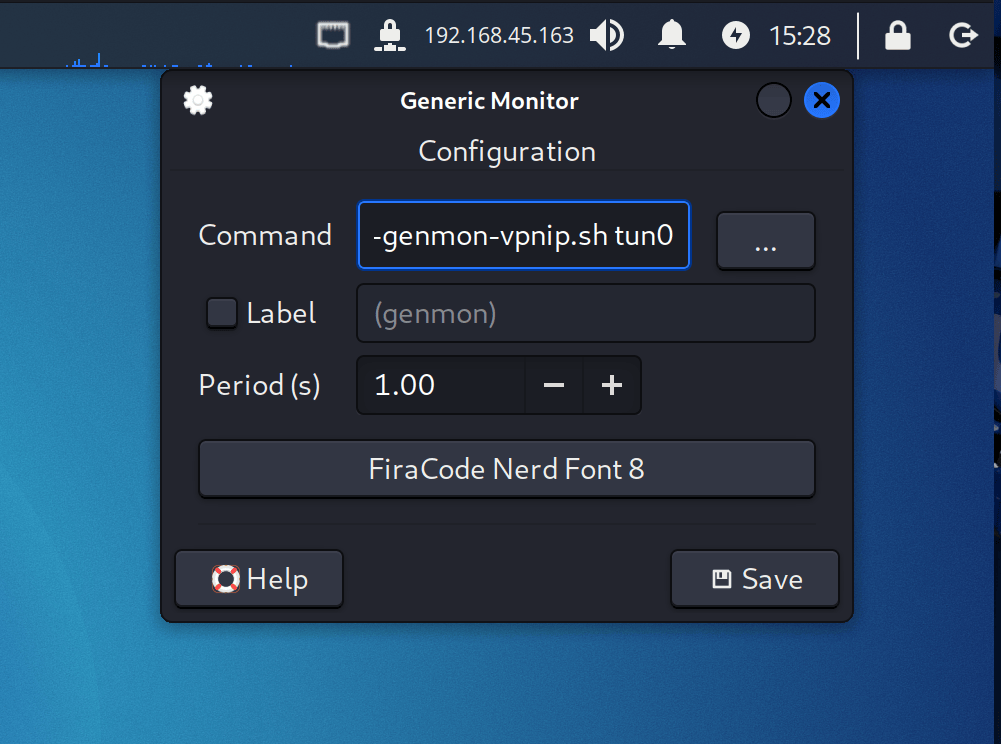
To configure it, right-click the VPN-IP plugin and open the preferences dialog, where you can set the new interface at the end of the “Command” parameter. If you don’t see the VPN-IP plugin, you can find it in the panel preferences by searching for the “Generic Monitor” plugin in the “Items” tab.
New Tools in Kali
It would not be a Kali release if there were not any new tools added! A quick run down of the 10 tools which have been added to the network repositories:
- Caido - The client side of caido (the graphical/desktop aka the main interface) - a web security auditing toolkit
- Caido-cli - The server section of caido - a web security auditing toolkit
- Detect It Easy (DiE) - File type identification
- Gemini CLI - An open-source AI agent that brings the power of Gemini directly into your terminal
- krbrelayx - Kerberos relaying and unconstrained delegation abuse toolkit
- ligolo-mp - Multiplayer pivoting solution
- llm-tools-nmap - Enables LLMs to perform network discovery and security scanning tasks using the nmap
- mcp-kali-server - MCP configuration to connect AI agent to Kali
- patchleaks - Spots the security fix and provides detailed description so you can validate - or weaponize - it fast
- vwifi-dkms - Setup “dummy” Wi-Fi networks, establishing connections, and disconnecting from them
There have also been numerous packages updates and new libraries as well.
As a heads up, we are looking at altering the tools which get installed by default in Kali 2025.4, via the kali-linux-default metapackage.
Kali NetHunter Updates
Kali NetHunter team and the community has been busy working away on Kali on mobile devices, with Kali NetHunter, app and terminal!
Wireless Injection
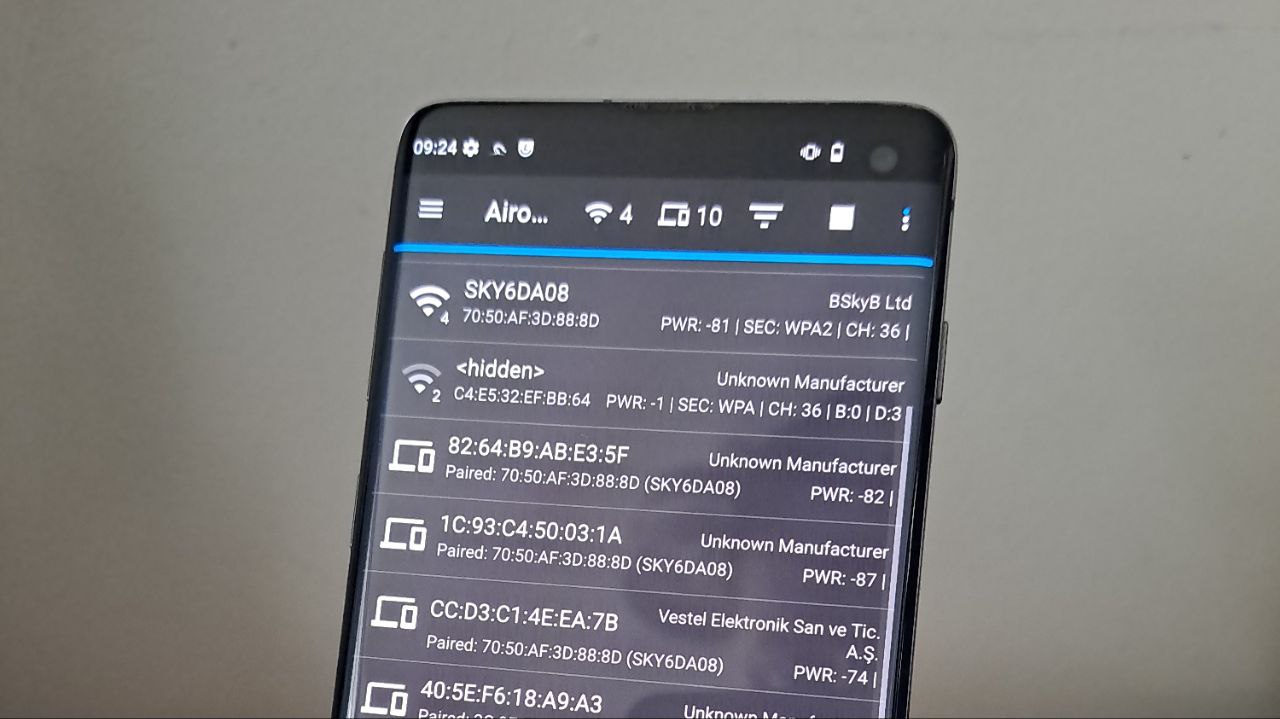
We are happy to announce that we finally have a new budget friendly device since Nexus 5, which supports internal monitor mode with injection on both 2.4Ghz and 5Ghz. After an awesome collaboration, the Kali NetHunter Samsung Galaxy S10 is born. The Nexmon team patched the broadcom firmware, @V0lk3n ported the Kali NetHunter kernel, and @yesimxev released Hijacker arm64 version to avoid app crashes. The install guide is available here for Nexmon and Kali NetHunter.
CARsenal Update
Kali NetHunter Car Hacking, CARsenal, continues to expand with a lot of change and new features by @V0lk3n!
You will need to run the setup again, to apply all the new changes and install any new packages.
Even if it’s a “Car Hacking” toolset, we discourage you from trying this on your daily driver. Use it on a controlled environment. Either OffSec or the Kali team will not take responsibility for your actions, especially if you break your car.
What’s New?
- Main - Settings has been moved to menu bar and all service commands can be edited by long pressing oranges buttons. New
RFCOMM Connectservice. - Tools - Settings has been moved to menu bar. When configuring your settings, tools buttons will be updated with it, and all tools commands can be edited by long pressing oranges buttons.
- CAN-USB - Settings as been moved to menu bar. When configuring your settings,
Runbutton will be updated with it. - Caring Caribou - All modules and sub-modules as been added to
Caribou, excepteddoipwhich should come in 2025.4 update andDCMwhich is replaced byUDS. All module spinner have been merged intomodulesandsubmodulesspinner. Settings parameters is now displayed depending of the module/submodule chosen. - ICSim rewrite -
ICSimis renamed toSimulator, andUDSimhas been added to it - enjoy more simulation for learning and testing purpose! Also a new feature to hide/display the controls view and to make ICSim/UDSim a float-able window has been added! Keep the simulator in front of your eyes while running tools from CARsenal or NetHunter Terminal! - New MSF tab - A new MSF tab has been added, providing automotive modules for Metasploit-Framework. Setup a hardware bridge, connect to it and run post modules!
- About dialog - About dialog page and it’s credit has been updated.
What Else?
- UI - User Interface has been updated a lot! Thanks to @kimocoder for inspiration!
- Bug Fix - A lot of bug fix and no more outdated libraries used! Thanks again to @kimocoder for this!
- CARsenal Refactoring - Refactoring process of CAN Arsenal to CARsenal is now complete.
- Documentation - Complete rewrite of CARsenal documentation for 2025.3 content (no change for the kernel documentation part).
- New Kernel Supporting CAN - OnePlus6 for LineageOS 22.2 (Android 15). Note that it was made for OnePlus6 and not it’s 6T variant. This will be updated soon as well to support it.
What to come next?
Expect to see for 2025.4 more UI update, better MSF screen terminal, Simulator update and more! We are also planning to make series of videos demonstrating CARsenal, If you notice a bug or simply wish to have a feature added to CARsenal, get in touch!
Modules in Magisk
Kernel modules install with Magisk is now supported and are included in the released install images. It is still in experimental state. Credits to @yesimxev and @cyberknight777.
Bugfixes & Improvements
Thanks largely to @kimocode who made a lot of code updates improving UI, stability and more!
Bellow is a list of changes:
- Boot animation is now fixed
- Improved/Added API 21 to API 34+
- Made
busybox_nhavailable in Android (SU) shell - Made the
bootkali" and “killkali” scripts available in Android (SU) shell - Removed the non-working ‘Deauth’ tab (fragment)
- Replaced many deprecated libraries
- Replaced the deprecated ‘AsyncTask’ with ‘Executer’ which improves threading and background tasks making the application for stable and improve performance
- Updated all libraries in use to latest
- Updated BusyBox binaries
- Updated Gradle / JAVA
- Updated the “Audio” fragment
- Updated the “GPS” fragment
- Updated the kernel “Modules” fragment
- Updated vulnerable database list (WPS)
- WP3: Fix templates not showing in the Spinner
Playground
@yesimxev had fun on his car radio again. Let’s combine a Kali NetHunter phone, RTL-SDR, and a car radio. The result? Airspace visualizer in your car, bringing the wardriving vibes, especially with the radar design. Credits to @ElbaSatGuy for creating this awesome project.
Finally, he tried out the Bad Bluetooth Attack on his smartwatch, to take over a Samsung tablet.
Kali ARM SBC Updates
Other than Nexmon, which we have already covered, Kali ARM has also had a few other improvements:
- We have fixed an issue with the Kernels not always getting updated.
- For our Raspberry Pi images, we are now recommending to use the 64-bit (
arm64) image rather than 32-bit (armhf). - The Raspberry Pi 64-bit (
arm64) image will also do Raspberry Pi 5! There is no longer a dedicated image just for this device. - The Raspberry Pi 2 doesn’t support 64-bit (
arm64), so if you are still rocking it, grab the 32-bit (armhf).
Miscellaneous
Below are a few other things which have been updated in Kali, which we are calling out, which do not have as much detail:
- New community wallpapers in multiple colors (thanks @IAmNewbie99)
- OffSec, the company who founded Kali, will be soon offering a free “Capture The Flag” (CTF) event in October with $100,000 in prizes. For more information, and to pre-register see “The Gauntlet”
- A great guide to read: So You Want To Build A NetHunter Kernel
Kali Documentation
Our Kali documentation has had various updates to existing pages as well as new pages:
- Installing Docker on Kali Linux (Updated)
- Resolving APT Errors Caused by an Expired Kali Linux Signing Key (New)
- Setting up a system for packaging (Updated)
- Reset Bloodhound’s admin password (Updated)
Kali Blog Recap
Since our last release, we did the following blog posts:
- The Raspberry Pi’s Wi-Fi Glow-Up
- Kali Linux & Containerization (Apple’s Container)
- Kali Vagrant Rebuilt: Out With Packer, In With DebOS
Community Shout-Outs
These are people from the public who have helped Kali and the team for the last release. And we want to praise them for their work (we like to give credit where due!):
Anyone can help out, anyone can get involved!
New Kali Mirrors
First, we have a new machine to host our tier-0 mirror archive.kali.org! The tier-0 mirror is the source from where all the other mirrors sync. This new machine has more bandwidth; we went from 500 Mb/s to 3 Gb/s, in other words we increased capacity by 6! In practical terms, it means mirrors will sync faster, which is especially relevant for “big syncs”, when a lot of new packages land in the repository at once. Faster mirror syncs means users get new packages faster, and it means smoother operations overall. This is a very welcome upgrade, long overdue!
Now, for the list of new Kali mirrors, this release cycle was again busy, we welcomed 6 new mirrors in Asia:
- China: mirror.nju.edu.cn, sponsored by the eScience Center, Nanjing University, thanks to YAO Ge.
- China: mirror.nyist.edu.cn, sponsored by the Nanyang Institute of Technology, thanks to Palve.
- China: mirrors.tuna.tsinghua.edu.cn, sponsored by the Tsinghua University, thanks to Miao Wang.
- Japan: mirror.tefexia.net, sponsored by Tefexia, thanks to Seungha Lee.
- South Korea: mirror.jeonnam.school, sponsored by Jeonnam High School, thanks to Wonchan Lee.
- South Korea: mirror.zzunipark.com, sponsored by zzuniMirror, thanks to MinJun Park.
We also welcomed a pair of mirrors sponsored by IONOS, thanks to William Fleurant:
- Germany: eu.mirror.ionos.com
- United States: us.mirror.ionos.com
If you have the disk space and bandwidth, we always welcome new mirrors.
Get Kali Linux 2025.3
Fresh Images:
So what are you waiting for? Go get Kali already!
Seasoned Kali Linux users are already aware of this, but for those who are not, we also produce weekly builds that you can use. If you cannot wait for our next release and you want the latest packages (or bug fixes) when you download the image, you can just use the weekly image instead.
This way you will have fewer updates to do.
Just know that these are automated builds that we do, not QA like we do for our standard release images. But we gladly take bug reports about those images because we want any issues to be fixed before our next release!
Existing Installs:
If you already have an existing Kali Linux installation, remember you can always do a quick update:
┌──(kali㉿kali)-[~]

└─$ echo "deb http://http.kali.org/kali kali-rolling main contrib non-free non-free-firmware" | sudo tee /etc/apt/sources.list

[...]

┌──(kali㉿kali)-[~]

└─$ sudo apt update && sudo apt -y full-upgrade

[...]

┌──(kali㉿kali)-[~]

└─$ cp -vrbi /etc/skel/. ~/

[...]

┌──(kali㉿kali)-[~]

└─$ [ -f /var/run/reboot-required ] && sudo reboot -f
You should now be on Kali Linux 2025.3. We can do a quick check by doing:
┌──(kali㉿kali)-[~]

└─$ grep VERSION /etc/os-release

VERSION="2025.3"

VERSION_ID="2025.3"

VERSION_CODENAME="kali-rolling"

┌──(kali㉿kali)-[~]

└─$ uname -v

#1 SMP PREEMPT_DYNAMIC Kali 6.12.38-1kali1 (2025-08-12)

┌──(kali㉿kali)-[~]

└─$ uname -r

6.12.38+kali-amd64
NOTE: The output of uname -r may be different depending on the system architecture.
As always, should you come across any bugs in Kali, please submit a report on our bug tracker. We will never be able to fix what we do not know is broken! And Social networks are not bug trackers!
Want to keep up-to-date easier? We’ve got you!
💬 Dyskusja społeczności i komentarze
Rozpocznij dyskusję w strumieniu transmisji Social Chat lub prześlij wyżej wkład ekspercki przez formularz uzupełnień.