
Zum Hauptinhalt springen
LIVE
CVSS 7.0CVE-2026-138158 | libgphoto2 through 2.5.34 contains a stack buffer overflow in sierra_get_string_register() that lets a malicious sierra-protocol camera or USB device overwrite stack memory. When files are listed, the device can answer the file-name register with an oversized packet, writing up to 32 KB past small stack buffers to cause crashes or possible code execution.CVSS 7.7CVE-2026-138159 | edbrowse through 3.8.19 contains an integer overflow in stringAndBytes() that allows malicious servers to write past a heap buffer by sending response bodies larger than 2 GB. When a user browses to an attacker-controlled HTTP, FTP, or gopher server, the oversized body skips reallocation and corrupts the heap, causing crashes or potentially code execution.CVSS 8.5CVE-2026-138160 | Gammu before 1.45.2 contains a stack-based buffer overflow vulnerability in ReadBackupTextLen() that allows attackers to overwrite stack memory via crafted backup files. Attackers can supply overlong quoted text values decoded into a 10,000-byte stack array during convertbackup, restore, or GSM_ReadBackupFile calls, causing crashes or potential code execution.CVSS 8.5CVE-2026-138161 | Gammu before 1.45.2 contains a buffer overflow vulnerability in LoadBackup() that allows attackers to corrupt memory by supplying an overlong MD5 value in a crafted backup file. Attackers can overwrite adjacent phonebook and calendar entry pointers via strcpy() into MD5Original when files are loaded with convertbackup or restore, causing crashes or potential code execution.CVSS 7.3CVE-2026-138162 | Gammu before 1.45.2 contains a stack-based buffer overflow vulnerability in ALCATEL_EncodeString() that allows attackers to overwrite stack memory via oversized encoded phonebook text. Attackers can supply a crafted backup restored with gammu restore or addnew to an attached Alcatel phone, using GSM extension characters to crash Gammu or potentially execute code.CVSS 8.5CVE-2026-138163 | Gammu before 1.45.2 contains a heap-based buffer overflow in ReadWAPSettingsEntry() that allows attackers to corrupt heap memory via crafted backup files with excess WAP or MMS settings entries. Attackers can supply a backup with more than four TitleNN keys in a [WAPSettings] or [MMSSettings] section, loaded via convertbackup, restore, or GSM_ReadBackupFile, causing crashes or potential code execution.CVSS 4.8CVE-2026-138164 | Gammu before 1.45.2 contains a stack-based buffer overflow vulnerability in SaveBackupText() in backtext.c that allows attackers to corrupt stack memory by supplying long text fields. Attackers can craft a backup with long calendar or note fields that, when converted with gammu convertbackup, writes hex digits past the 10,000-byte stack buffer.CVSS 9.3CVE-2026-138154 | POSTAL 2 before build 26810491 contains a sandbox escape vulnerability that allows malicious Steam Workshop mods to execute code by calling ConsoleCommand with a start file URI. Attackers can ship a batch file in a mod at the predictable workshop install path and launch it via ShellExecuteW, executing commands as the player on Windows.
Alle im Drawer
Intelligence View
⚡ tsecurity.de Intelligence

Everything as Code: When Your Tasks Become Markdown You Can Commit to Git

title: Add a smoke test to the release flow status: in-progress tags: [release, testing] deadline: 2026-07-10 Goal Run the critical path automatically before…

Beitrag
0
Seite
0
↗ Quelle (dev.to)
Quelle & Fakten · 4 Min. Lesezeit
Quelle: dev.to
Rubrik: Sichere Programmierung

title: Add a smoke test to the release flow

status: in-progress

tags: [release, testing]


deadline: 2026-07-10


Goal


Run the critical path automatically before every release; block the tag on failure.


Steps


  • [x] Log in + create task

  • [ ] Browse the three core pages

  • [ ] Assert no console errors


The frontmatter is the task's **structured metadata**: title, status, tags, deadline, assignee, links — the 20% of fields that cover 80% of cases are all first-class, and all queryable. The body below the frontmatter is the task's **canonical document (the Single Source of Truth)**: a living piece of Markdown.

No proprietary format. No binary blob to export. No vendor lock-in. What you see is all there is.

### apply, Just Like kubectl

Save that Markdown to a file, then:


bash

ud apply -f task.md


The rules are exactly like `kubectl apply`: **no id in the frontmatter means create, an id means update**. apply is a **full replace** — the file is the source of truth.

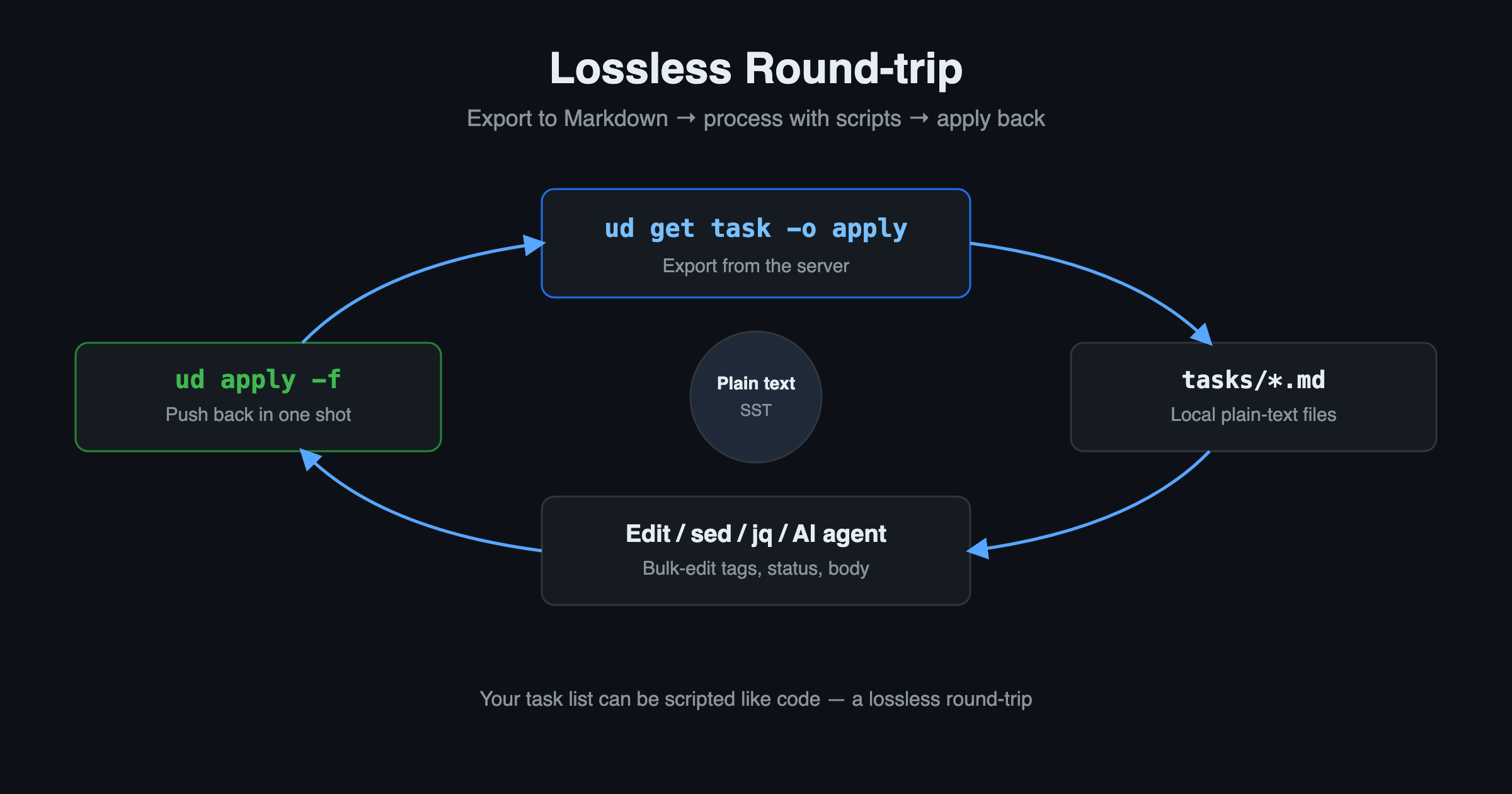
Want to export in bulk, edit, and push it all back? `ud get task -o apply` prints your tasks in the same format apply accepts — a lossless round-trip. That means your task list can be processed like code with sed / jq / any script, then applied back in one shot.
![Lossless round-trip: ud get -o apply exports to local md, scripts process it, ud apply pushes it back](https://pub-35d77f83ee8a41798bb4b2e1831ac70a.r2.dev/features/blog/everything-as-code/concept-2.png)

### Why This Is a Superpower for Developers (and AI)

**1. Version-controllable, GitOps-friendly.** Tasks are plain text, so they naturally diff, live in Git, and go through PR review. Your project plan and your code can share the same commit history.

**2. Native I/O for AI agents.** Markdown is human-readable and AI-readable. Any terminal-based coding agent — Claude Code, Codex, OpenCode, or any agent that lives in your shell — can read and write your tasks directly through the `ud` CLI, with no special plugin or SDK. The whole knowledge base is plain-text-native and AI-ready.


bash


things an agent can do right in your terminal


ud get task 'status = in-progress'

ud apply -f new-task.md

ud describe task 8b30140e


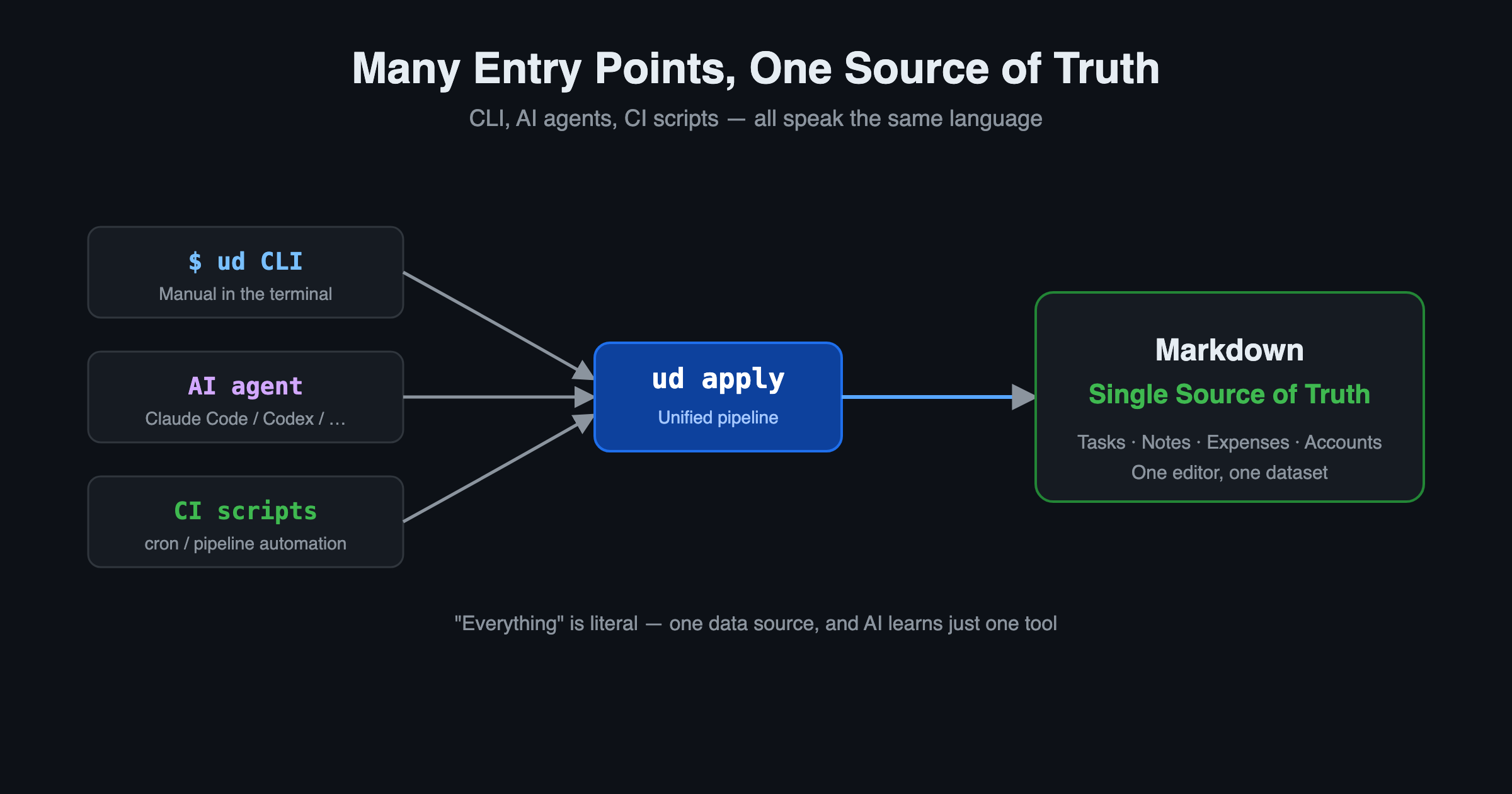
**3. Scriptable and composable.** A SQL-like query syntax plus kubectl-style verbs (get / describe / apply / delete / patch) turn task management into something you can drop into any automation. Create a task in CI, bulk-retag from a script, generate a weekly report from cron — each is just a few lines of shell.
![Many entry points, one source of truth: CLI, AI agents, and CI scripts all write to the same Markdown data source through ud apply](https://pub-35d77f83ee8a41798bb4b2e1831ac70a.r2.dev/features/blog/everything-as-code/concept-3.png)

### Not Just Tasks

Here's a detail that's easy to miss: UnDercontrol's Markdown editor is **not task-specific**. It's a single editor shared across every text surface — tasks, notes, even expense and account memos all use the same editing experience and the same Markdown core.

So the "Everything" in "Everything as Code" is literal: your todos are Markdown, your notes are Markdown, the memo on an expense you logged is Markdown. One data source, organized the way you like, all in one place. No switching between apps, and an AI agent only has to learn a single tool to reach all of your information.

### Three Content Layers

Each information unit has three layers. Each has a design intent, but you're free to use them however suits you:

| Layer | Format | Design Intent |
|-------|--------|---------------|
| **Task body** | Markdown | The canonical, evolving document — Single Source of Truth |
| **Notes** | Markdown | An append-only timeline — how this unit evolved |
| **Comments** | Plain text | Lightweight, threaded conversation — short and focused |

What distinguishes a "doc" from a "task" isn't the data structure — it's **tags, metadata, and the view**. UnDercontrol doesn't force a folder hierarchy or a tagging convention on you: the same task can appear on multiple boards (a board is a *saved query*, not a container, so there's no duplication).

### Get Started

If you're tired of trapping your ideas inside a UI, try turning them into Markdown you can apply:


bash

ud apply -f my-first-task.md


Everything as Code isn't just a slogan — it's how your tasks, your scripts, and your AI agents finally speak the same language.


Information ergänzen Fachhinweis, Update, Korrektur oder Quelle zur Meldung beitragen
Gäste-Hinweise werden kurz redaktionell geprüft und danach hier angezeigt.

Community-Hinweise zur Meldung

0 freigegeben
Social ReaktionenReagiere als Erste:r — dein Feedback zählt!
Informations-Bewertung:

💬 Dyskusja społeczności i komentarze

🌐 Dołącz do głównego czatu

Rozpocznij dyskusję w strumieniu transmisji Social Chat lub prześlij wyżej wkład ekspercki przez formularz uzupełnień.

Cyber Threat Intelligence i Kryminalistyka

Navigator ATT&CK · Radar IoC i Graf

IoC Intelligence
1 Indikatoren · Defanged · STIX 2.1
35d77f83ee8a41798bb4b2e1831ac70a
Community Rating & Social Proof
⭐ Ocena czytelników
–
Ø / 5.0
Brak recenzji czytelników
Czy ten artykuł był pomocny?
0
Dodaj swoją ocenę
Ocena szczegółowa (opcjonalnie)
Treść i jakość
Źródło i wiarygodność
Aktualność
Security Briefing Bezpłatnie · Wypisanie 1 kliknięciem

Intelligence Digest - bezpłatnie

Codziennie najważniejsze wiadomości bezpieczeństwa · można pobrać w każdej chwili

Powiązany klaster opowieści i źródła (wektor AI)

4 Cluster
2 źródeł
Mozilla Thanks Users For New Features in Firefox 161: Site-Specific VPN and Keyboard Shortcuts
tsecurity.de 1 dzień temu
1 inne źródło
2 źródeł
Florian Quèze: Quickly debugging an intermittent failure that never reproduced locally, with the Firefox Profiler
tsecurity.de 2 dni temu
1 inne źródło
2 źródeł
GitHub Release: can1357/oh-my-pi v19.1.1 (23.11.2026)
tsecurity.de 5 dni temu
1 inne źródło
Podobne wkłady
🔍 Verwandte News

Auch interessante Nachrichten Everything as Code: When Your Tasks Become Markdown You Can Commit to Git

Thematisch verwandte Begriffe: Everything, Code, When, Your · 6 Treffer

Laden...

Składki są załadowane...

Laden...

Filmy są załadowane...

Laden...

Składki są załadowane...

Laden...

Filmy są załadowane...

Laden...

Składki są załadowane...

Laden...

Filmy są załadowane...

Laden...

Składki są załadowane...

Laden...

Filmy są załadowane...

Uwagi Komentarze są ładowane..
Rysunek do aktualizacji
Widgets & Topics
Loading widgets…
Nächster Beitrag