
Zum Hauptinhalt springen
LIVE
CVSS 4.8CVE-2026-138092 | A security flaw has been discovered in ggml-org llama.cpp up to 0.8.0. This vulnerability affects the function ggml_roll of the file ggml/src/ggml.c of the component Ggml Tensor Library Roll Operation. The manipulation results in integer overflow. The attack needs to be approached locally. Upgrading to version 0.9.0 is able to resolve this issue. The patch is identified as 0978a6e9022fb9bd6874b86154ee304e81929b9f. It is suggested to upgrade the affected compCVSS 10.0CVE-2026-138091 | A vulnerability was identified in Tenda AC10U 15.03.06.48. This affects the function TendaTelnet of the file /goform/telnet of the component Web UI. The manipulation leads to missing authentication. The attack is possible to be carried out remotely. The exploit is publicly available and might be used.CVSS 10.0CVE-2026-138090 | A vulnerability was determined in Tenda AC10U 15.03.06.48. Affected by this issue is the function ate_ifconfig_set of the file /bin/httpd of the component ATE Service. Executing a manipulation can lead to os command injection. The attack can be executed remotely. The exploit has been publicly disclosed and may be utilized.CVSS 6.9CVE-2026-138089 | A vulnerability was found in Youzan ZanProxy up to 5.1.0. Affected by this vulnerability is the function processRedirect of the file src/core/proxy/middleware/rule.ts of the component Forwarding Rule Redirect. Performing a manipulation of the argument Target results in path traversal. Remote exploitation of the attack is possible. The exploit has been made public and could be used. The project was informed of the problem early through an issue report but hasCVSS 6.9CVE-2026-138088 | A vulnerability has been found in SchneeHertz exhentai-manga-manager up to 1.6.16. Affected is the function mangaToLANraragiArchive of the file index.js of the component LAN Browsing Service. Such manipulation leads to missing authentication. The attack may be launched remotely. The exploit has been disclosed to the public and may be used. The reported GitHub issue was closed with the reason "completed". However, it was not possible to determine the PR or coCVSS 6.9CVE-2026-138087 | A flaw has been found in linhaojun857 aurora up to 07e9524caacf6ceb021f3408e73f900f230d05f2. This impacts the function generalKey of the file aurora-springboot/src/main/resources/application-prod.yml of the component JWT Token Service. This manipulation of the argument secret causes use of hard-coded cryptographic key . The attack may be initiated remotely. The exploit has been published and may be used. This product uses a rolling release model to deliverCVSS 6.9CVE-2026-138086 | A security vulnerability has been detected in wonderunit storyboarder 3.0.0. The impacted element is the function MobileServer of the file src/js/express-app/app.js. The manipulation leads to missing authentication. The attack can be initiated remotely. The exploit has been disclosed publicly and may be used. The project was informed of the problem early through an issue report but has not responded yet.CVSS 5.3CVE-2026-138085 | A weakness has been identified in ThingsBoard up to 4.2.2.7/4.3.1.7/4.4.0. The affected element is the function downloadTestReport of the file application/src/main/java/org/thingsboard/server/controller/DashboardReportController.java of the component Report Service. Executing a manipulation of the argument userId can lead to authorization bypass. It is possible to launch the attack remotely. The exploit has been made available to the public and could be used
Alle im Drawer
Intelligence View
⚡ tsecurity.de Intelligence

Tom Ritter: webgl renderer privacy

WebGL exposes the details of your graphics hardware (specifically, the string that describes the rendering engine) in 2 ways. There are three levels of…

Beitrag
0
Seite
0
↗ Quelle (ritter.vg)
Quelle & Fakten · 3 Min. Lesezeit
Quelle: ritter.vg
Rubrik: Admin & Dev Tools

WebGL exposes the details of your graphics hardware (specifically, the string that describes the rendering engine) in 2 ways. There are three levels of protection that browsers have taken to protect this data.


  1. gl.getParameter(gl.VENDOR) and gl.getParameter(gl.RENDERER) - these are the 'simple' names. At some point in the past, someone argued that it wasn't enough information, and therefore we have a second API

  2. let ext = gl.getExtension('WEBGL_debug_renderer_info'); and then gl.getParameter(ext.UNMASKED_VENDOR_WEBGL) and gl.getParameter(ext.UNMASKED_RENDERER_WEBGL)


The unmasked values are intended to be the more detailed ones, so always make sure you're comparing apples to apples. Another axis is that WebGL can render with Hardware or Software. This isn't a guarentee which one you'll get, but you can hint towards one or the other and the browser may or may not respect it. Here are your values:


Alright, now let's talk about what browsers do about it. There's no point in talking about Vendor, Renderer, and Unmasked Vendor - they don't really show as much detailed info, it's all about Unmasked Renderer. There are three levels:


  1. Give a constant value. (Or don't return anything at all.)

  2. 'Round' the values into buckets

  3. Give the exact value back


Safari and Tor Browser give constant values.


Firefox 'rounds'.


Chrome (and Brave, and I assume all-ish other Chrome-based browsers) give the exact value.


Firefox actually is purusing constant values, this week. I wrote this document for our QA team to test it. (You can get a sense of the internal sausage making it takes to launch a privacy feature from it.) I don't know if you can see the dates but I made it May 20th. The problem is this - websites use this data legitimately to adjust behavior so that users get the best experience possible. I found one example where they detect a buggy graphics stack; and a couple of examples where they adjust rendering so things are more performant for users with lower end machines - a problem Apple has less to worry about because they only support certain machine models!


A common response to this seems to be ambivalence, and I would suggest that is a bit elitist. Yes, if you're caring about the details reveal by a particular Web API you probably have a computer where you don't need to worry, but making the web work well for everyone is important for equitable access to improving everyone's human condition.


We have been bucketing WebGL Renderer since 2021. While many of our (supported, on-by-default) fingerprinting protections are part of Enhanced Tracking Protection - rolling out first in PBM/ETP Strict before making it to ETP Standard/Normal Browsing Mode - the bucketing is on by default, for everyone, and is not disabled if ETP is disabled.


How much of a difference does it make? A lot! Here is the distribution of the raw values. 83,705 distinct values.
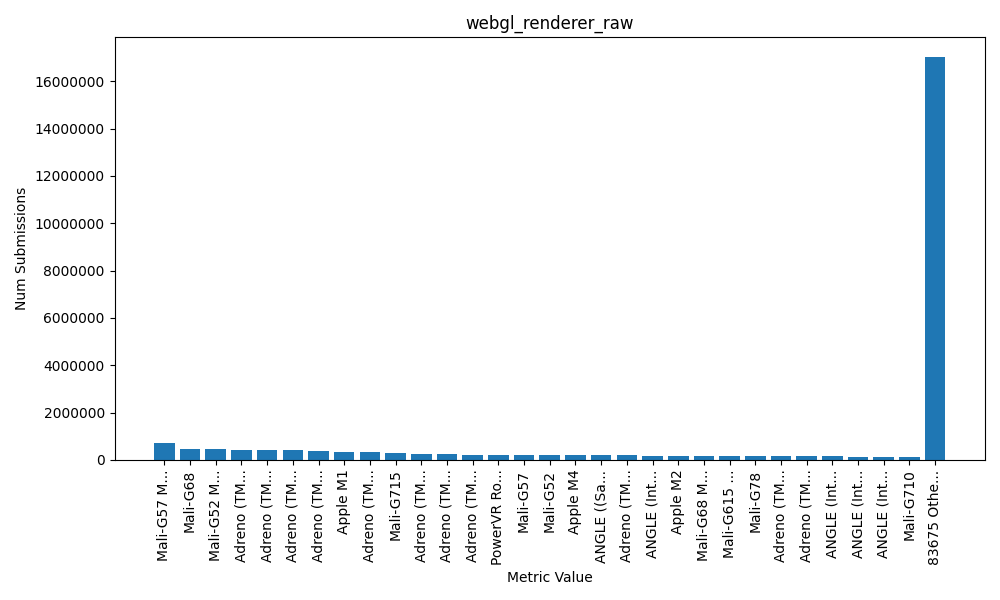


WebGL Renderer Value Distribution, before bucketing

Compare that to the bucketed data. 131 distinct values.
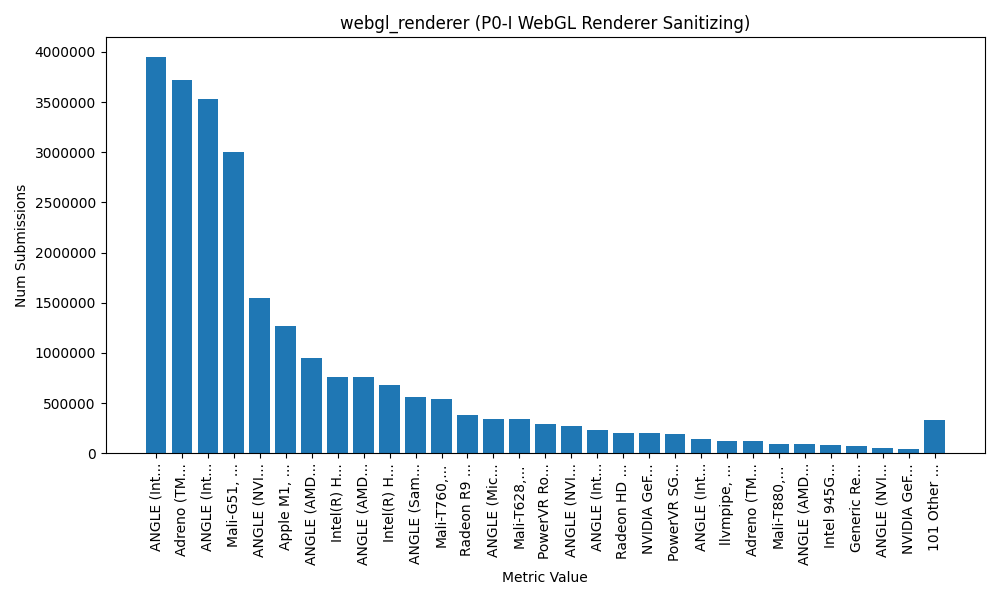


WebGL Renderer Value Distribution, after bucketing

Now this data is from Firefox, so I cant say conclusively what the distribution of data is in other browsers, but... yeah. To claim Chrome (of all browsers!) is doing this better than us is pure FUD. We're making a big impact in how fingerprintable you are today and we're trying to improve it even further.

Information ergänzen Fachhinweis, Update, Korrektur oder Quelle zur Meldung beitragen
Gäste-Hinweise werden kurz redaktionell geprüft und danach hier angezeigt.

Community-Hinweise zur Meldung

0 freigegeben
Social ReaktionenReagiere als Erste:r — dein Feedback zählt!
Informations-Bewertung:

💬 Topluluk tartışması ve yorumlar

🌐 Ana sohbete katıl

Tartışmayı başlat: Social Chat yayın akışı veya yukarıdaki ekleme formuyla uzman katkısı gönder.

Community Rating & Social Proof
⭐ Okuyucu Puanı
–
Ø / 5.0
Hiçbir okuyucu henüz yorum yok
Bu makale yararlı mıydı?
0
Değerlendirmenizi gönderin
Detaylı değerlendirme (isteğe bağlı)
İçerik ve Kalite
Kaynak ve Güvenilirlik
Güncellik
Security Briefing Ücretsiz · Tek tıkla abonelikten çıkma

Zeka Digest - ücretsiz

Günlük en önemli güvenlik haberi · herhangi bir zamanda alınabilir

İlgili Story Cluster & Kaynaklar (vector AI)

1 Cluster
2 Kaynaklar
Samsung zieht eigener App am 31. März 2027 den Stecker
Giga.de 10 saat önce
1 başka bir kaynak
Benzer katkılar
🔍 Verwandte News

Auch interessante Nachrichten Tom Ritter: webgl renderer privacy

Thematisch verwandte Begriffe: Ritter, webgl, renderer, privacy · 6 Treffer

Laden...

Contributions yüklenir ...

Laden...

Videolar yükleniyor...

Laden...

Contributions yüklenir ...

Laden...

Videolar yükleniyor...

Laden...

Contributions yüklenir ...

Laden...

Videolar yükleniyor...

Laden...

Contributions yüklenir ...

Laden...

Videolar yükleniyor...

Yorumlar yüklenir..
Update to Update
Widgets & Topics
Loading widgets…
Nächster Beitrag