
Zum Hauptinhalt springen
Echtzeit-Radar & Feeds
Alle RSS Feeds ➔
👥 Community & Social
•
IT Security NachrichtenBetrüger phishen mit vermeintlicher Reisebestätigung - IT-Markt(24.09.2026 um 23:41 Uhr)
••
Sicherheitslücken (CVE)IT Security News Daily Summary 2026-09-24(24.09.2026 um 23:55 Uhr)
•
Sicherheitslücken (CVE)IT Security News Roundup: 2026-09-24(24.09.2026 um 23:57 Uhr)
•
Sicherheitslücken (CVE)IT Security News Hourly Summary 2026-09-25 00h : 9 posts(25.09.2026 um 00:00 Uhr)
•••
IT NachrichtenMicrosoft puts Brad Smith in charge of communications(25.09.2026 um 00:08 Uhr)
•••
IT Security NachrichtenBetrüger phishen mit vermeintlicher Reisebestätigung - IT-Markt(24.09.2026 um 23:41 Uhr)
••
Sicherheitslücken (CVE)IT Security News Daily Summary 2026-09-24(24.09.2026 um 23:55 Uhr)
•
Sicherheitslücken (CVE)IT Security News Roundup: 2026-09-24(24.09.2026 um 23:57 Uhr)
•
Sicherheitslücken (CVE)IT Security News Hourly Summary 2026-09-25 00h : 9 posts(25.09.2026 um 00:00 Uhr)
•••
IT NachrichtenMicrosoft puts Brad Smith in charge of communications(25.09.2026 um 00:08 Uhr)
••
Intelligence View
⚡ tsecurity.de Intelligence

How Zero Trust is supposed to look

Over the last few years, it has become more and more apparent that the status quo for networking and security is no longer viable. Endlessly extending hub-and-spoke networks to more remote users, branch offices, and cloud apps increases…

0
↗ Quelle (cio.com)
Reagiere als Erste:r — dein Feedback zählt!


Over the last few years, it has become more and more apparent that the status quo for networking and security is no longer viable. Endlessly extending hub-and-spoke networks to more remote users, branch offices, and cloud apps increases risk, harms the user experience, and is prohibitively complex and expensive. The same is true when relying on castle-and-moat security models to secure the expanding network through ever-growing stacks of security appliances.


Zero trust has quickly cemented itself as the go-to solution to the problems of these perimeter-based architectures. Unfortunately, all the zero trust buzz has created confusion about what exactly the term means. Sometimes it is described as a specific capability or yet another appliance (either hardware or virtual). In other cases, zero trust is presented as an imaginary holy grail, something that does not actually exist but is believed to solve all of an organization’s problems. However, the reality is quite different from these two views.


Zero trust is an architecture; it is neither an extra lever for the status quo nor a mere figment of a hopeful or naive imagination. Zero trust constitutes a departure from hub-and-spoke networks and castle-and-moat security models, and that is why it is so effective at avoiding their problems. In terms of the way that it works, you can click here to see more detailed information (you can also get a quick sense of the “how” by taking a quick look at the diagram below).
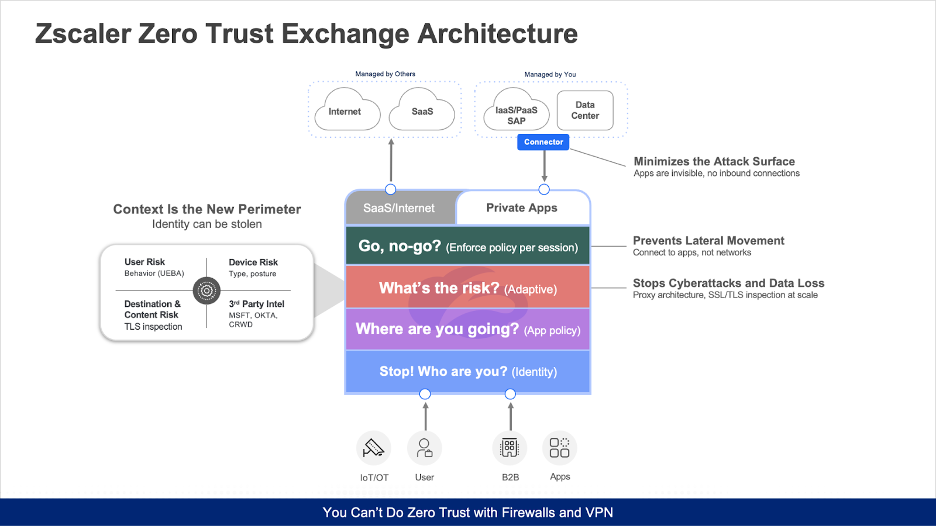


Zscaler


In terms of the “what,” this architecture should secure anything and everything within an organization. Fortunately, this comprehensive form of zero trust is not just hypothetical. The ideal is real and organizations can benefit from it today. Read on to see the four key areas protected by a complete zero trust architecture.


Zero trust for users


Your users need fast, secure, and reliable access to applications and the internet from anywhere and everywhere. This is often the first reason that organizations embrace a zero trust architecture—so that users can do their jobs securely and productively without the aforementioned shortcomings of perimeter-based architectures. In large part because of this need, Gartner coined the phrase security service edge (SSE) to describe edge-delivered security platforms that provide secure web gateway (SWG), zero trust network access (ZTNA), cloud access security broker (CASB), digital experience monitoring (DEM), and other functionalities. However, there is more to zero trust (and SSE, for that matter) than just securing users.


Zero trust for workloads


Workloads must also be secured with a zero trust architecture if organizations are to prevent data loss and cyberthreat infections. A workload is any specific service (e.g., virtual machine, container, microservice, application, storage, or cloud resource) used either as needed or in an always-on fashion to complete a specific task; for example, AWS S3. Much like users, they need to be granted secure access to both applications and the internet. At the same time, their configurations and entitlements must be set properly in order to avoid any issues that may lead to data exposure. Zero trust architecture can address both of these challenges by securing workload communications and providing capabilities like cloud security posture management (CSPM) and cloud infrastructure entitlement management (CIEM).


Zero trust for IoT and OT


“Internet of things” and “operational technology” are not just buzzwords. IoT and OT devices are transforming the way that organizations operate and have quickly become indispensable assets. However, despite their importance and the volume and sensitivity of data they can collect, they are not designed with security in mind. As a result, organizations need to discover these devices across the entire environment, extend privileged remote access to them in a secure fashion, and ensure that the IoT and OT devices themselves are granted secure access to the internet, to applications, and to other devices. Naturally, zero trust architecture is perfectly designed to address this trifecta of needs


Zero trust for B2B partners


Internal employees are not the only humans who need secure, performant access to IT systems. B2B suppliers, customers, and other partners also have legitimate access requirements. Preventing this access disrupts productivity, but granting excessive entitlements or network access enables compromise and lateral threat movement. Zero trust architecture circumvents both of these challenges by adhering to the principle of least privilege (PoLP) and granting B2B partners access only to the specific resources they need. With agentless browser-based access and browser isolation, it overcomes the challenge of securing partner devices where installing software is infeasible.


The Zscaler Zero Trust Exchange is the One True Zero Trust Platform. It provides the modern architecture that delivers comprehensive security for all users, workloads, IoT/OT devices, and B2B partners. With Zscaler, your organization can experience firsthand that the zero trust ideal is, in fact, real.


To learn more, register for our webinar that serves as an introduction to zero trust.


Security
SOC Incident Playbook: Remote Code Execution (RCE) Defense
Syntax validiert (0 Fehler)
title: Detect Exploitation - How Zero Trust is supposed to look
id: acfedbfa-7160-4bdf-a44c-1a0cfaa1e2f6
status: experimental
description: Automatisch generierte SIEM-Erkennungsregel basierend auf CTI Intelligence
references:
  - https://tsecurity.de/
author: iShareStuff CTI Automated Detection Engine
date: 2026-09-25
logsource:
  category: network_connection
  product: any
detection:
  selection:
      CommandLine|contains:
        - 'exploit'
  condition: selection
falsepositives:
  - Legitime administrative Zugriffe oder Penetrationstests
level: high
tags:
  - attack.initial_access
Syntax validiert (0 Fehler)
rule CTI_Threat_Indicator {
    meta:
        author = "iShareStuff CTI Automated Detection Engine"
        date = "2026-09-25"
        description = "YARA Signature for "
    strings:
        $str = "How Zero Trust is supposed to " ascii wide
    condition:
        any of them
}
Syntax validiert (0 Fehler)
index=security sourcetype IN ("cisco:asa", "pan:traffic", "zeek_conn", "suricata", "WinEventLog:Security")
("How Zero Trust is supposed to look")
| stats count earliest(_time) as first_seen latest(_time) as last_seen by src_ip, dest_ip, dest_host, signature
| eval first_seen=strftime(first_seen, "%Y-%m-%d %H:%M:%S"), last_seen=strftime(last_seen, "%Y-%m-%d %H:%M:%S")
| sort - count
Syntax validiert (0 Fehler)
message: "*How Zero Trust is supposed to look*"
Syntax validiert (0 Fehler)
CommonSecurityLog
| where Message has "How Zero Trust is supposed to look"
| summarize EventCount = count(), FirstSeen = min(TimeGenerated), LastSeen = max(TimeGenerated) by SourceIP, DestinationIP, DestinationPort, Activity
| extend DetectionRule = "iShareStuff-CTI-Compiled"
| sort by EventCount desc
🎯
MITRE ATT&CK Matrix Navigator 14 Taktiken
Reconnaissance
-
Resource Development
-
Initial Access
Execution
Persistence
-
Privilege Escalation
Defense Evasion
Credential Access
-
Discovery
-
Lateral Movement
-
Collection
-
Command and Control
Exfiltration
-
Impact
tsecurity.de Cognitive Threat RAG
Fokus-Vektor:

Kognitive Analyse für identifizierte Bedrohung: Erhöhte Bedrohungslage im Bereich How Zero Trust is supposed to look.... Basierend auf 368k Vektor-Korrelationen werden sofortige Isolationsmaßnahmen für betroffene Endpunkte empfohlen.

🛡️ Angriffsfläche & Exposure

Netzwerk/Remote-Zugriff ohne Vorauthentifizierung möglich.

⚡ Empfohlene Sofortmaßnahmen
  • 1. Perimeter-Inspektion: Relevante Portfreigaben und exponierte Endpunkte unverzüglich scannen.
  • 2. Patch-Applikation: Hersteller-Hotfix einspielen oder betroffene Daemons in isolierte DMZ-Segmente überführen.
  • 3. Telemetrie & EDR-Alerts: Prozessaufrufe und Child-Processes auf anomale Shell-Spawns überwachen.
🔗 Semantisch verwandte Zero-Days MariaDB 11.7 VEC
Ähnliche Beiträge
🔍 Verwandte News

Auch interessante Nachrichten How Zero Trust is supposed to look

Thematisch verwandte Begriffe: Zero, Trust, supposed, look · 6 Treffer

Laden...

Videos werden geladen ...

Laden...

Beiträge werden geladen ...

Laden...

Videos werden geladen ...

Laden...

Beiträge werden geladen ...

Laden...

Videos werden geladen ...

Laden...

Beiträge werden geladen ...

Laden...

Videos werden geladen ...

Laden...

Beiträge werden geladen ...

Laden...

Videos werden geladen ...

Zum Aktualisieren ziehen
ZERO-DAY CVE-2026-87722 | Uncontrolled Resource Consumption (CWE-400 / CWE-1333) in regex search q…
Advisory →
tsecurity.de Icon
Offline-Lesen, Eilmeldungen & 0ms Ladezeit

Installiere tsecurity.de direkt auf deinen Home-Bildschirm für das ultimative Vollbild-Magazinerlebnis ohne Browser-Leisten.

Nächster Beitrag
Themen-Radar & Intelligence Matrix
Echtzeit-Taxonomie nach Angriffsvektoren & Plattformen

tsecurity.de Live Threat Radar

🔴 LIVE RADAR
MONITORING
AKTIV
CVE-DATENBANK
LIVE
🔍
Community Radar & Live Chat
Sentinel Bot online • Live-Stream
Dein Cluster: Security Explorer
Match:
lädt…
Verbindung zum Community-Stream wird aufgebaut...
Bearbeitungsmodus — Senden überschreibt deine Nachricht
Community-Puls — was gerade passiert
lädt…
Aktivitäten deiner Analysten
lädt…
Neues Thema oder Eilmeldung einreichen

Reiche interessante Links, Zero-Days oder Debatten ein. Die Community entscheidet per Upvote über die Veröffentlichung.

Heiß diskutierte Einreichungen
📂 Keine gespeicherten Artikel vorhanden.
Zurück Ziehen Vor
Links: vorheriger Artikel • Rechts: nächster Artikel • unten: schließen
News NIS-2 Frühwarnung Tier-1 Intel TTP ⏱️ 3 Min vor 10 Min
Artikeldaten werden geladen...
↗ Original-Quelle