
Key Desired Qualities in Watermarking
Robustness — it should withstand perturbations of the watermarked text/structure.
If an end user can simply swap a few words before publishing or the protein can undergo mutations and become undetectable, the watermark is insufficient.
Detectability — it should be reliably detected by special methods but not otherwise.
For text, if the watermark can be detected without secret keys, it likely means the text is so distorted it sounds strange to the reader. For protein design, if it can be detected nakedly, it could lead to a degradation in design quality.
Watermarking text and Synthtext-ID
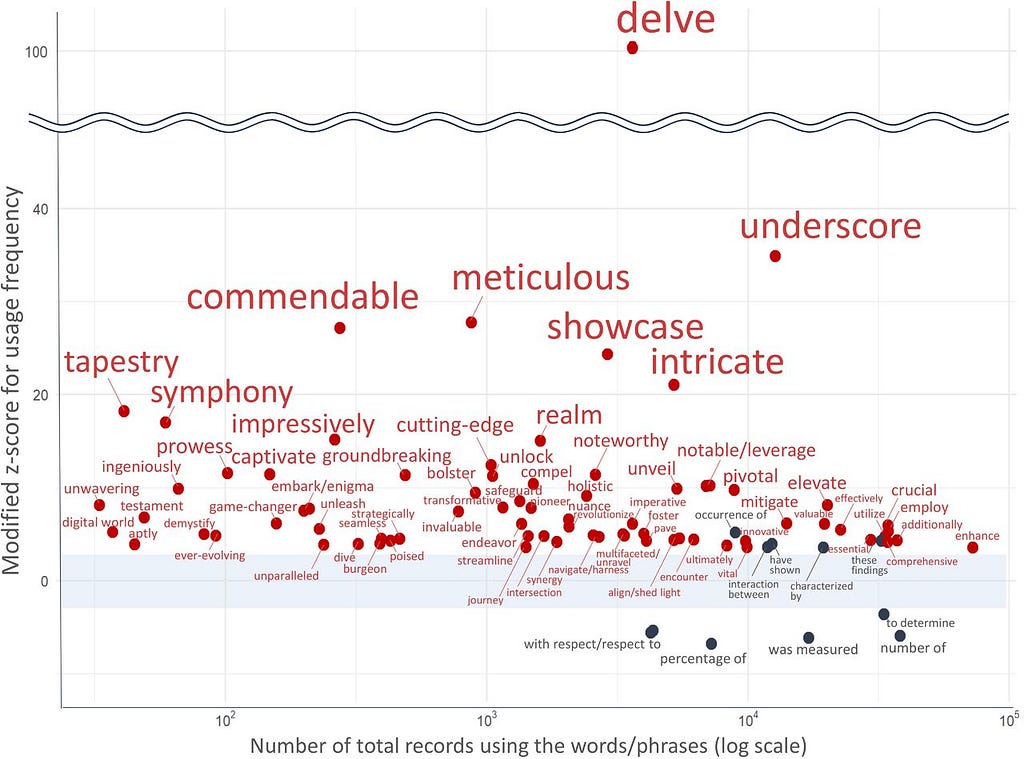
Let’s delve into this topic. If you are like me and spend too much time on are written by or with the help of ChatGPT. This is itself a sort of “fragile” watermarking because it can help us identify text written by an LLM. However, as this becomes common knowledge, finding and replacing instances of “delve” is too easy. But the idea behind SynthText-ID is there, we can tell the difference between AI and human written text by the probability of words selected.
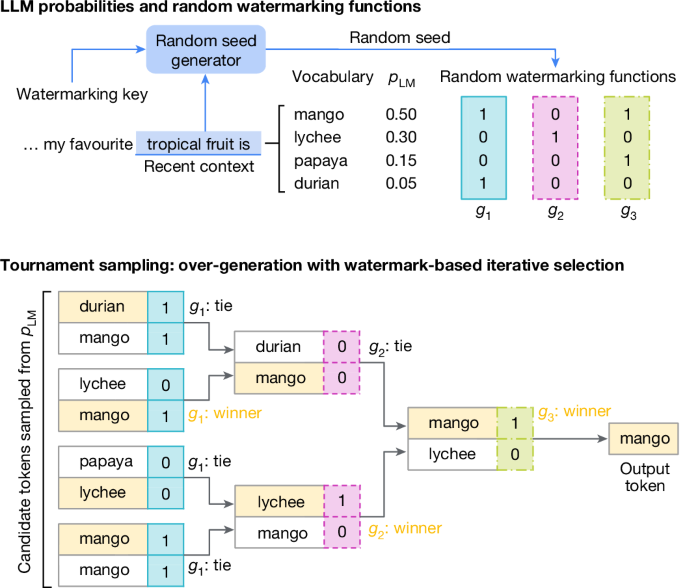
In the paper’s example, the sequence “my favorite tropical fruit is” can be completed satisfactorily with any token from a set of candidate tokens (mango, durian, lychee etc). These candidates are sampled from the LLMs probability distribution conditioned on the preceding text. The winning token is selected after a bracket is constructed and each token pair is scored using a watermarking function based on a context window and a watermarking key. This process introduces a statistical signature into the generated text to be measured later.
Watermarking Generative Proteins and Biosecurity
Biosecurity is a word you may have started hearing a lot more frequently after Covid. We will likely never definitively know if the virus came from a wet market or a lab leak. But, with better watermarking tools and biosecurity practices, we might be able to trace the next potential pandemic back to a specific researcher. There are existing database logging methods for this purpose, but the hope is that generative protein watermarking would enable tracing even for new or modified sequences that might not match existing hazardous profiles and that watermarks would be more robust to mutations. This would also come with the benefit of enhanced privacy for researchers and simplifications to the IP process.
When a text is distorted by the watermarking process, it could confuse the reader or just sound weird. More seriously, distortions in generative protein design could render the protein utterly worthless or functionally distinct. To avoid distortion, the watermark must not alter the overall statistical properties of the designed proteins.
The watermarking process is similar enough to SynthText-ID. Instead of modifying the token probability distribution, the amino acid residue probability distribution is adjusted. This is done via an unbiased reweighting function (Gumble Sampling, instead of tournament sampling) which takes the original probability distribution of residues and transforms it based on a watermark code derived from the researcher’s private key. Gumble sampling is considered unbiased because it is specifically designed to approximate the maximum of a set of values in a way that maintains the statistical properties of the original distribution without introducing systematic errors; or on average the introduced noise cancels out.
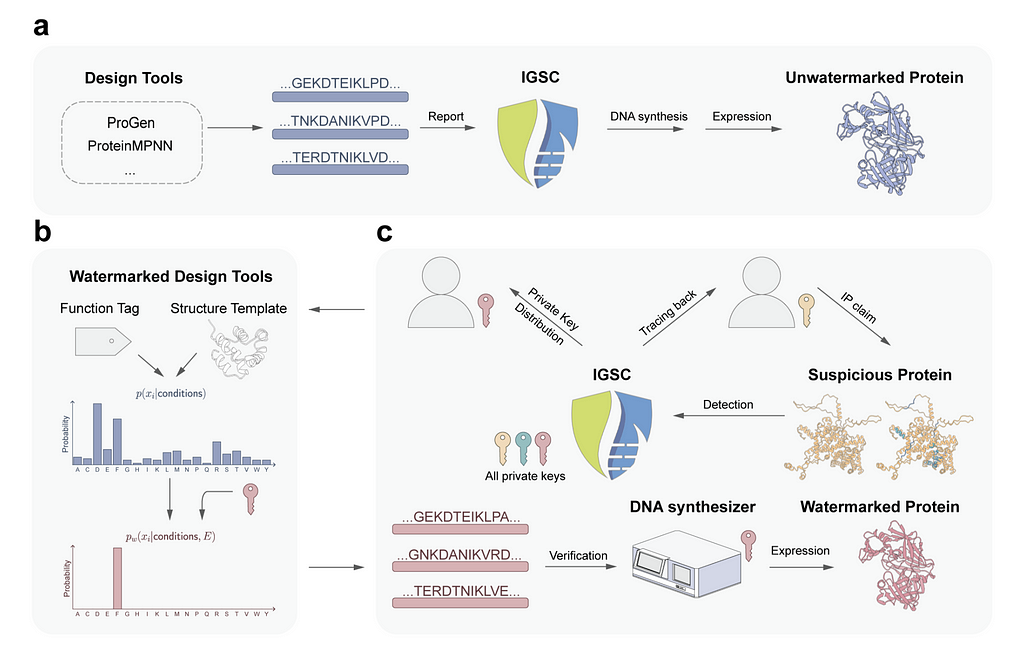
Similar to detection with low-temperature LLM settings, detection is more difficult when there are only a few possible high-quality designs. The resulting low entropy makes it difficult to embed a detectable watermark without introducing noticeable changes. However, this limitation may be less dire than the similar limitation for LLMs. Low entropy design tasks may only have a few proteins in the protein space that can satisfy the requirements. That makes them easier to track using existing database methods.
Takeaways
- Watermarking methods for LLMs and Protein Designs are improving but still need to improve! (Can’t rely on them to detect bot armies!)
- Both approaches focus on modifying the sampling procedure; which is important because it means we don’t need to edit the training process and their application is computationally efficient.
- The temperature and length of text are important factors concerning the detectability of watermarks. The current method (SynthText-ID) is only about 90% TPR for 1–2 paragraph length sequences at 1% FPR.
- Some proteins have limited possible structures and those are harder to watermark. However, existing methods should be able to detect those sequences using databases.
on Medium, where people are continuing the conversation by highlighting and responding to this story.

SOCIAL SHARE CARD GENERATOR