You decided to employ generative AI at your company and have already conducted initial experiments with it. And now comes the question: do I need a dedicated person (-s) to handle all the upcoming prompt work?
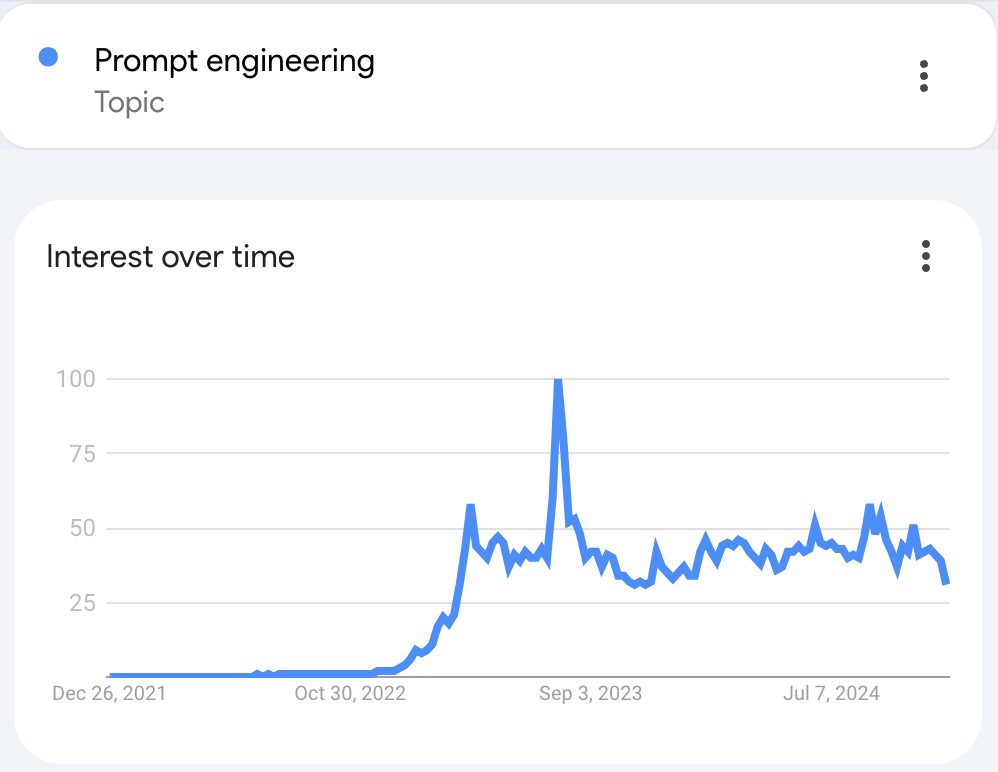
While the general interest around prompt engineering has remained steady over the last few years, a lot of companies struggle to make their first step in building prompt engineering competency because of simply not knowing where to start.

A prompt engineer usually starts by defining the problem that an LLM needs to solve. By experimenting with prompt content, how to structure it and maybe how to chain multiple prompts, a person doing prompt engineering is expected to get an LLM output of desired quality.
All of the above can be done “on paper” and without a need of writing even a single line of code. The paper in this case are playgrounds each LLM vendor have in their offering. And if one needs to make multiple prompts work together, the output of the previous prompt can just be injected into the next prompt by hand.
What kind of person would shine as a prompt engineer
We are currently in the unique position where the shape of this role is not final and is being constantly adjusted by the industry needs: literally every half of a year the progress in tooling and prompting techniques in AI requires people working on prompts to expand their skills.
But there are two of them which are by-default critical: curiosity and creativity.
A person genuinely curious about the field they are operating within will be the one delivering the best results regardless of what field it is. Constantly staying up-to-date with the latest developments in prompt techniques, unique capabilities of large language models (and the vast variety of both commercial and open-source ones on the market) will allow them to not simply throw “a GPT” on every problem they solve, but instantly recognize that e.g. non-complex tasks can be solved by less capable but cheaper and faster models.
Another crucial skill is to be creative when doing prompt engineering. While there are already some prompt engineering approaches guaranteeing solid results, we are far from understanding what prompts or techniques would deliver the best output. By just keeping writing their plain and straightforward prompts the people would have never discovered is another take about other qualities a good prompt engineer should have.
Where to find people working on prompts
While hiring someone from the outside always remains an option, such a person won’t be having an immediate knowledge about the output you want to get from LLMs. Because of the non-deterministic nature of LLMs, their output can have a multitude of forms and styles and this is a work of a prompt engineer to make that outcome more predictable.
Who would best know the kind of output your LLM assistant should produce? (e.g. how deep must be its answers and what tone of voice should be used?).
Right. These are internal people who are already employed in your organization and deeply involved in working on your product. Take a closer look: maybe some of them are already excited about capabilities of generative AI and want to try out a new role?
These folks would be ideal candidates to become prompt engineers: their domain and product knowledge is deep enough to know what level of complexity and accuracy the model output should be. Often they also have useful internal connections to other departments which deeply technical people do not necessarily have. For example a person originating from the customer success department and who became a prompt engineer will have much easier time knowing how the final output of an LLM-based product they’re contributing to should look like VS yesterday’s software engineer who worked inside the technical department previously and most likely was all the time focused on deeper technical work inside of a single product area.
How to grow your prompt engineers
With time, you will face the need to grow the people authoring the prompts in your organization. The growth for such specialists doesn’t only mean to be able to quickly find an optimal prompting technique to the given problem (this comes with experience), but rather expanding the horizons of what’s possible for them beyond just defining what the system prompt of an LLM-based application will be.
Besides staying on top of the LLM research and latest advancements in prompt engineering techniques, more advanced prompt engineers need to tackle LLM evaluators — these are tools giving feedback about the performance of the model/prompt (similar to unit tests in software engineering).
Generally, evaluators can be both LLM-based (e.g. model B evaluates the output of the model A) or code-based (e.g. Python functions checking if model output adheres to the expected JSON-schema). Though code-based evaluators don’t require proficient programming skills, the person implementing them must have a high-level understanding about the programming language they are using (mostly Python) — so boosting this skill could be a one direction of growth for prompt engineers.
Just imagine: someone has delivered a prompt which not only “works” but also has instructions inside of it covered with tests/evaluators ensuring the safety net similar to unit tests providing in a traditional software development.
Prompt engineering is also not only about prompting techniques, output quality and evaluators. On a more proficient level, the people occupied with prompts must deeper understand the effect LLM hyperparameters are having on the output. This means another potential direction of growth for such people — learning machine learning fundamentals and investing in knowledge about how LLMs works under the hood.
Ideally, your organization already includes a leader who has experience somewhere on the intersection of software development and classical machine learning (or generative AI). Such a person could guide the growth of prompt engineers more precisely by steering their development into areas above.
Building the prompt engineering expertise
There is no one and all approach to building the expertise of prompt engineering because each organization has its own requirements about the LLM applications those prompts are used in. Building the expertise can have a vastly different meaning in different organizations.
But the one thing always remains true: your prompt engineers must be deeply engaged into both product aspects of something they work on and also possess specific knowledge to their unique role: the first allows them to quicker achieve desired model output quality and the latter makes sure those results are sustainable and adhere to current best practices in the very rapidly developing world of generative AI.
Give your prompt engineers the freedom to explore novel approaches while holding them accountable for the results they are delivering: despite the non-deterministic nature of LLM output, we could and should reduce the risk of unexpected output quality deviations and there are tools for making those measures quantifiable.
Building prompt engineering expertise within your organization is not just about adapting to the current trends in AI — it’s about shaping the future of how your company leverages technology for innovation. By empowering your team to master prompt engineering, you foster a culture of creativity, efficiency, and forward-thinking.
on Medium, where people are continuing the conversation by highlighting and responding to this story.

SOCIAL SHARE CARD GENERATOR